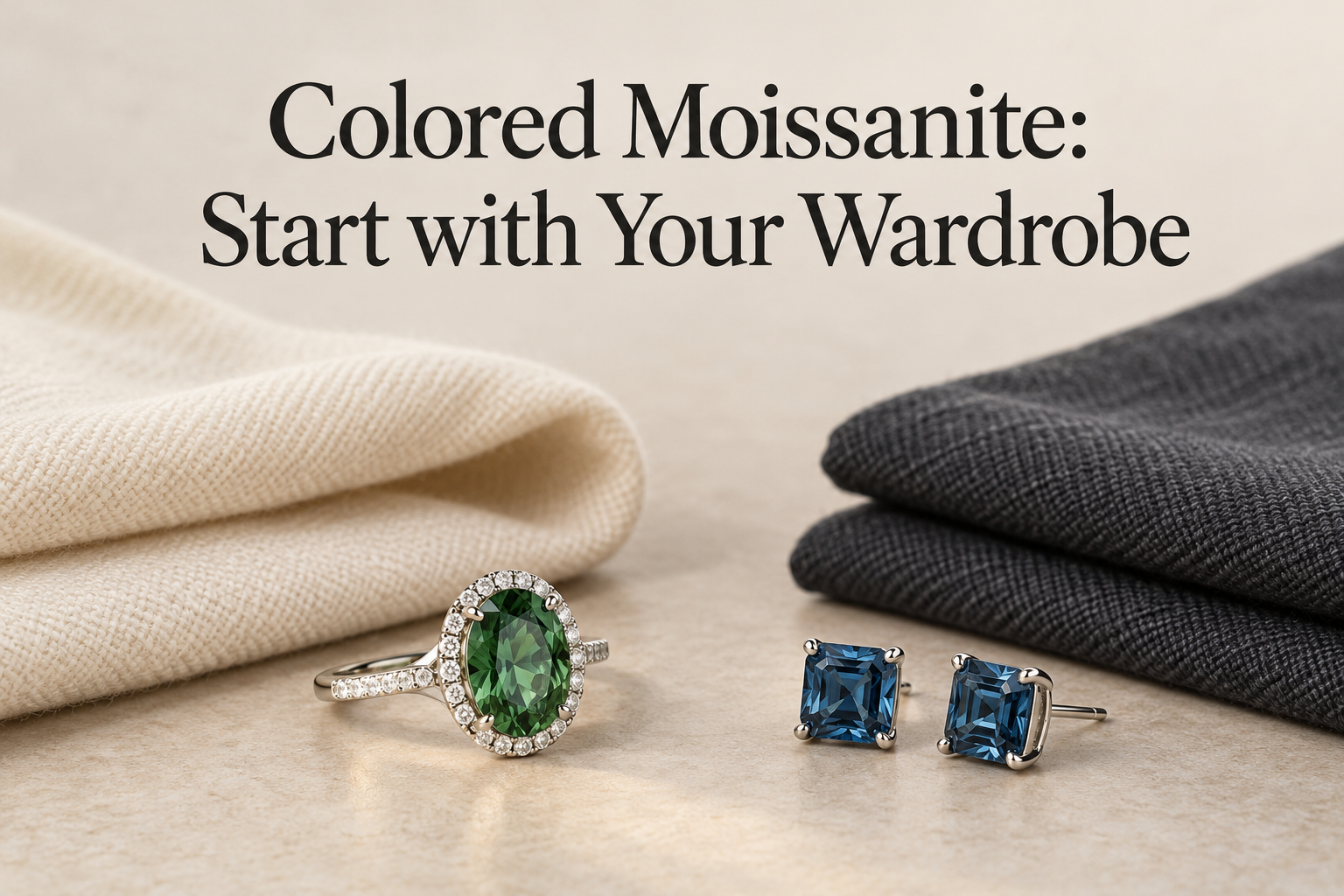
Choose colored moissanite by starting with clothes you already enjoy, then deciding whether you want the color at your hand, near your face or nowhere in that outfit. Green and blue do not need a matching garment. Treat product color, fit and material as separate questions, and do not buy a new wardrobe to justify one piece.
Our editorial view is simple: a color you like wearing is a better starting point than a rule about what a person “should” wear. This is not a claim about this season’s trends or a color-analysis system. You do not need a prescribed palette, a new style identity or a permanent preference for colorful jewelry before considering one ring or pair of studs.
A useful question, not a reader submission
“I like a colored stone, but do I need clothes in exactly the same shade?” This is an illustrative editorial question, not a submitted letter. Our answer is no: exact matching is one possible choice, not the admission price for colored jewelry. You can repeat a color you already wear, place it beside a neutral you like or decide that a particular outfit needs no extra accent.
Set out two familiar outfits before browsing. Notice whether you are drawn to the stone itself or to the complete styled photograph around it. If you would need to replace the clothes, bag and other accessories to enjoy the piece, pause. You may be responding to that image rather than identifying something you actually want to wear.
Green at the hand: one detail you choose for yourself
The Green Moissanite Halo Ring offers a hand-focused option. Its current description identifies an oval green moissanite, halo, pavé band and S925 sterling silver, with listed 1 ct and 2 ct center options. That supports a specific design and material description; it does not establish exact stone dimensions or how a selected green will look in every setting.
In an illustrative outfit, try that idea with a plain shirt or familiar knit and leave the rest of the jewelry unchanged. You might like seeing a green detail when you reach for a book; it does not have to echo a green sleeve. If you already wear a patterned top, compare the idea with that as well rather than assuming color belongs only with neutrals.
Decide the finger and confirm sizing before choosing a stone option. A carat label is not a fit measurement, and a larger option is not automatically the better way to express a color preference. Use our ring-size guide as a starting point and resolve uncertainties before ordering. No resizing promise follows from the styling idea.
Blue near the face: a different place for the accent
If you would rather leave your hands free of a ring, the Blue Asscher-Cut Moissanite Stud Earrings provide another direction. Their live description states blue Asscher-cut centers and geometric frames. They are an alternative way to place a color accent, not a requirement to build a matching ring-and-earring set.
Look at that idea beside the collar and hairstyle you actually use. There is no need to promise that blue will flatter every complexion, bring out a particular eye color or appear identical on different screens. Exact dimensions, weight, post-and-back materials and fastening are not established by the checked description. Confirm those details separately; the compressed option labels are not a reliable basis for inventing them.
Keep one thing, change one thing
Try a small wardrobe exercise with pieces you already own. Keep the clothes the same and change only the jewelry’s color or position. Then keep the jewelry and change one top. You are comparing your own preferences, not collecting points or finding a scientifically correct combination. An existing accessory in a similar color can help you explore the idea without making a purchase.
- Repeat: let the accent echo a color you already enjoy in a garment or accessory, without requiring an exact shade.
- Contrast: try the accent beside a different color you like and decide whether the combination feels right to you.
- Pause: if neither version appeals, keep the outfit and skip the colored piece. That is a useful result, not a failed styling test.
For a different kind of detail in familiar clothes, see our pendant-and-knitwear scenes. For combining pieces you already have, read why your jewelry does not have to match. This article’s narrower question is where a color accent fits in your actual wardrobe, not how many pieces to coordinate.
The color is a preference; the specification is a question
Check the selected ring or earring option’s current information before ordering. Ask about the complete materials and any color treatment or finish when that affects your choice. The words “green” and “blue” do not identify a treatment, certify color stability or guarantee the shade shown by your display. The ring description verifies S925; the checked earring description does not.
Follow construction-specific care instructions. GIA’s jewelry-care guidance explains why chemical exposure and protective storage deserve attention, and why known treatments can affect care. That is a reason to ask for information, not evidence that either featured item has a particular treatment. Personal taste and reliable product details can sit comfortably beside each other.
Editorial notes and sources
Prepared October 20, 2026 (Asia/Taipei). Products 54 and 621 were published and in stock when checked; only their stated descriptions and resolved attributes support the product facts here. No independent color, wear, fit or material test was performed, and parent availability is not every-variant availability. Styling questions and outfits are illustrative opinion, not customer submissions, personality analysis or measured trend research. GIA supports limited care context, not product certification. The cover is an AI-generated editorial illustration of alternative accents, not exact product photography or a color-accurate matched set.