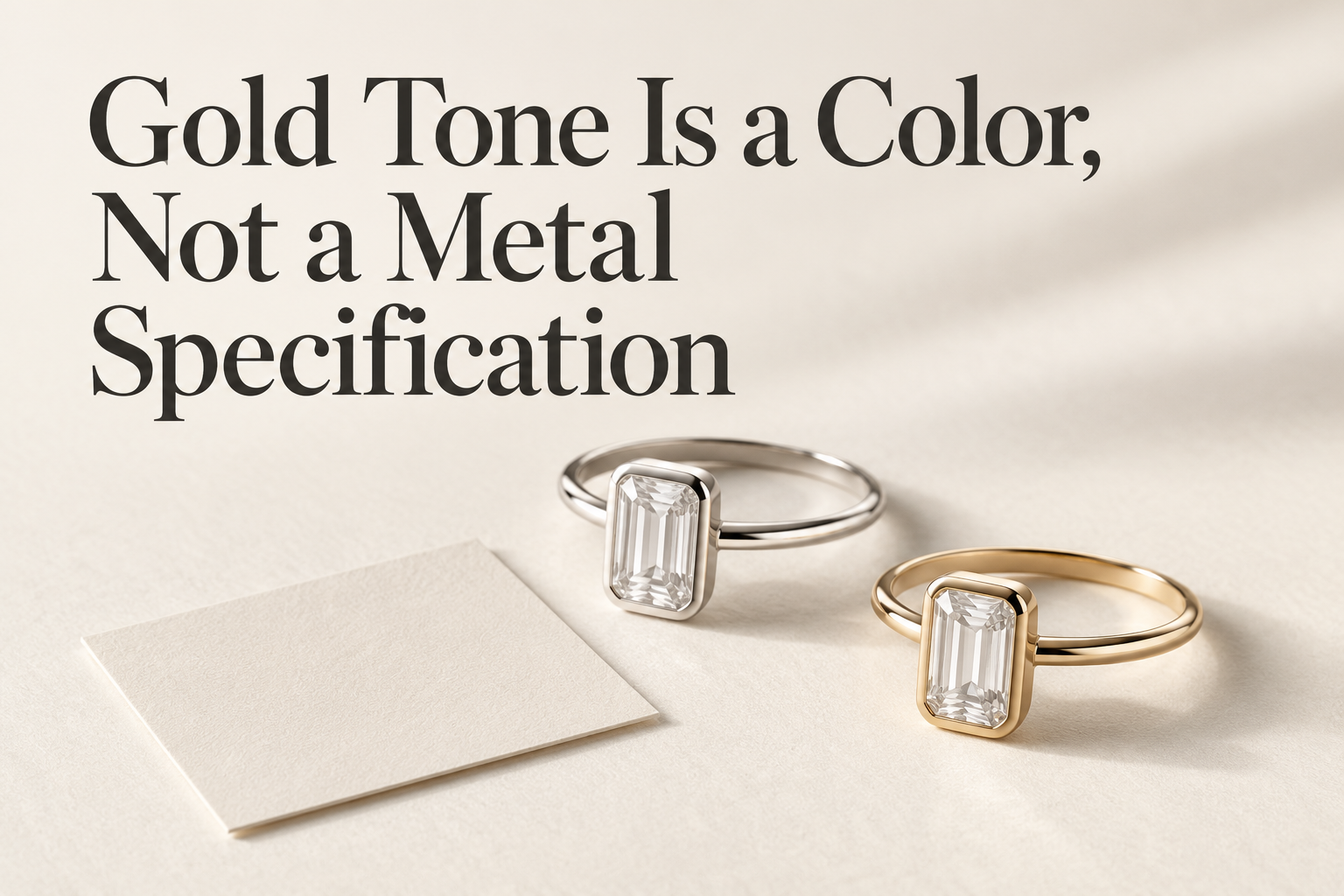
Gold tone and white gold tone describe appearance; by themselves, they do not establish a gold alloy, gold plating or a sterling silver body. Read moissanite finish labels alongside an explicit metal description. If the listing says S925 sterling silver, that identifies the stated silver composition, while the surface treatment remains a separate question.
You can enjoy a warm or cool finish without confusing it with a material specification. The practical task is to keep three pieces of information separate: the stone, the metal that forms the piece and any surface treatment. A photograph or an option name may help you select a look; neither supplies every missing construction detail.
Start with the words actually used
- Moissanite: the stated stone, not the surrounding metal.
- S925 sterling silver: a stated silver composition. GIA’s white-metal guide explains sterling as 925 parts silver per thousand; a listing statement is not an independent assay of this particular item.
- Gold tone or champagne gold tone: a color description. It does not identify a karat value or the material used to create the surface.
- Gold plated: a specific surface-construction statement, when expressly provided. It does not mean the whole piece is a gold alloy.
- White gold: when used as a metal claim, it needs supporting gold-alloy information, such as a karat specification. “White gold tone” does not supply that evidence.
Do not fill a gap with whichever explanation sounds most premium. A silver-colored finish is not automatically rhodium plating, and a warm finish is not automatically a layer of gold. If a piece is described as solid gold, that still does not mean pure 24K gold: the FTC distinguishes the construction wording from its karat purity. Keep the seller’s actual metal and finish statements together.
Example one: S925 plus two finish names
The current Emerald Cut Moissanite Bezel Ring description explicitly identifies S925 sterling silver and offers white gold tone and champagne gold tone choices. You can therefore distinguish the stated silver body from the visual choice. Calling the white gold tone version a solid white-gold ring would change the claim rather than summarize the listing.
Those facts still do not establish the exact coating material, thickness or expected wear interval. Ask about the selected finish if those details matter to you. The listing’s S925 wording also does not prove a nickel-free formula, suitability for a particular sensitivity or resistance to every cleaning product. Our broader sterling silver and moissanite guide provides material context; this checklist focuses on the finish wording.
Example two: a gold option with missing metal details
The Red Cord Moissanite Tennis Bracelet has option names including Gold Moissanite Bracelet and White Gold Moissanite Bracelet. Its current description identifies a moissanite center and an adjustable red cord. The checked description and attributes do not establish the metal components’ composition or a karat value.
That missing information is a reason to ask what the selected version contains. It is not evidence that the bracelet is S925, solid gold, gold plated or made of the same metal as the ring above. Even two pieces with similar color labels can have different construction. Browse bracelets and rings for designs, then confirm each item’s specification separately.
Four questions before you choose the finish
- What metal forms the selected item’s band, setting and other relevant components?
- Is the color a coating, and what material is used for that surface?
- Does the written specification apply to this exact option rather than a different item in the menu?
- What care instructions apply to the complete piece, including stones, coatings and any cord?
Save the answer with the product details so a shade preference does not become an unsupported material assumption later. If the answer remains incomplete, you can delay the purchase or choose an item whose construction is clearer. There is no need to settle the missing facts by inspecting a screen image more closely.
Care follows construction, not just color
Do not treat every gold-colored surface as solid gold or every silver-colored surface as bare sterling silver. The FTC notes that plated layers can wear with use, depending in part on their thickness. GIA’s care guidance also emphasizes the effect of chemicals and the limits of ultrasonic cleaning. Neither source establishes a lifetime or cleaning method for an unspecified coating on these products.
Read the seller’s instructions for the actual finish before using a polishing treatment or machine. Our silver moissanite care guide discusses coating-aware care; it is not a substitute for identifying an unknown surface. Once the ordinary specifications are clear, you can return to the personal decision, such as choosing a ring to mark a new job.
Two quick questions
Does white gold tone mean white gold?
No. The tone wording describes a look. Confirm an explicit metal composition and, for a gold-alloy claim, the karat specification rather than inferring one from the color.
Does S925 identify the finish too?
No. It states sterling silver composition, not the coating material or thickness. Ask about the selected finish separately; do not infer waterproof, allergy or wear guarantees from S925.
Sources and editorial method
Live linked product descriptions and attributes were checked before publication; missing specifications remain identified as missing. GIA’s white-metal guide supports the sterling and white-gold composition distinction. The FTC’s consumer guide to gold and silver jewelry supports the limited gold terminology and plated-layer context. GIA’s jewelry-care guidance supports the limited chemical and cleaning context. These are general references, not assays, product certifications or a legal compliance assessment.
The cover is an AI-generated editorial illustration of alternative finishes, not a product photograph, exact shade comparison, material test or evidence that two rings are sold as a set.