Tag: jewelry buying guide

  • Moissanite Tennis Bracelet Styles: Continuous Line or Halo Links?

    Moissanite Tennis Bracelet Styles: Continuous Line or Halo Links?

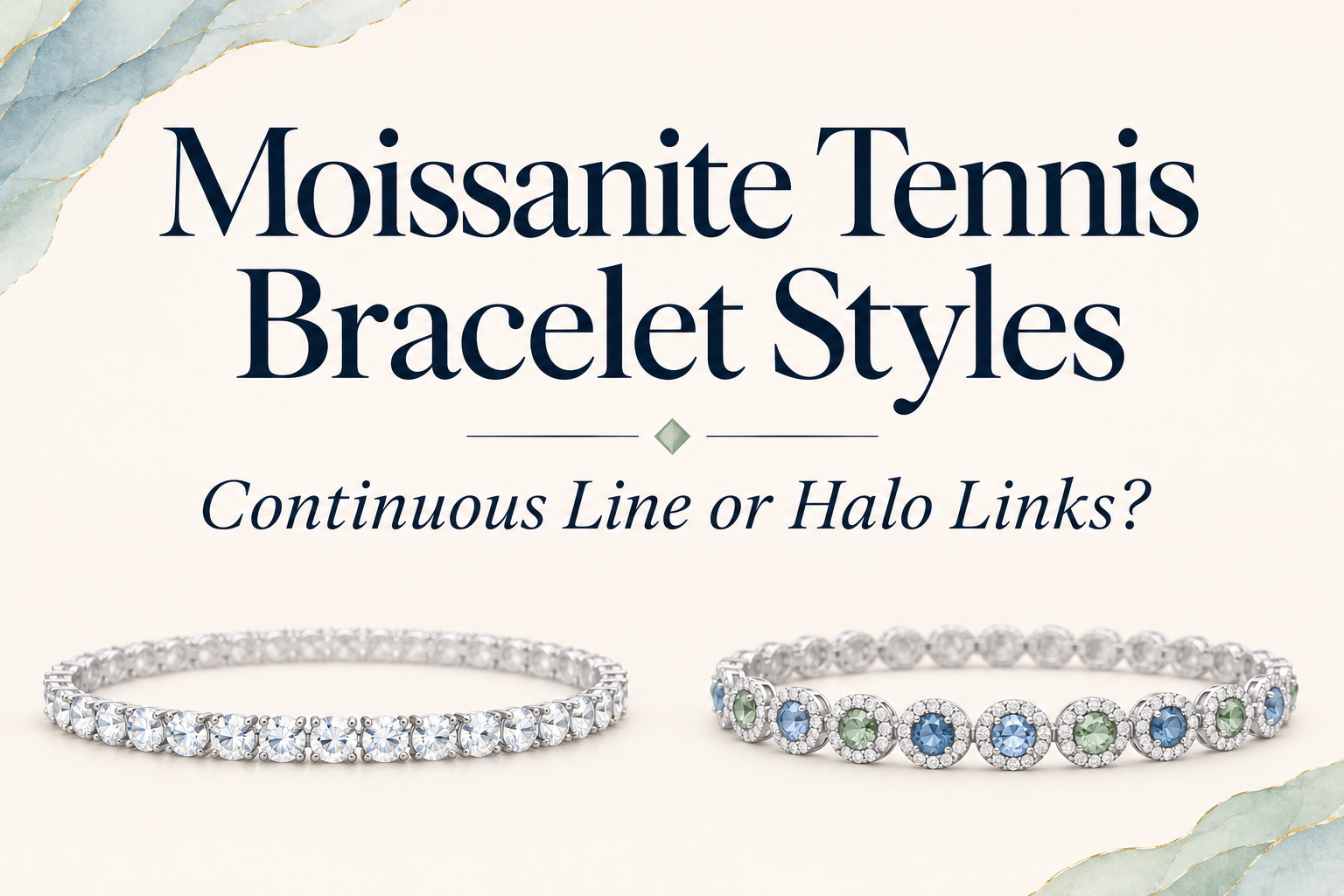
    To compare moissanite tennis bracelet styles, first decide which stone arrangement you prefer: a continuous line of round stones in four-prong settings, or colored round stones framed by halo links. Then check the selected bracelet’s length, closure and metal separately. The word “tennis” and a front-view photograph do not provide those missing specifications.

    Jewelers of America describes a tennis bracelet as a strand of individually set gemstones arranged in a row and recommends asking about a secondary safety on the clasp. GIA’s tennis-bracelet guide also treats stone arrangement, setting, metal and fit as separate design decisions. These guides help frame the questions; their diamond and precious-metal examples do not establish specifications for a moissanite listing.

    A continuous line of four-prong round stones

    The Four-Prong Moissanite Tennis Bracelet description says round moissanite stones in four-prong settings form a continuous classic line. It has one listed style, “Fully Iced Bracelet.” This is the clearer example if you prefer a repeated row of round stones without a colored center described in the product text.

    The current description does not state a finished length, clasp type, secondary safety, dimensions or component metals. Four-prong describes how each stone is held, not how the bracelet closes. Ask for the details of the exact option rather than inferring them from the product name or a front image.

    Colored stones in halo links

    The 5 Carat Colored Moissanite Tennis Bracelet is described as colored round moissanite in halo links. Its listed selector calls the option “5ct Multicolor Moissanite Bracelet.” That label is not an independent measurement or an explanation of how a total carat figure is calculated.

    The halo-link outline supplies more repeated framing than the continuous-line description of product 578. Whether that extra outline suits your wardrobe is a preference, not a guarantee about size, sparkle, flexibility or comfort. The checked listing does not confirm a finished length, closure, metal composition or a second safety latch.

    A short checklist for the selected option

    1. Design: confirm whether the option is a continuous four-prong line or colored halo links.
    2. Fit: ask what the stated length measures and how it relates to the intended wrist. A 5ct style label is not a bracelet measurement.
    3. Closure: ask the seller to identify the main clasp and show whether a separate safety latch is present.
    4. Material: request the metal composition of the complete bracelet. Neither checked description explicitly verifies S925 sterling silver.
    5. Order details: check the exact option’s current stock and price before checkout; parent-product stock does not guarantee every selection.

    Our bracelet size guide separates wrist circumference from a finished bracelet measurement, and the clasp guide shows what to ask about the closure. Browse the bracelet collection only after confirming the facts that matter for your selected design.

    Sources and verification

    Products 578 and 306 were published and in stock at the parent-product level when checked November 26, 2026 (Asia/Taipei); confirm the exact selection before ordering. Their current descriptions support the stone arrangement and option wording above, but do not establish S925, bracelet length, clasp construction, secondary safety, weight or wear performance. Jewelers of America and GIA supply general tennis-bracelet context, not an assay or endorsement of these listings. The cover is an AI-generated editorial illustration, not an exact product image, scale drawing or setting diagram.
  • Moissanite Bracelet Size Guide: Wrist, Length and Fit

    Moissanite Bracelet Size Guide: Wrist, Length and Fit

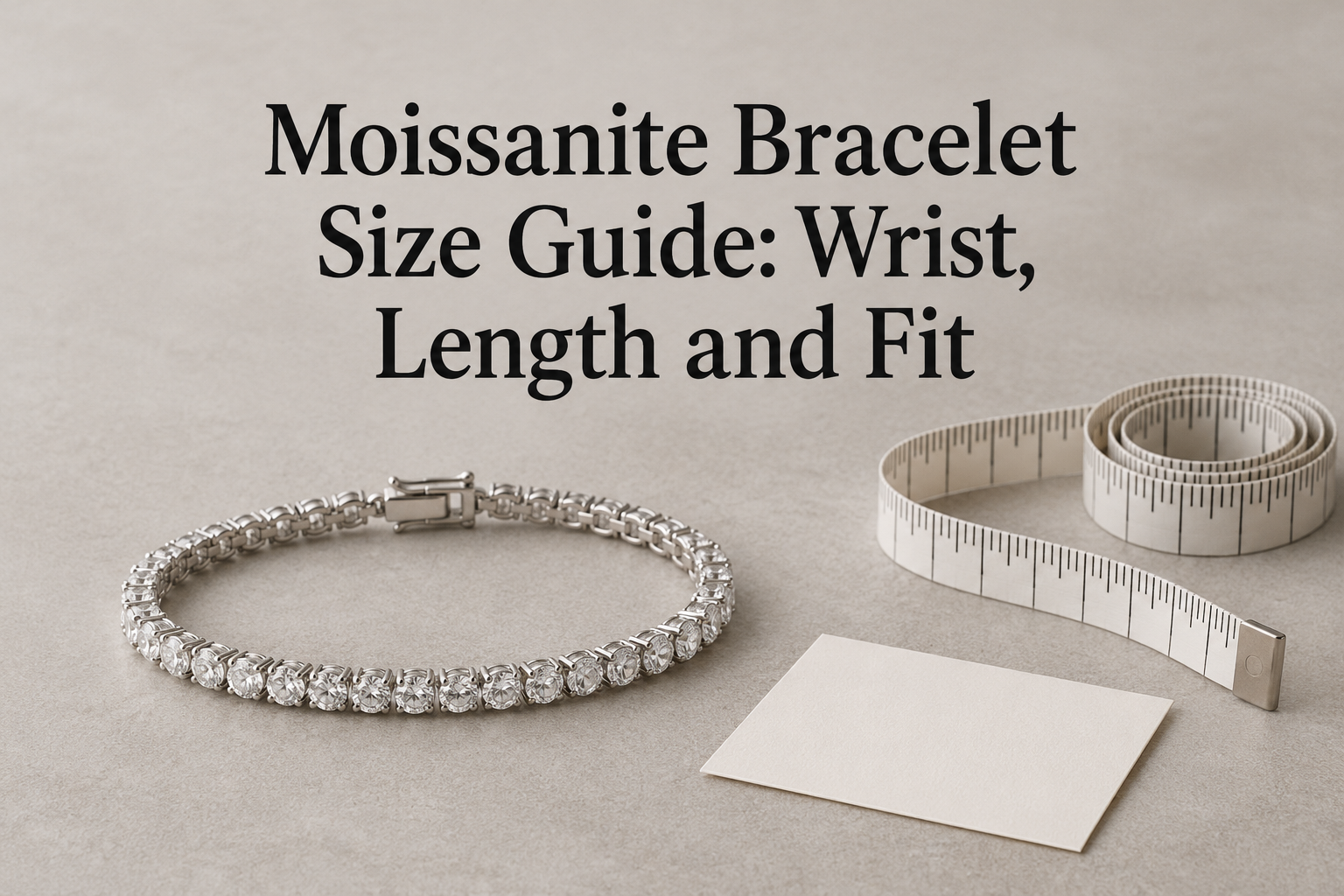
    To choose a moissanite bracelet size, measure the wrist where you intend to wear it, then ask the seller how the bracelet’s stated length is measured and what fit that construction allows. Confirm the clasp and any adjustment range. Do not treat wrist circumference, an option labeled “17cm” and a comfortable finished fit as the same measurement.

    This guide is about sizing, not a ranking of bracelet styles or a promise that one centimeter allowance suits everyone. A flexible link bracelet, an adjustable cord and a rigid design require different questions. Moissanite identifies the gemstone; it does not specify the length, closure, metal or fit of the complete piece.

    Measure the intended wrist, not a photograph

    Tiffany & Co.’s bracelet guidance describes measuring around the wrist with a flexible tape, string or paper strip, marking the meeting point and measuring the marked length. It also distinguishes the wearing preferences of link or chain bracelets from cuffs and bangles. Use the measurement method as a starting point, not Tiffany’s brand-specific size labels as a conversion for another seller.

    1. Choose the wearing position: measure where the bracelet will sit on the intended arm.
    2. Wrap without compressing: keep the tape or strip comfortably against the wrist, not pulled tight.
    3. Mark and read: if using string or paper, lay it flat and measure to the mark with a ruler.
    4. Record what you measured: note “wrist circumference” and the unit, not simply “bracelet size.”

    For example, a hypothetical wrist measurement of 15 cm is a wrist measurement—not an instruction to order a 15, 16 or 17 cm bracelet. The right next step is to compare it with the seller’s sizing guidance for the exact design and your preferred movement. This example is not a tested recommendation or a measurement of any product below.

    Ask what the listed length includes

    Ask whether a listed centimeter figure means the full end-to-end length with the clasp, the usable closed length, an inner measurement or a recommended wrist size. These are different descriptions. If there is an extension, ask which endpoints it covers. Record the answer alongside the wrist measurement instead of comparing numbers with different definitions.

    A bracelet you already wear comfortably can help the discussion: tell the seller its construction and how you measured it. Do not assume that copying its end-to-end length into another design will reproduce the same fit. Ask the seller to confirm the comparison rather than inventing a universal “add two centimeters” rule.

    A live 16, 17 and 18 cm example

    The current Mixed-Shape Moissanite Tennis Bracelet lists three style options: “16cm Fully Iced Moissanite Bracelet,” “17cm Fully Iced Moissanite Bracelet” and “18cm Fully Iced Moissanite Bracelet.” These are verified selector labels, not our independent measurements of finished pieces.

    The checked description does not clarify whether those values include the clasp, how they translate to usable closed fit, or whether alteration is available. Ask those questions before choosing. Recheck price and availability for the exact option; the parent product being in stock does not establish every possible order configuration. No S925 composition or finished weight is established by the checked text.

    “Adjustable” still needs a range

    The Red Cord Moissanite Tennis Bracelet is described as a round moissanite center with an adjustable red cord. The description supports “adjustable,” but it does not give the minimum or maximum usable circumference or explain the exact adjustment mechanism.

    Ask for the usable range and how the closure is operated, and confirm whether it suits the intended wrist. Do not interpret the word as “one size fits everyone.” Its gold and white-gold option wording does not establish solid gold or sterling silver, either. Fit and material are separate checks.

    A classic tennis line is not a sizing specification

    The Four-Prong Moissanite Tennis Bracelet identifies round stones and four-prong settings in a continuous line. Its checked description does not provide a finished length or clasp details. The “Fully Iced Bracelet” selector is a style label, not a measurement or a security rating.

    If you like that outline, ask for the missing information before ordering rather than estimating from a hand or display in a photograph. For an occasion idea, our quiet-anniversary scenario uses this design direction without treating a styled image as a fit test.

    A short message that keeps the measurements clear

    My wrist circumference at the intended wearing position is ___ cm. For this selected bracelet option, please confirm the usable closed length or adjustment range, how the stated size is measured, the clasp or closure, and your fit guidance. Please also confirm component materials and whether any size alteration is available before I order.

    Ask about current shipping and return terms separately; do not plan around unconfirmed resizing, alteration or return eligibility. If it is a gift and the wrist measurement or preference is unknown, consider choosing together. Our ring-free gift shortlist discusses why a bracelet is not automatically fit-free.

    Questions that often cause confusion

    Should I add a fixed amount to my wrist measurement?

    Not as a universal rule. Ask for guidance for the exact construction and confirm what the seller’s listed length means. This guide does not establish one allowance for every link, cord, cuff or bangle.

    Can an adjustable bracelet be bought without measuring?

    Measuring still helps you check whether the confirmed adjustment range suits the intended wrist. “Adjustable” alone does not give that range.

    Does a larger carat label mean a longer bracelet?

    A carat label does not specify finished bracelet length. Ask for length and construction details independently; do not calculate the fit from an ambiguous stone-size label.

    Sources and verification notes

    Products 764, 714 and 578 were published and in stock when checked on October 18, 2026 (Asia/Taipei). Current descriptions and attributes support the named selector labels and design facts, not independent measurements. Tiffany supports the wrist-measurement starting method; its charts and product services are not MSEARTHIA promises. Follow the actual bracelet’s care instructions; GIA’s general guidance supports protective storage and care around chemicals. The cover is an AI-generated editorial illustration, not a scale diagram or exact product photo. No fit, closure or alteration test was performed. Explore bracelets after resolving the practical questions.

  • Moissanite Studs or Drop Earrings? A Practical Buying Guide

    Moissanite Studs or Drop Earrings? A Practical Buying Guide

    Choose moissanite studs when you want a design centered close to the earlobe; consider drops when you prefer a silhouette extending below it. Then check dimensions, weight per earring, the fastening and component metals. Neither category guarantees comfort, a particular level of sparkle or verified sterling silver.

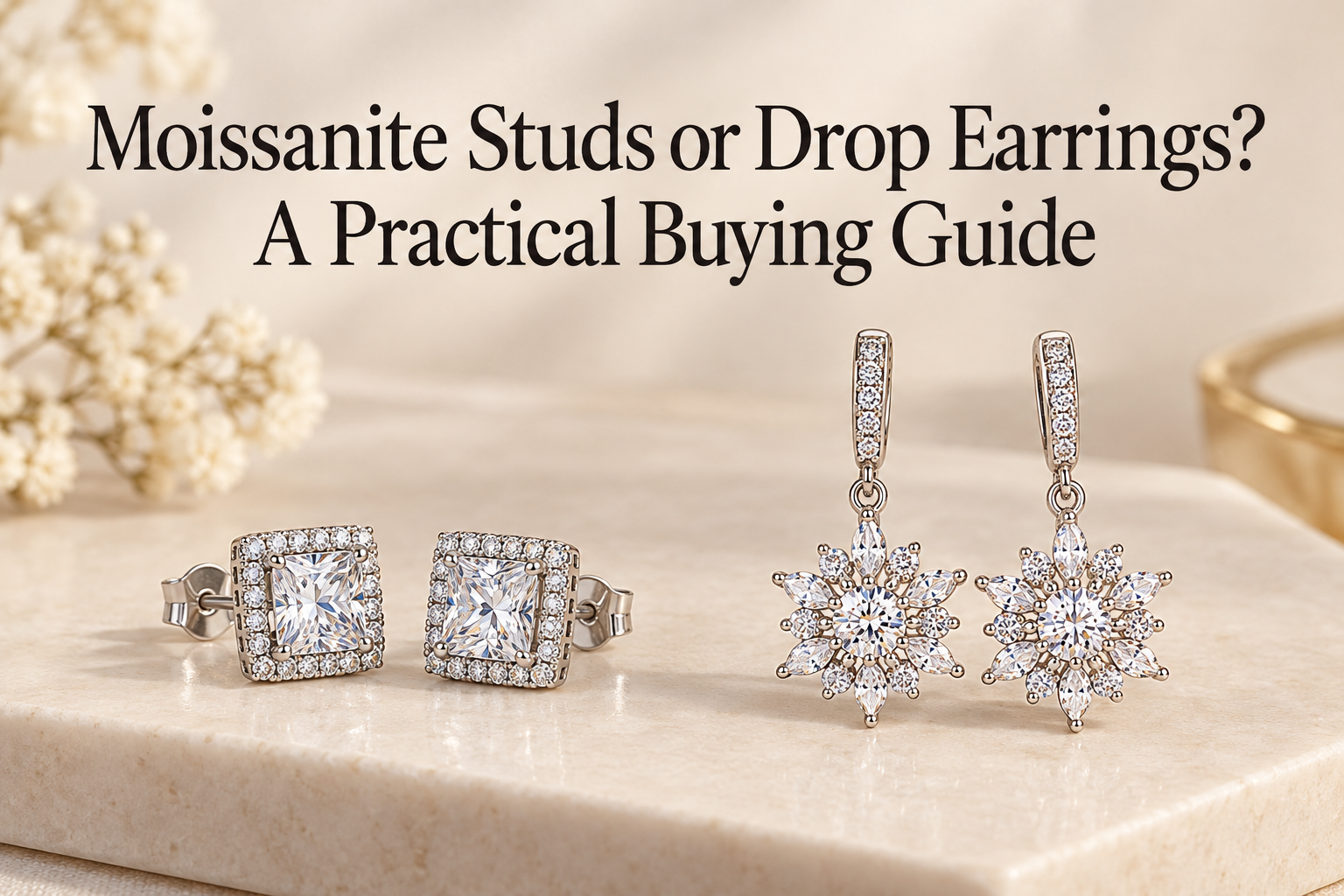
    A close-up can make a pair of earrings look perfectly scaled even when it tells you little about actual size. Instead of choosing only from the brightest photograph, compare how the earrings are built and what the listing really establishes. This guide uses current MSEARTHIA studs and drops as design examples, with missing specifications clearly separated from verified facts.

    Studs and drops: what actually changes?

    DesignStarting silhouetteQuestions before buying
    StudA design centered near the lobeFace-up width, projection, post and back type, weight per piece
    DropA design extending below the lobeTotal length, widest point, connection or hinge, fastening and weight per piece

    A drop may have moving elements, but not every drop swings freely. A stud can have a broad halo and be visually prominent. “Stud” does not mean tiny, and “drop” does not mean heavy. Ask for the actual construction and measurements rather than letting the category label answer those questions.

    Example one: a geometric halo stud

    The Geometric Halo Moissanite Stud Earrings are described as a square cushion-cut look with a geometric halo. Their squared outline is the verified design feature to compare. The surrounding halo contributes to the full visible shape; its footprint is not established by the center-stone label alone.

    The current description does not supply millimeter dimensions, weight per earring, post length or a detailed back specification. Some option labels also contain compressed numbers that do not clearly explain the size. Ask what the selected label means and request measurements. Do not infer a per-stone carat amount or total pair weight from an ambiguous string.

    Example two: a snowflake-inspired drop

    The Moissanite Snowflake Drop Earrings use a snowflake-inspired cluster arrangement and are described as drops with visible movement. That makes them a useful contrast to the stud outline. It does not establish the precise length, weight or metal of the fastening.

    Look for a side view and a photograph showing the connection above the decorative section. Ask whether it is articulated and what closure is used. When a scarf, high collar or hairstyle occupies the same area, consider how the drop might meet it. This is a fit question to investigate, not proof that one design will catch or that another cannot.

    Five specifications worth asking for

    1. Dimensions in millimeters. Request width and height, plus full drop length where applicable. A ruler photograph can help, but an explicit measurement is easier to compare.
    2. Weight per earring. Clarify whether a listed weight refers to one piece or the pair. Without that figure, there is no factual basis for ranking these examples as lighter or heavier.
    3. The fastening. Ask about post length, back or closure type and how it secures. Do not assume a butterfly back, screw back or leverback from the word “earring.”
    4. Component metals and finish. Verify the decorative body, posts and backs separately, including any plating.
    5. The selected configuration. Confirm whether size and carat labels refer to a center, a complete earring or a pair, and review current price and stock.

    Silver-colored is not a complete metal specification

    These two examples’ current descriptions identify moissanite and their designs, but do not clearly verify S925 throughout the earrings. A URL containing “925 silver” is not enough to establish every component’s composition. The gemstone, decorative setting, post, back and finish are separate material questions.

    If sterling silver is a priority, request explicit confirmation for the exact option and components. A silver mark also does not, by itself, establish a nickel-free alloy or a promise about skin sensitivity. Our sterling-silver and moissanite guide explains how to read material wording without treating surface color as proof.

    Choose for your day, then your outfit

    For a familiar everyday look, start with a pair whose size and fastening you already know you enjoy. Compare a prospective pair against those measurements. If your day includes a headset, scarf or high neckline, ask how far the design projects or extends. For an occasion, you might prefer a visible drop; do not let the occasion erase the fit checks.

    A stud may fit the outline you want while a drop may frame the face differently. Those are visual preferences, not rules about age, gender or face shape. For three ways to build an outfit around studs, read One Pair of Moissanite Earrings, Three Outfit Ideas. For jewelry chosen to remember an achievement, see our personal-milestone pendant story.

    Care follows the whole piece

    Avoid direct exposure to household cleaners and cosmetics, and store earrings separately so they do not rub against other jewelry. Follow instructions for the complete construction, especially its finish and small connections. An ultrasonic cleaner should not be assumed suitable just because the center stone is moissanite; GIA cautions that vibration can loosen stones. Ask a jeweler if construction or cleaning suitability is unclear.

    Explore MSEARTHIA earrings, using the same questions for each design. If a listing leaves a necessary detail unanswered, asking before ordering is more useful than treating a product photo as a measurement.

    Frequently asked questions

    Are moissanite studs always smaller than drops?

    No. Stud and drop describe the general design, not a fixed size. Compare the complete width, height and projection of each pair.

    Does a carat label tell me the earring’s weight?

    It does not establish the weight of the complete earring. Ask how the stone label is defined and request the finished weight per piece separately.

    Can I assume the posts are silver if the setting looks silver?

    No. Appearance cannot identify the alloy, and posts or backs may have different specifications. Obtain explicit material information for the selected configuration.

    Sources and methodology

    Products 639 and 594 were published and in stock when checked on October 10, 2026 (Asia/Taipei). Design examples come from their linked live descriptions; missing dimensions, weight, fastening and component metals have not been invented. Care guidance follows GIA’s Tips on Caring for Jewelry. The cover is an AI-generated editorial comparison, not an exact product photograph, measured scale drawing or documented wear test.