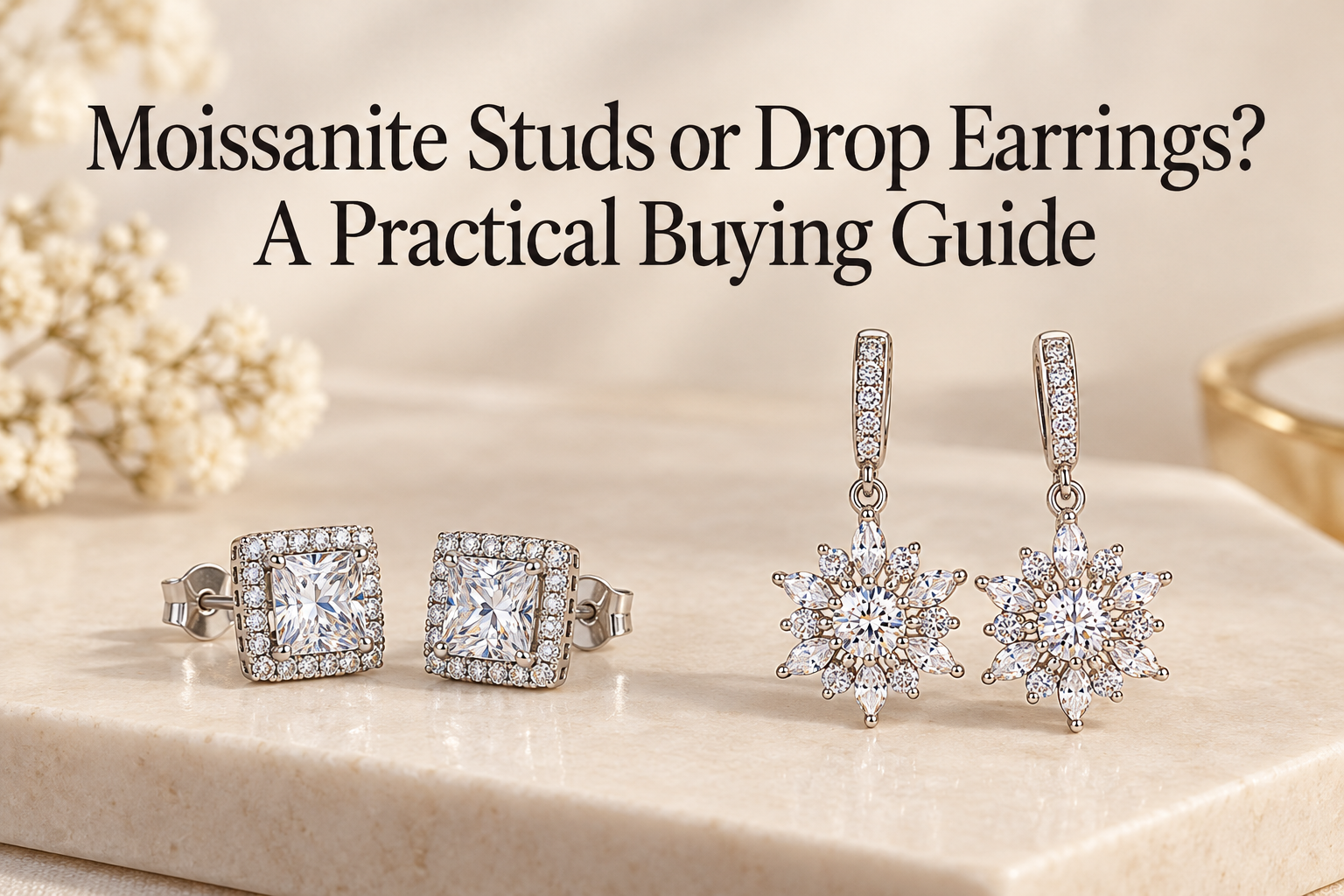
Choose moissanite studs when you want a design centered close to the earlobe; consider drops when you prefer a silhouette extending below it. Then check dimensions, weight per earring, the fastening and component metals. Neither category guarantees comfort, a particular level of sparkle or verified sterling silver.
A close-up can make a pair of earrings look perfectly scaled even when it tells you little about actual size. Instead of choosing only from the brightest photograph, compare how the earrings are built and what the listing really establishes. This guide uses current MSEARTHIA studs and drops as design examples, with missing specifications clearly separated from verified facts.
Studs and drops: what actually changes?
| Design | Starting silhouette | Questions before buying |
|---|---|---|
| Stud | A design centered near the lobe | Face-up width, projection, post and back type, weight per piece |
| Drop | A design extending below the lobe | Total length, widest point, connection or hinge, fastening and weight per piece |
A drop may have moving elements, but not every drop swings freely. A stud can have a broad halo and be visually prominent. “Stud” does not mean tiny, and “drop” does not mean heavy. Ask for the actual construction and measurements rather than letting the category label answer those questions.
Example one: a geometric halo stud
The Geometric Halo Moissanite Stud Earrings are described as a square cushion-cut look with a geometric halo. Their squared outline is the verified design feature to compare. The surrounding halo contributes to the full visible shape; its footprint is not established by the center-stone label alone.
The current description does not supply millimeter dimensions, weight per earring, post length or a detailed back specification. Some option labels also contain compressed numbers that do not clearly explain the size. Ask what the selected label means and request measurements. Do not infer a per-stone carat amount or total pair weight from an ambiguous string.
Example two: a snowflake-inspired drop
The Moissanite Snowflake Drop Earrings use a snowflake-inspired cluster arrangement and are described as drops with visible movement. That makes them a useful contrast to the stud outline. It does not establish the precise length, weight or metal of the fastening.
Look for a side view and a photograph showing the connection above the decorative section. Ask whether it is articulated and what closure is used. When a scarf, high collar or hairstyle occupies the same area, consider how the drop might meet it. This is a fit question to investigate, not proof that one design will catch or that another cannot.
Five specifications worth asking for
- Dimensions in millimeters. Request width and height, plus full drop length where applicable. A ruler photograph can help, but an explicit measurement is easier to compare.
- Weight per earring. Clarify whether a listed weight refers to one piece or the pair. Without that figure, there is no factual basis for ranking these examples as lighter or heavier.
- The fastening. Ask about post length, back or closure type and how it secures. Do not assume a butterfly back, screw back or leverback from the word “earring.”
- Component metals and finish. Verify the decorative body, posts and backs separately, including any plating.
- The selected configuration. Confirm whether size and carat labels refer to a center, a complete earring or a pair, and review current price and stock.
Silver-colored is not a complete metal specification
These two examples’ current descriptions identify moissanite and their designs, but do not clearly verify S925 throughout the earrings. A URL containing “925 silver” is not enough to establish every component’s composition. The gemstone, decorative setting, post, back and finish are separate material questions.
If sterling silver is a priority, request explicit confirmation for the exact option and components. A silver mark also does not, by itself, establish a nickel-free alloy or a promise about skin sensitivity. Our sterling-silver and moissanite guide explains how to read material wording without treating surface color as proof.
Choose for your day, then your outfit
For a familiar everyday look, start with a pair whose size and fastening you already know you enjoy. Compare a prospective pair against those measurements. If your day includes a headset, scarf or high neckline, ask how far the design projects or extends. For an occasion, you might prefer a visible drop; do not let the occasion erase the fit checks.
A stud may fit the outline you want while a drop may frame the face differently. Those are visual preferences, not rules about age, gender or face shape. For three ways to build an outfit around studs, read One Pair of Moissanite Earrings, Three Outfit Ideas. For jewelry chosen to remember an achievement, see our personal-milestone pendant story.
Care follows the whole piece
Avoid direct exposure to household cleaners and cosmetics, and store earrings separately so they do not rub against other jewelry. Follow instructions for the complete construction, especially its finish and small connections. An ultrasonic cleaner should not be assumed suitable just because the center stone is moissanite; GIA cautions that vibration can loosen stones. Ask a jeweler if construction or cleaning suitability is unclear.
Explore MSEARTHIA earrings, using the same questions for each design. If a listing leaves a necessary detail unanswered, asking before ordering is more useful than treating a product photo as a measurement.
Frequently asked questions
Are moissanite studs always smaller than drops?
No. Stud and drop describe the general design, not a fixed size. Compare the complete width, height and projection of each pair.
Does a carat label tell me the earring’s weight?
It does not establish the weight of the complete earring. Ask how the stone label is defined and request the finished weight per piece separately.
Can I assume the posts are silver if the setting looks silver?
No. Appearance cannot identify the alloy, and posts or backs may have different specifications. Obtain explicit material information for the selected configuration.
Sources and methodology
Products 639 and 594 were published and in stock when checked on October 10, 2026 (Asia/Taipei). Design examples come from their linked live descriptions; missing dimensions, weight, fastening and component metals have not been invented. Care guidance follows GIA’s Tips on Caring for Jewelry. The cover is an AI-generated editorial comparison, not an exact product photograph, measured scale drawing or documented wear test.
Leave a Reply