Tag: personal style

  • Do Moissanite Rings Have to Be Engagement Rings?

    Do Moissanite Rings Have to Be Engagement Rings?

    No. You can wear a moissanite ring without being engaged or planning a proposal. Our editorial view is that enjoying the design is enough of a reason to choose it. Decide what it means to you, confirm the practical fit and leave room for other people to read jewelry differently.

    Consider this illustrative question: “I like a sparkling ring, but I do not want to announce an engagement. Is it still for me?” It is an editor-written prompt, not a reader submission or an interview. The answer starts with your reason for wearing it, rather than a rule that assigns every ring one purpose.

    Separate your reason from someone else’s interpretation

    You might want a ring for its outline, a color you enjoy or a private reminder. None of those reasons requires a relationship announcement. You can also choose not to attach a story to it at all. A piece does not have to commemorate an achievement before it belongs in your wardrobe.

    That freedom does not guarantee that nobody will ask about it. Meanings and expectations can differ between people and settings. If an interpretation matters in your particular circumstances, think about how you would answer a question. “I chose it because I like the design” is one possible response; you do not owe anyone a detailed personal history.

    Choose a design you want, not an escape code

    It can be tempting to look for a ring that is guaranteed to look “not engaged.” We would not promise that a stone color, setting or finger placement will settle the meaning for every observer. Instead, compare the designs for what you would actually enjoy seeing and wearing.

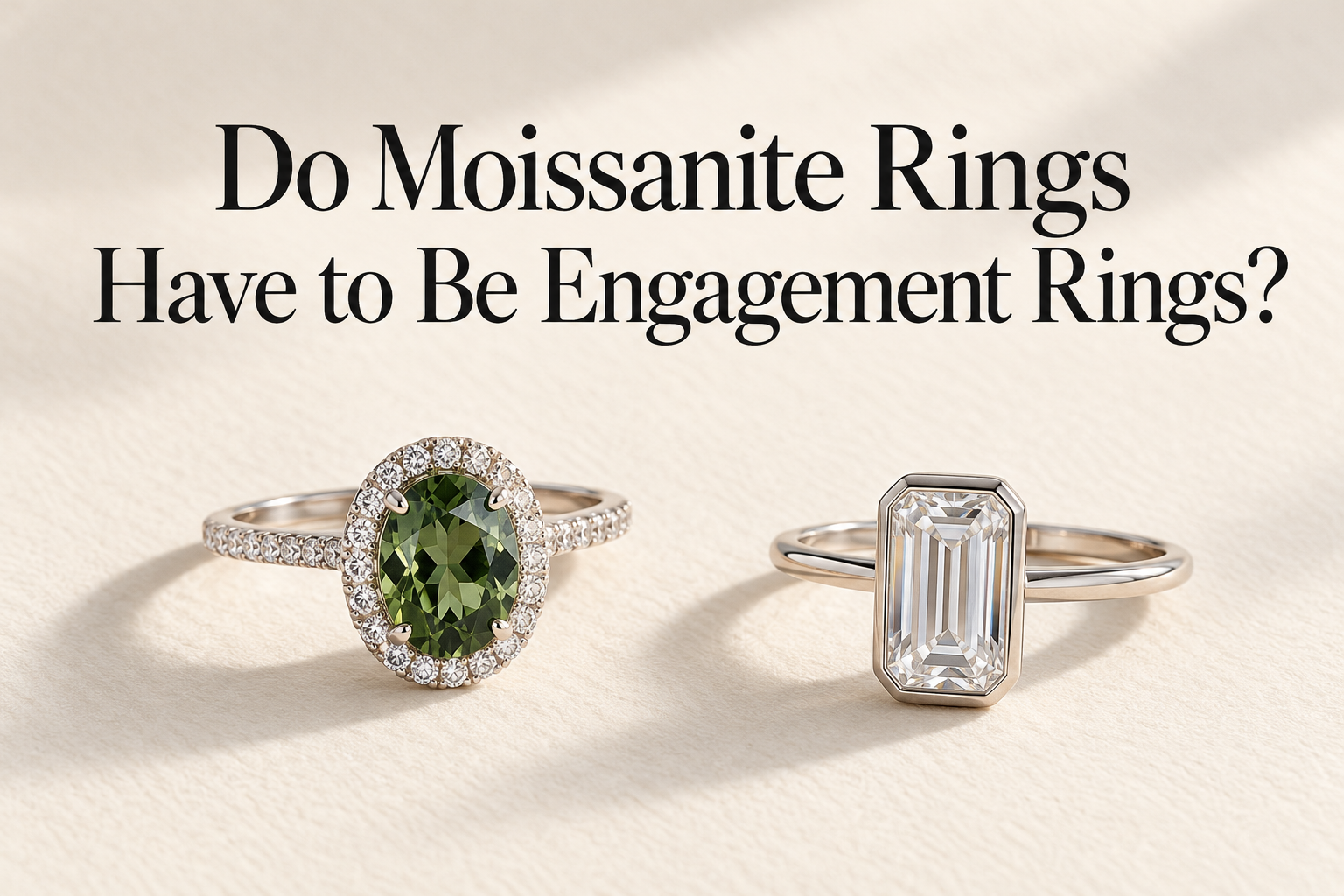
    The Green Moissanite Halo Ring offers an oval green moissanite, a surrounding halo and a pavé band. Its current description explicitly states S925 sterling silver, with listed 1 ct or 2 ct center options and US sizes 4–9. Choose green if you enjoy that design; it is not a universal signal about relationship status.

    The Emerald Cut Moissanite Bezel Ring is a different visual direction: an emerald-cut moissanite enclosed by a polished bezel. It explicitly states S925 sterling silver, a listed 2 ct center and US sizes 5–9. White gold tone and champagne gold tone are finish names, not solid-gold claims. Our finish-label guide explains that distinction.

    These are two design references, not an engagement-versus-fashion classification. Neither listing supplies the complete millimeter footprint or setting height used for a measured on-hand comparison here. Browse moissanite rings for the outline you like, then verify the selected option rather than using a larger carat label as a measure of meaning.

    Choose the finger with the actual fit in mind

    If you want to wear the ring on a different finger from another ring you own, measure that intended finger. A familiar ring size is not automatic evidence of fit elsewhere. Use the ring-size guide, ask for missing dimensions and confirm the final size before ordering. Do not depend on an unconfirmed resizing service to rescue a guess.

    Finger choice can be personal, but no placement comes with a universal interpretation guarantee. If a workplace or activity restricts rings, follow that requirement and choose another wearing moment. Our view about personal meaning is not a comfort, safety or all-day suitability test of either product.

    Try an ordinary outfit before inventing an occasion

    Imagine the ring with clothes you already wear for a normal afternoon. Keep your usual watch or bag in the comparison; there is no need to rebuild the outfit to justify the ring. If you like the result, you can let that be the finished decision. If you prefer it only for occasional outings, that is a useful answer too.

    Our blue-earring and brown-outfit scene uses the same small-change approach for a different category, rather than recommending a matching set. If you do want a private milestone, the new-job ring article offers an illustrative note-to-yourself scene. Neither purpose needs to be announced to make the piece enjoyable.

    What if I want to give the ring to someone else?

    Then the recipient’s understanding matters as well as yours. Discuss what you intend before relying on a ring to communicate it silently, particularly if a proposal could reasonably be expected in that situation. Confirm their design preference and size. Our ring-gift guide explores the practical questions; it does not tell you what a recipient will feel.

    You do not need to remove the romantic possibility from rings, or make every ring romantic. Choose the purpose with the person involved. For a self-purchase, start with whether you want the piece at all, rather than whether you can produce an occasion worthy of it.

    Sources and editorial method

    Meaning and styling recommendations are editorial opinions, not a survey, cultural-history claim or universal etiquette rule. Product details come from the linked live listings checked before publication. For ordinary handling, GIA’s care guidance supports storing removed jewelry separately with protection and keeping it away from chemicals. That general guidance does not certify these rings or establish a finish lifespan.

    The cover is an AI-generated editorial illustration of design alternatives, not exact product photography, an engagement announcement, an authentic try-on, a size comparison or a supplied two-ring set.
  • Moissanite Pendant or Bracelet? Choose Your Focal Point

    Moissanite Pendant or Bracelet? Choose Your Focal Point

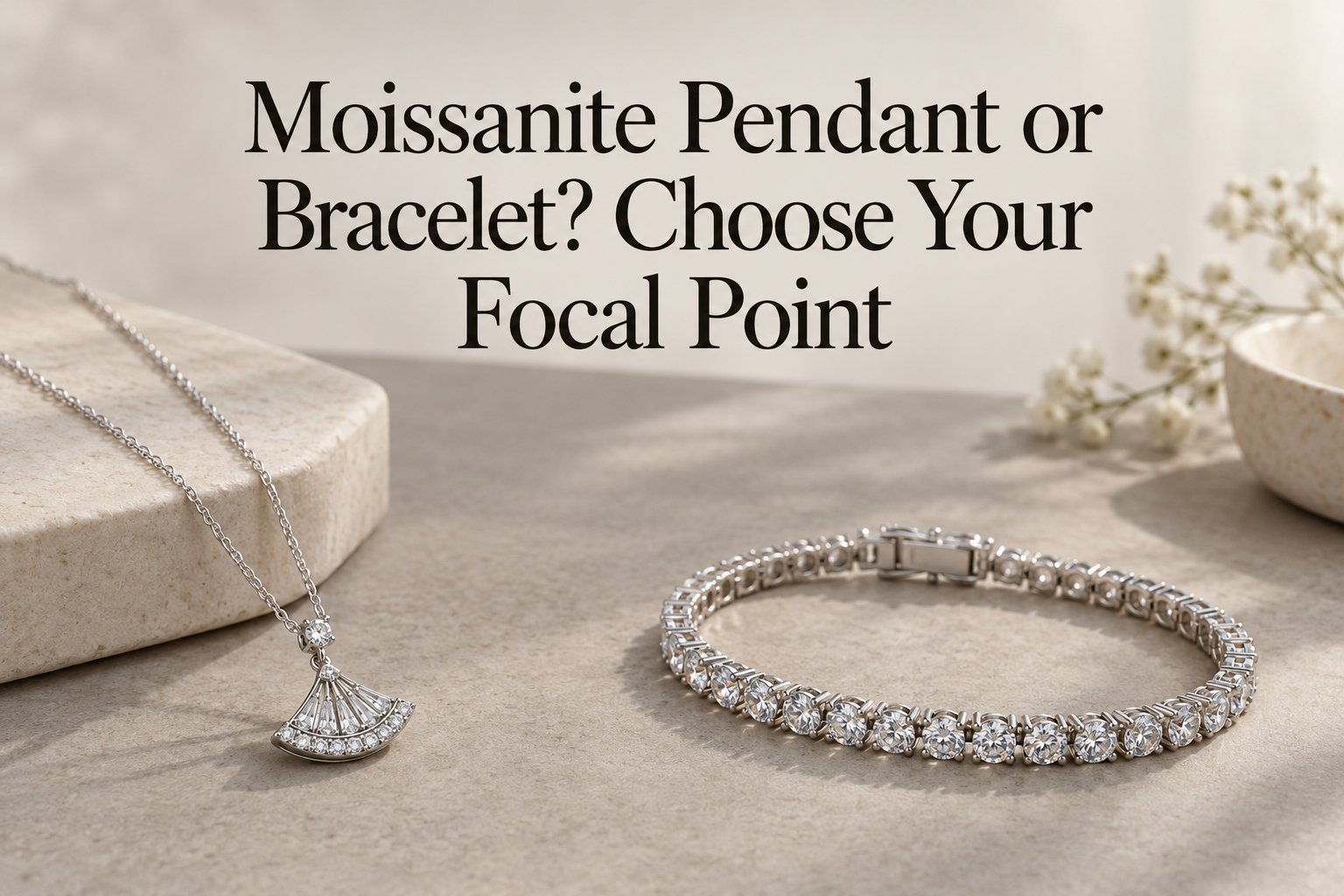
    Choose a moissanite pendant if the detail you want belongs with your neckline; choose a bracelet if you would rather put that detail at your wrist. Then check the actual garment, length, closure and selected product. Neither category is automatically easier, more versatile or a better gift. You can also choose neither.

    This two-route editorial guide is for the moment when you like both ideas but do not want to buy a matching set. It is a preference exercise, not a personality test or a ranking based on physical trials. Begin with pieces you already own, if possible. You are deciding where you want a focal point, not proving that your jewelry collection needs another category.

    Question one: which detail would you miss?

    Think of an outfit you enjoy wearing, not an image you would need to recreate from scratch. Imagine it once with a neckline accent and once with a wrist accent. Which version interests you more? If your answer is “I would not miss either,” keep the outfit. There is no need to turn a comparison into a purchase.

    If you want a detail in the frame of a top or open cardigan, explore the pendant route. If you prefer something you notice at your hand or beside a sleeve, explore the bracelet route. These are starting directions only. A watch, scarf, printed neckline or an activity may change which idea you prefer on another day.

    Route A: a pendant that belongs with the top

    The Moissanite Fan Pendant Necklace provides one design example: its current description identifies a fan-shaped moissanite focal point. Consider that geometric outline if it is the part you like. You do not need the same motif in earrings or a bracelet to make it a deliberate choice.

    Try a familiar necklace with the actual top before shopping for a different one. Notice where it sits without holding it and whether a collar or scarf occupies the same area. Our pendant-and-knitwear scenes offer three outfit contexts, while the chain and fit checklist handles the separate specification questions.

    Before ordering the fan design, confirm whether the selected order includes a chain, its usable length, the pendant dimensions and the connection. The checked description does not establish those facts. Its “Small Diamond Pendant” option wording is not independent proof of diamond content; ask for clarification rather than treating a selector label as a gemstone report.

    Route B: a bracelet that belongs with the sleeve

    The Four-Prong Moissanite Tennis Bracelet provides a different role. Its description identifies round moissanite stones held in four-prong settings along a continuous line. That repeating outline is a design reason to consider it, not evidence of a particular weight, finished length or clasp performance.

    Try the wrist-detail idea with a bracelet you already know fits. Keep the actual cuff and watch in view and notice contact during ordinary movement. Do not assume that changing to the other wrist settles fit; the selected bracelet still needs to suit that wrist. If the combination repeatedly catches or presses, remove or change an item rather than making your day accommodate it.

    For the linked tennis design, ask for finished length, how it is measured, closure details and complete materials before choosing a configuration. Our bracelet-size guide explains the difference between wrist circumference and the measurements of a finished piece. A classic line is not a universal fit formula.

    Question two: which uncertainty needs resolving?

    • Pendant route: if you like the neckline detail but do not know where it will sit, resolve chain configuration and length before choosing.
    • Bracelet route: if you like the wrist detail but do not know whether it will fit, resolve usable length, closure and adjustment before choosing.
    • Both routes: if the materials or selected option remain unclear, ask first. A silver-colored surface does not answer the metal question.

    Neither checked product description verifies S925. Do not read sterling silver into the cover’s silver-tone appearance. Follow the care instructions for the actual construction: GIA’s care guidance supports protective storage and avoiding damaging chemical exposure, not a durability ranking between necklaces and bracelets.

    A tie does not require buying both

    If both routes appeal, keep two notes rather than two cart items: the outfit you would wear each with, and the specification still missing. Revisit them with the clothes in front of you. You may discover that an existing piece already serves one role, or that earrings suit the outfit better. Our scarf-day earring scene is one such alternative, not another item to add automatically.

    Explore necklaces or bracelets after a route becomes useful. If this is a gift, let the intended wearer make the preference and fit decisions; a choice you enjoy for yourself is not evidence of what someone else wants. The outcome can be a shortlist, a question or no purchase.

    Editorial notes and sources

    Prepared October 24, 2026 (Asia/Taipei). Products 203 and 578 were published and in stock when checked. Their current descriptions and resolved attributes support the design details, not independent dimensions, all-variant availability or tested performance. The two routes are editorial preferences, not scientific assessment, universal versatility scores or a matched set. No wear test or material analysis was performed. GIA supports limited care context only. The cover is an AI-generated editorial illustration of alternatives, not exact product photography, a scale comparison or proof that the pictured chain is supplied.

  • A Weekend Away with One Moissanite Ring

    A Weekend Away with One Moissanite Ring

    For a weekend jewelry capsule, start with the outfits and activities, then choose one moissanite ring you would enjoy with several of them. Pack a dedicated protective case and decide when the ring will stay off. One familiar piece can provide continuity without requiring a separate jewelry set for every stop.

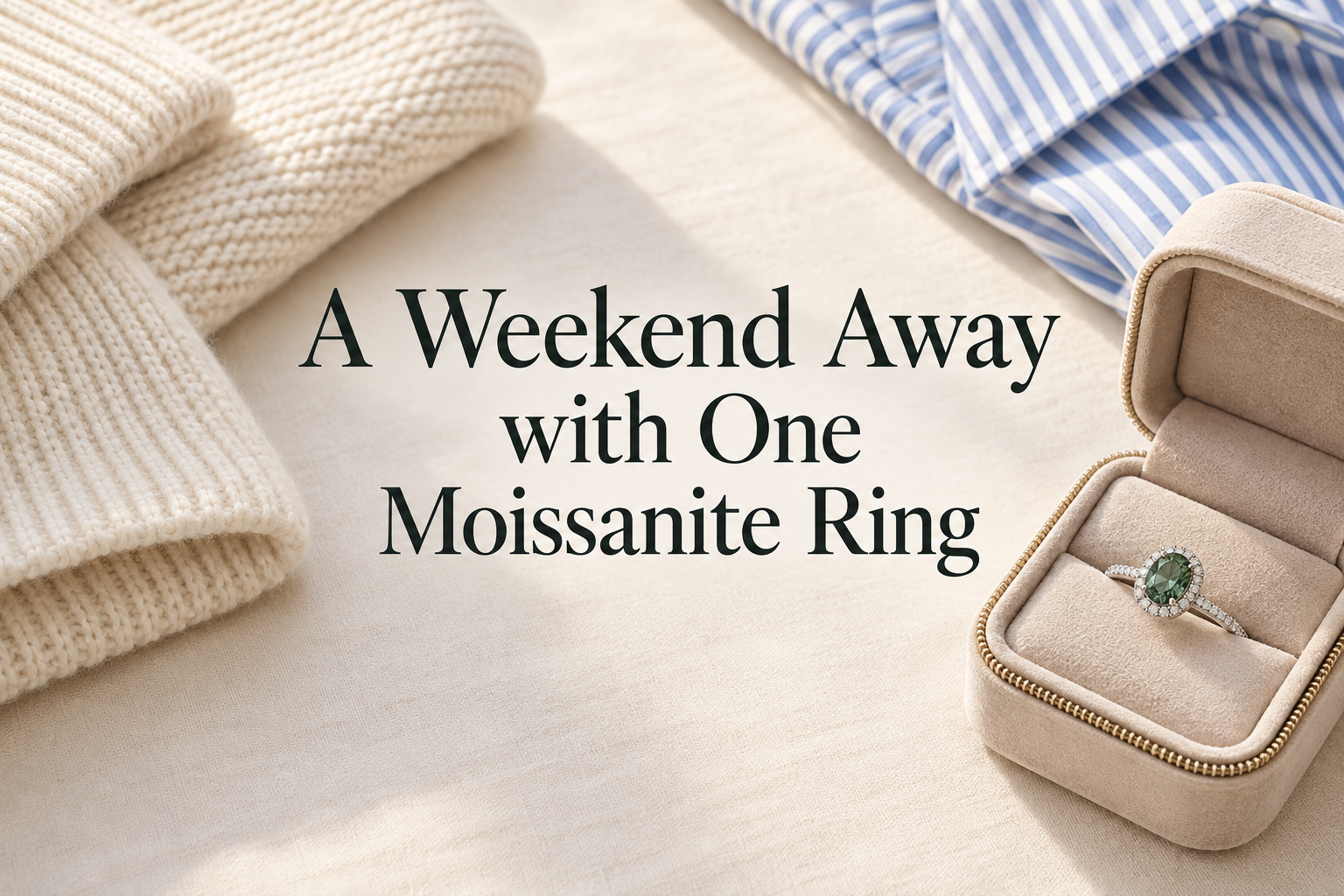
    The example below is an illustrative two-night city break, not a customer story or a wear test. There is a striped shirt, a soft knit and one dinner outfit in the bag. The aim is not to prove that a ring belongs everywhere; it is to give one favorite a considered role and leave the rest of the jewelry box at home.

    Friday: let one detail make the outfit yours

    Picture the first outfit: a striped shirt, comfortable trousers and a small weekend bag. An oval green ring could be the only deliberate color accent. You do not need green shoes, a green bag and matching earrings to justify it. Keep the clothes familiar and let the ring be the detail you notice when the journey slows down.

    The Green Moissanite Halo Ring is a current example: its description identifies an oval green moissanite, a halo, a pavé band and S925 sterling silver, with 1 ct and 2 ct center options. Those are listed design and material facts, not a promise about its height, exact shade in every light or comfort while carrying bags. Check the selected size and availability rather than treating this scene as a recommendation for every hand.

    Saturday morning: change the clothes, not the whole jewelry plan

    For the next scene, swap the shirt for a cream knit and visit a gallery or a café. The same green accent can sit against a different texture. If the sleeve is long, look at the cuff and ring together before leaving: does the combination feel comfortable, and can you move your hands without the fabric repeatedly catching? This is a practical check to perform yourself, not something a styled photograph can establish.

    Prefer a geometric outline to a colored center? The Emerald Cut Moissanite Bezel Ring is an alternative, not another item you must pack. Its description states a 2 ct emerald-cut moissanite in a bezel and S925 sterling silver. White gold tone and champagne gold tone are finish names, not solid-gold composition. Neither its setting name nor the word “bezel” proves that this specific ring will never catch on knitwear.

    Saturday evening: make the outfit quieter around the ring

    Imagine dinner in a simple dark dress or a plain shirt. Rather than adding several new accessories, try leaving the neckline uncluttered and keeping the ring as the focal detail. The same piece now sits in a calmer outfit. That change comes from the clothes around it, not from an invented claim that the stone has become brighter after dark.

    If you prefer earrings as well, use a pair you already know fits your routine. They do not need to duplicate the ring’s outline; our mix-and-match jewelry article explores that choice. A capsule is a personal limit, not a universal rule that one ring is always enough or that an empty necklace slot needs filling.

    The most useful part of the edit is the off-duty plan

    Decide where the ring goes when it is not on your hand. Use a padded compartment or separate protective case, rather than leaving it loose among other jewelry or bag hardware. For silver, an appropriate anti-tarnish bag or cloth can be part of the storage plan. GIA’s jewelry-care guidance discusses protective storage and advises removing fine jewelry before a chlorinated swim or household cleaning.

    Leave the ring off for activities where wearing jewelry is unsuitable, and follow the piece’s own care instructions. If it repeatedly snags, feels loose or has a moving stone, pause wear and ask a jeweler to inspect it. Do not use this itinerary as evidence of impact resistance or sports suitability.

    GIA’s traveling-with-jewelry tips also support taking a small selection, photographing what you bring and keeping it with you rather than in checked baggage. These habits do not guarantee against loss. If taking a particular ring would make the weekend less relaxing, leaving it at home is a perfectly complete styling decision.

    A five-minute packing edit

    • Lay out the actual outfits: choose the ring after the clothes, not after a destination mood board.
    • Check fit and condition: try the intended finger, inspect the setting and review our ring-size guide if the size is uncertain.
    • Choose its off-duty home: pack a dedicated protective compartment before packing another accessory.
    • Match the edit to the activities: a museum weekend and an active beach break need different decisions, including the option of no jewelry.
    • Use what you own first: explore moissanite rings only if there is a genuine gap.

    If a pendant would serve your wardrobe better than a ring, make that the single focal piece instead. Our pendant chain, length and fit checklist covers the details to confirm before that choice. The point is a lighter decision, not a larger shopping list.

    Editorial notes and sources

    The weekend is an illustrative editorial scenario; no journey, physical test or customer experience is claimed. Products 54 and 73 were published and in stock when checked on October 12, 2026 (Asia/Taipei), and both descriptions explicitly identify S925 sterling silver. Outfit suggestions are editorial preferences. General storage, chemical-exposure and travel habits are supported by the GIA sources linked above. The cover is an AI-generated editorial illustration, not an exact product photograph or proof of dimensions, finish durability or fit.

  • Your Moissanite Jewelry Does Not Have to Match

    Your Moissanite Jewelry Does Not Have to Match

    Your moissanite earrings, ring and bracelet do not have to match exactly. One way to build a coherent combination is to choose a focal piece, repeat a single detail—such as shape or visible metal color—and let the other designs differ. This is an editorial styling approach, not a rule that every outfit must follow.

    A matching set can be useful when you enjoy its symmetry. But it is not a prerequisite for looking intentional, and it is not a reason to replace pieces you already love. A different shape can bring contrast; a familiar piece can bring continuity. Our starting opinion is simple: choose the combination for the clothes and occasion, rather than trying to make every item belong to one collection.

    Start with the piece you would miss

    Lay out the outfit and the jewelry you are considering. If you removed everything but one piece, which would you keep? Start there. It might be a ring that you wear for its meaning, earrings that frame the face, or a bracelet you enjoy with a simple sleeve. That answer gives the combination an anchor without requiring a new purchase.

    If two pieces feel equally important, try each as the anchor on different days. You do not need to solve your entire jewelry wardrobe in one outfit. The everyday jewelry style guide offers a few preference questions, while our milestone pendant story explores how meaning can guide a choice independently of an exact match.

    Repeat one detail and allow the rest to change

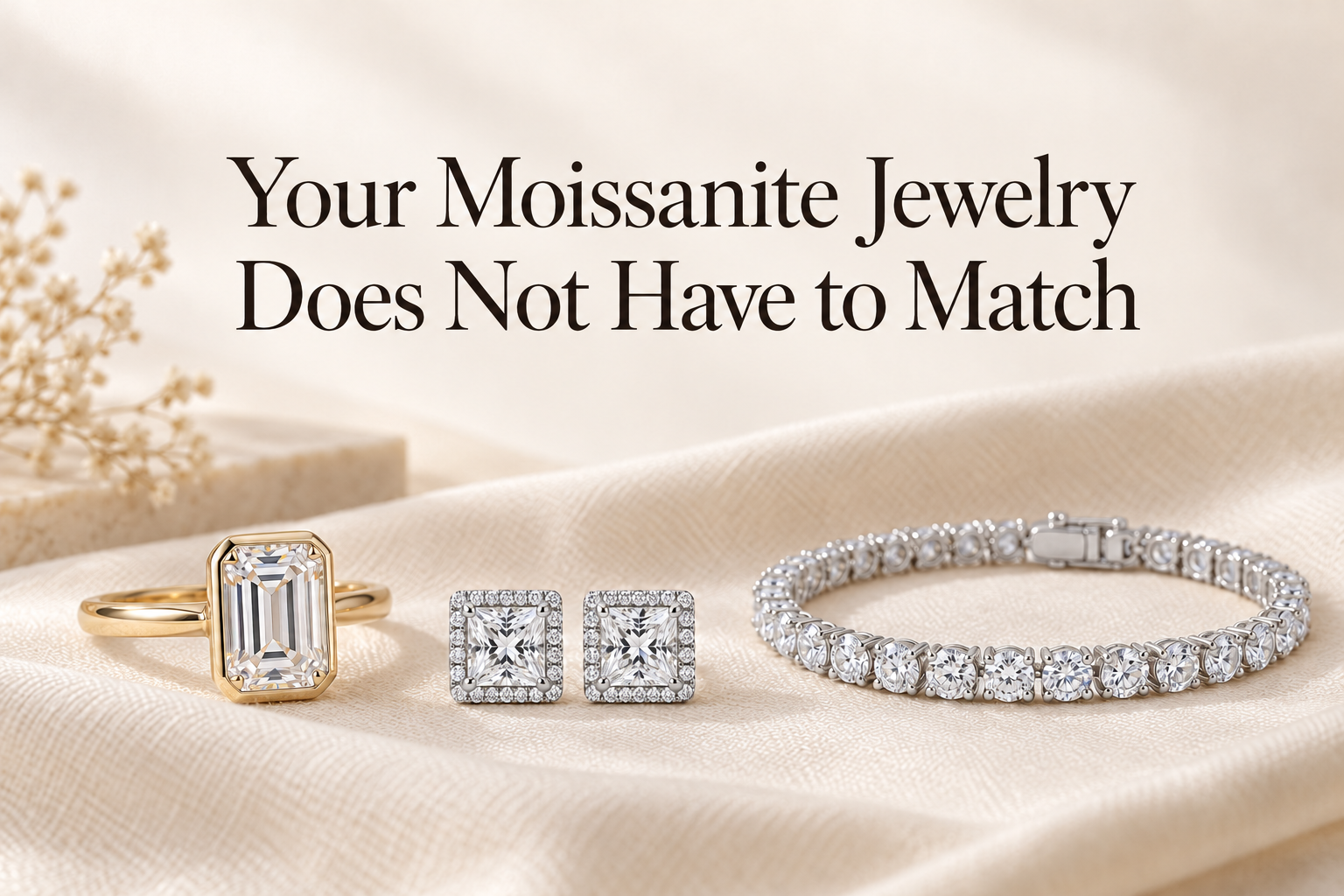
    A geometric outline is one connecting detail. The Emerald Cut Moissanite Bezel Ring has a 2 ct emerald-cut center in a bezel and explicitly states S925 sterling silver. The Geometric Halo Moissanite Stud Earrings are described as a square cushion-cut look framed by a halo. Their outlines differ, but both provide a structured shape.

    You could connect them through geometry while letting the smooth bezel and decorative halo contrast. That is a styling proposal, not a claim that they have identical dimensions or a verified matching finish. The earring description does not establish component metal or weight. Confirm practical specifications separately before ordering a combination.

    A round bracelet does not break a geometric look

    The Four-Prong Moissanite Tennis Bracelet is described as round stones in four-prong settings forming a continuous line. Its repeating round shapes can provide a contrast to the ring and earrings rather than copy them. Try the bracelet as the only additional piece first; add the earrings later if the whole outfit still feels like you.

    Notice where the pieces sit, too. Earrings and a bracelet occupy different parts of the outfit; a ring and bracelet sit closer together visually. You may prefer more detail at one location and less at another. For a casual starting outfit, see a moissanite tennis bracelet with your favorite jeans. None of these suggestions establishes that a specific combination will suit every wearer.

    Mixing visible metal tones is a preference, not a mistake

    If you like consistent color, keep it. If you enjoy contrast, you can make different visible metal tones part of the outfit. You might repeat one tone in a watch or bag fitting, or simply let one piece stand out. There is no need to buy a second version of every favorite just to make the colors identical.

    Keep color language separate from material claims. The bezel ring offers white gold tone and champagne gold tone finishes, but its description states S925 rather than solid gold. Those finish names do not establish an exact match with the bracelet or earrings. Our silver and moissanite guide explains why similar-looking surfaces can have different material specifications.

    Matching a look is different from stacking pieces together

    Styling different pieces in one outfit does not require letting their surfaces touch. If rings or bracelets rub against one another, think about separating them rather than treating a photograph of a stack as proof of safe wear. Store jewelry separately when it is off, and follow the care instructions for each complete piece and finish.

    A coherent combination should also fit your routine. Check ring size, bracelet length and earring fastenings independently. A set label cannot guarantee a comfortable fit. Remove fine jewelry before swimming or using household cleaners; a well-chosen outfit is not a reason to skip care.

    Try the outfit before adding to the jewelry box

    1. Keep one favorite: choose the anchor you already enjoy.
    2. Choose a connection: repeat one visible detail, not necessarily every detail.
    3. Add one contrast: a different outline, surface or scale can be enough.
    4. Look at the whole outfit: include neckline, sleeve, hair and bag rather than inspecting the pieces in isolation.
    5. Stop when it feels complete: an unused jewelry slot is not a problem you need to fill.

    Explore rings, earrings or bracelets if you want a specific addition. A matching set is an option. So is a combination that has developed slowly around your favorites.

    Editorial notes and sources

    This article presents MSEARTHIA’s editorial styling opinion, not a survey, customer submission or documented wear test. Products 73, 639 and 578 were published and in stock when checked on October 10, 2026 (Asia/Taipei). Product descriptions support the named shapes; only the bezel ring explicitly verifies S925 in this selection. The cover is an AI-generated editorial arrangement, not an exact product photograph or measured comparison. General chemical-exposure and separate-storage advice follows GIA’s Tips on Caring for Jewelry.

  • A Moissanite Pendant to Mark Your Own Milestone

    A Moissanite Pendant to Mark Your Own Milestone

    To choose a moissanite pendant as a self-gift, start with the milestone you want to remember, then choose a shape you enjoy and check how the complete necklace fits your ordinary clothes. Verify chain length, pendant dimensions, metal and the exact option before buying. Its meaning comes from your story, not a required carat size or price.

    Imagine closing the notebook on a project you have finally finished. There is no party on the calendar, and nobody else needs to decide what the achievement counts for. You might write down the date, take a favorite photograph, or choose a piece of jewelry. This is an illustrative scenario, not a customer’s story or a claim that shopping makes an achievement more meaningful.

    Name the moment before choosing the necklace

    If you want this piece to mark a particular moment, write one sentence: “This reminds me that I finished something difficult,” or “This belongs to the year I started again.” Keep that sentence for yourself. You do not need a design with an official symbolic meaning, and you do not need to explain it to anyone else.

    Give the purchase a comfortable budget before browsing. A bigger pendant is not a bigger achievement. If buying now would put pressure on another priority, a saved shortlist and a note about the occasion can preserve the idea just as well. Let the timing serve you.

    A circle can be your starting point, without a fixed meaning

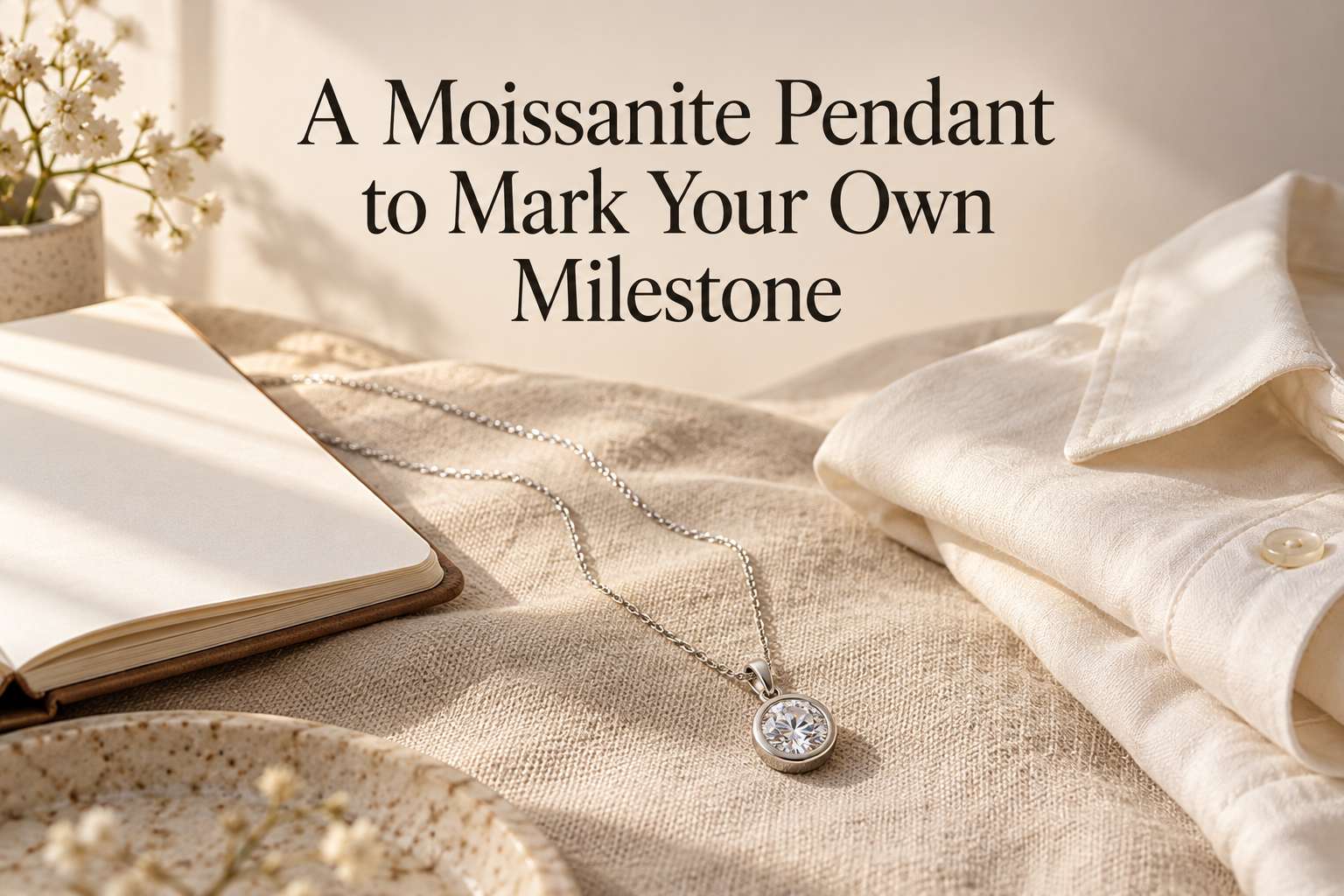
    The 1 Carat Moissanite Circle Pendant Necklace provides a concrete rounded-design option. Its current description identifies a 1 ct option, a circle pendant with pavé accents and a U-shaped necklace profile. That describes the design; it does not establish its chain length, clasp construction or full metal composition.

    You could choose a circle because you like a continuous outline, or privately associate it with completing a chapter. That association is yours, not a universal meaning attached to the product. Ask for missing measurements before choosing. A carat label alone cannot tell you where the necklace will sit or how wide the complete pendant is.

    Or choose geometry that simply feels like you

    The Moissanite Fan Pendant Necklace is described as a fan-shaped moissanite pendant with a geometric focal point. It offers a different outline from the circle. You might enjoy its shape with a plain shirt or an open neckline; that is an editorial styling suggestion, not a documented fit or wear test.

    Compare the full piece rather than treating these pendants as interchangeable. The live listings do not give enough information to rank their weight, measured size or comfort. Ask what is included, whether the chain can be changed, and how the selected configuration is described. An unclear option label should prompt a question, not an assumption about gemstone identity.

    Picture a normal Tuesday, not only the celebration

    Pick three outfits you actually wear: perhaps a shirt, a crew-neck sweater and an evening top. Consider whether you want the pendant above the fabric or within an open neckline. Use a necklace you already own to test a preferred length, then measure that chain and compare with the seller’s actual measurement. A photograph of another person cannot guarantee the same placement on you.

    If you layer necklaces, check where their pendants meet and whether the chains rub or tangle. Start with the new piece alone before adding another. If you already favor noticeable earrings, the pendant can take a quieter role—or you can save one piece for another outfit. Our everyday jewelry style guide can help you decide what you want the focal point to be.

    Keep the material question separate from the moment

    Moissanite names the gemstone; silver tone describes appearance unless a metal statement is also provided. Neither pendant example’s current description establishes S925 for all components, so this article does not present either complete necklace as verified sterling silver. Confirm the pendant, chain, clasp and any finish separately if silver is important to you. Read our silver and moissanite buying guide for those distinctions.

    • Ask for measurements: chain length, any extension and the pendant’s width and height in millimeters.
    • Confirm the components: base metal, surface finish, clasp and whether the chain is included.
    • Check the live option: gemstone wording, current stock and price for your selection.
    • Read current shop policies: delivery and return terms matter if you want the piece for a particular date.

    Let the memory outlast the unboxing

    Write down the date and the sentence you chose at the beginning. Keep the product details and care instructions with that note. The necklace can then be connected to something specific, whether you wear it frequently or only for occasions. You decide the ritual; the purchase does not have to carry the entire memory.

    Remove fine jewelry before swimming or using household cleaners, avoid direct exposure to cosmetics and chemicals, and store pieces separately to reduce rubbing. Use care advice for the complete construction, including its finish. For an earring companion later, our studs-versus-drops buying guide focuses on practical details rather than assuming a perfect matching set.

    Explore MSEARTHIA necklaces with your own milestone in mind—or keep the idea on a shortlist until you are ready.

    Editorial notes and sources

    The milestone scenario and private meanings are editorial suggestions, not testimonials or established psychological benefits. Products 210 and 203 were published and in stock when checked on October 10, 2026 (Asia/Taipei). Details come from the linked live descriptions; missing dimensions and component metals remain unverified. The cover is an AI-generated editorial illustration, not a photograph of either exact product. General chemical-exposure and storage guidance follows GIA’s Tips on Caring for Jewelry.

  • Quiet Sparkle or a Statement Piece? Find Your Everyday Jewelry Style

    Quiet Sparkle or a Statement Piece? Find Your Everyday Jewelry Style

    Your everyday jewelry style can start with four choices: what you wear most, how much attention you want the jewelry to draw, whether you enjoy coordinating accessories, and which details catch your eye. Use the questions below to find a starting direction—clean lines, balanced sparkle or a color-led statement—then confirm practical details before buying.

    Some days you want a familiar detail you barely think about. Other days you want a ring that becomes the conversation. Both can belong in the same jewelry box. This short editorial quiz helps you choose for the version of your day you actually have, rather than for a permanent personality type.

    How to use this guide

    Choose A, B or C for each question and note which letter appears most often. If you have a tie, read both directions. The choices describe styling preferences; they are not a psychological assessment, and they cannot predict comfort or how a piece will look on your hand.

    1. What does an ordinary outfit look like?

    • A: Simple shapes and a small palette—a shirt, plain knit or tailored basics.
    • B: Familiar basics with one decorative detail, such as texture, a patterned scarf or a favorite bag.
    • C: Color, contrast or a strong silhouette; I like an outfit to have a visible point of view.

    2. When someone notices your jewelry, what feels right?

    • A: A close-up detail rather than the first thing they see.
    • B: A little sparkle that completes the outfit.
    • C: A piece they might ask me about.

    3. How much do you enjoy building a jewelry combination?

    • A: I prefer choosing one piece and getting on with my day.
    • B: I enjoy a repeatable pair of accessories that works with several outfits.
    • C: I like changing the focal point depending on my mood or occasion.

    4. Which detail makes you pause in a product photo?

    • A: A crisp geometric outline or a smooth metal frame.
    • B: A decorative halo or a repeated shape that feels balanced.
    • C: A colored center, an unusual silhouette or a design with several points of interest.

    Mostly A: start with a clean outline

    Your answers suggest that the arrangement of lines matters more than adding decoration everywhere. Begin with one piece, then see whether you want anything else. A geometric ring can provide a clear focal point without asking you to coordinate several accessories.

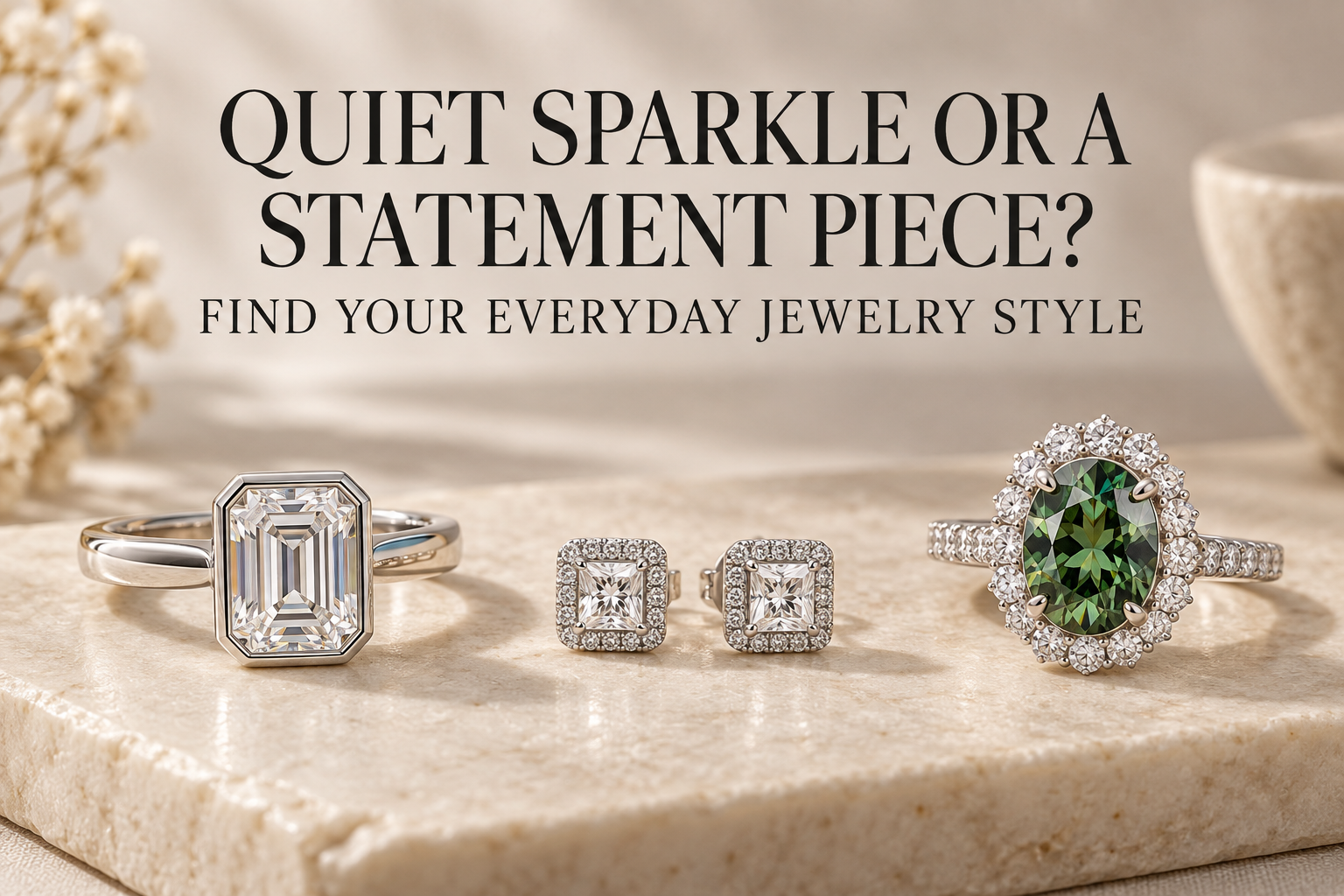
    The Emerald Cut Moissanite Bezel Ring is one example to explore: its current description identifies a 2 ct emerald-cut moissanite, a bezel setting and S925 sterling silver. The white gold tone and champagne gold tone choices describe the finish, rather than solid-gold construction.

    The clean-outline direction does not promise low sparkle or a small ring. Check the actual dimensions and side profile. If you love the lines but want less visual presence, ask about measured size rather than assuming the label “bezel” makes a piece subtle.

    Mostly B: start with a repeatable sparkle detail

    Your answers point toward a familiar piece that can move between outfits. Try choosing earrings as the repeating detail, then change the neckline, fabric or hairstyle around them. You can build a recognizable look without using the same clothes every day.

    The Geometric Halo Moissanite Stud Earrings offer a square cushion-cut look framed by a halo. Their geometric outline is the reason for including them here; exact dimensions, weight and component metals should be confirmed separately.

    Try the three combinations in One Pair of Moissanite Earrings, Three Outfit Ideas. Treat “balanced” as your preference for the whole outfit, not a guaranteed measurement or performance claim about the earrings.

    Mostly C: start with color or a distinctive focal point

    Your answers suggest that you enjoy giving one piece a more visible role. Choose a colored center or a distinctive outline, then decide how much else the outfit needs. You might repeat the color in one detail, or let it stand alone against a neutral outfit.

    The Green Moissanite Halo Ring is a color-led example. Its description identifies an oval green moissanite, halo, pavé band and S925 sterling silver, with current 1 ct and 2 ct center options. The green center and surrounding detail support this style direction; they do not establish the ring’s exact millimeter footprint.

    A statement can come from color rather than size. Compare the ring with what you actually wear and review it in a range of photographs or a video when available. Your favorite image may show lighting quite different from a normal room.

    If your answers are mixed

    A tie is useful. You might want a clean ring for a workday and a colored pair of earrings for a dinner. Instead of trying to fit one label, choose one ordinary-day combination and one occasion combination. Start with jewelry you own before adding another piece.

    For a gift, answer from the recipient’s visible preferences rather than your own. Look at their usual jewelry and outfits, and ask about size or materials when necessary. The quiz cannot substitute for a conversation about what they like.

    Before turning a preference into an order

    1. Confirm dimensions: ask for millimeter measurements and side views if the listing does not provide them.
    2. Check fit: use the ring size guide and the exact product selector.
    3. Check materials: stone, base metal, finish and earring posts are separate details. Read the silver and moissanite material guide.
    4. Consider daily activities: choose based on your actual routine and remove fine jewelry for tasks involving impacts or chemicals.
    5. Confirm the live option: availability and price can change by variant.

    Explore the rings collection or earrings collection with your preferred direction in mind. You are choosing a starting point, and you can change it whenever your outfit or day calls for something else.

    Editorial notes and sources

    This is an editorial preference exercise created by MSEARTHIA, not a validated personality test or a customer survey. The three product examples were checked on October 7, 2026 and were published and in stock at that time. Material claims are limited to explicit product wording. The cover is an AI-generated editorial illustration. General chemical-exposure advice follows GIA’s Tips on Caring for Jewelry; factual product details come from the linked live listings.