Moissanite and diamond are different materials, and almost every difference follows from that. Diamond is crystallized carbon with a Mohs hardness of 10; jewelry moissanite is laboratory-created silicon carbide at about 9.25, with more fire, less density and a much lower purchase price. If you want the hardest known gem material and the traditional diamond market, choose diamond. If you want intense fire, excellent everyday durability and far more visual size for the money, moissanite is the stronger value—provided it is sold and described honestly as moissanite.
The 60-second decision
- Choose diamond if owning the actual diamond material, maximum scratch resistance and a conventional resale market matter most.
- Choose moissanite if you want stronger rainbow fire, a larger-looking stone for the budget, and durability that comfortably handles daily wear.
- Compare by millimeters, not carat when switching between the two: moissanite is less dense, so equal carat weights do not look the same size.
- Buying for disclosure and honesty: moissanite should be identified as moissanite or as a diamond simulant. It is not a laboratory-grown diamond.
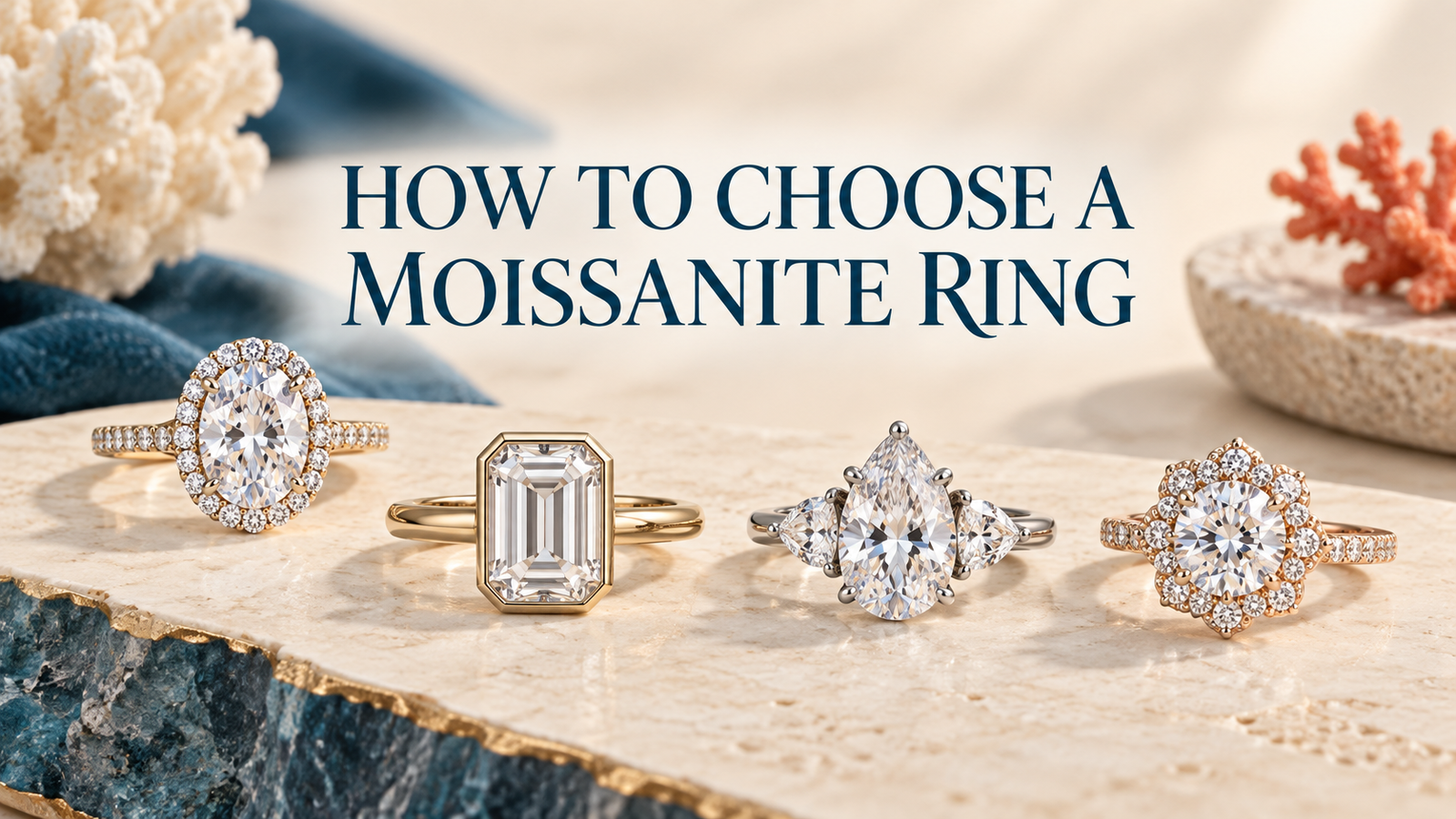
- Still deciding on shape and setting? Read How to Choose a Moissanite Ring first, then come back to the material question.
The material difference behind everything else
GIA describes diamond as a gem material composed almost entirely of carbon, and it classifies synthetic moissanite—silicon carbide—as a diamond imitation or simulant, because it can resemble diamond while remaining chemically and structurally different. A laboratory-grown diamond is still diamond: it has essentially the same optical, physical and chemical properties as a mined diamond. Moissanite does not, and should not be described as a natural, laboratory-grown or synthetic diamond.
That distinction is not marketing hairsplitting. It explains the fire, the weight, the price and the long-term care, and it is why the U.S. Federal Trade Commission’s Jewelry Guides require truthful disclosure of gemstone identity rather than vague wording.
Side-by-side properties
| Property | Diamond | Moissanite |
|---|---|---|
| Material | Crystallized carbon | Silicon carbide (SiC) |
| Category | Diamond | Diamond simulant |
| Mohs hardness | 10 | About 9.25 |
| Refractive index | About 2.42 | 2.648 and 2.691 |
| Dispersion (fire) | 0.044 | 0.104 |
| Optical behavior | Singly refractive | Doubly refractive |
| Specific gravity | About 3.52 | About 3.22 |
The numerical values for synthetic moissanite come from the Gems & Gemology study by Nassau, McClure, Elen and Shigley, which recorded refractive indices of 2.648 and 2.691, dispersion of 0.104, a hardness of 9¼ on the Mohs scale and a specific gravity of 3.22. Diamond values are GIA’s published reference figures.
1. Brilliance and fire
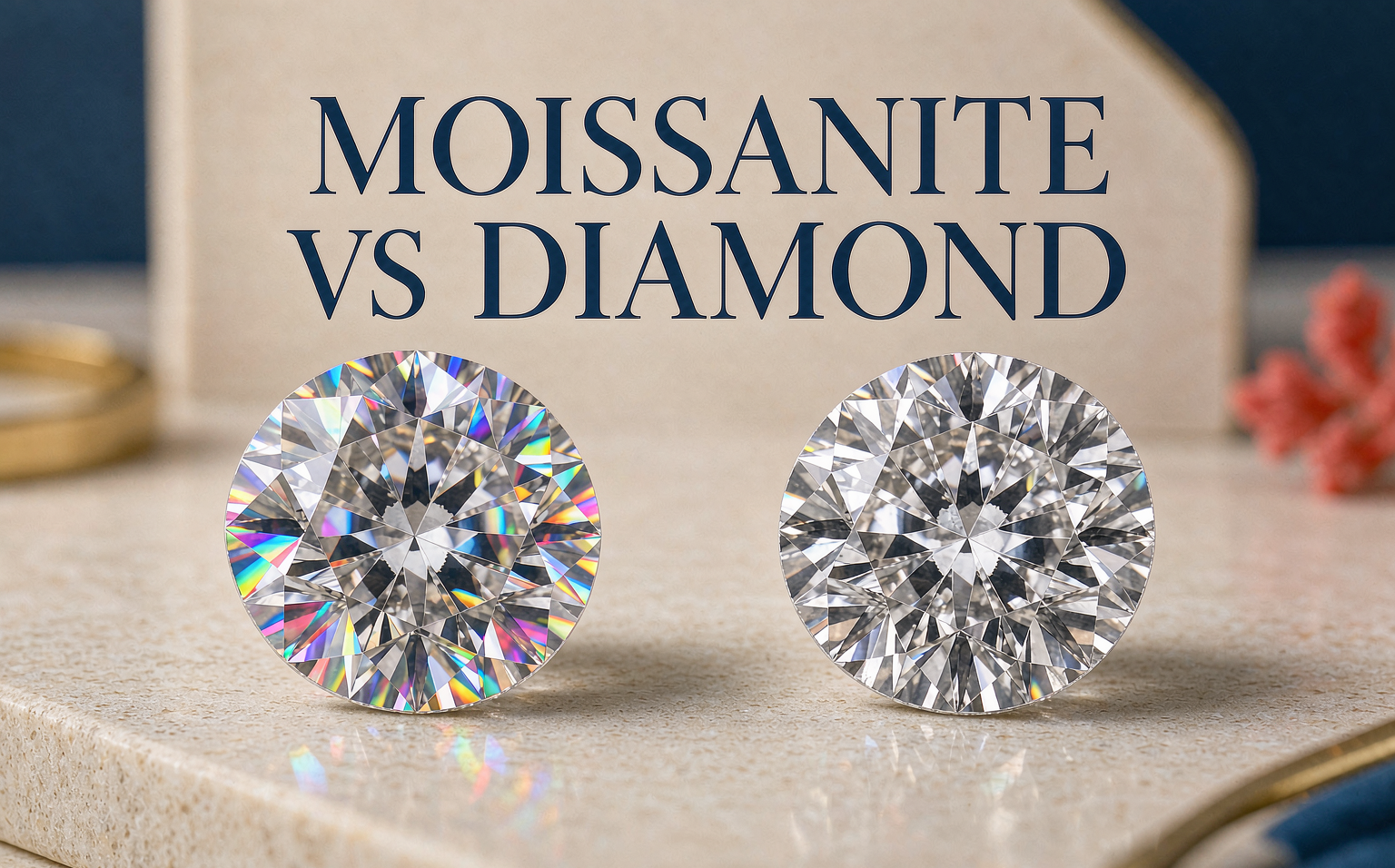
Fire is the colored light you see when a stone splits white light into spectral flashes. Moissanite’s dispersion of 0.104 is more than twice diamond’s 0.044, and GIA notes that moissanite also has slightly more brilliance. In practice that means larger, more obvious rainbow flashes, especially under spotlights or direct sun.
Whether that is a feature depends on taste. GIA also records the trade-off: in sizes of roughly one carat and above, moissanite’s intense fire may give it away as a non-diamond gem, and because moissanite is doubly refractive, viewing through the crown can show a doubling of the back facets that makes the interior look slightly fuzzy. Diamond shows no such doubling. Neither effect is a defect—they are simply what the material does.
2. Durability for everyday wear
On the Mohs scale, diamond is 10 and moissanite is about 9.25, which still makes moissanite harder than every other diamond simulant and harder than sapphire or ruby. Both are hard enough for a ring worn daily. Hardness resists scratching; it is not the same as toughness, and a hard stone with a thin girdle can still chip from a sharp blow. That is true of diamond too.
GIA notes that because diamond is harder, it can take a better polish and therefore shows a brighter luster than most simulants, and that many simulants may develop scratches and abrasions along facet junctions sooner. For a piece you intend to wear for years, that polish retention is a real advantage for diamond. For a piece you intend to wear and enjoy rather than keep pristine, the practical gap is smaller than the numbers suggest.
3. Price, and what you are actually comparing
Moissanite is manufactured, so its supply is not constrained by mining, and comparable-looking stones generally cost far less than natural diamonds. The honest way to shop is to compare complete rings—same metal, similar stone size, setting included—rather than comparing a loose diamond price to a finished moissanite ring.
On MSEARTHIA, the five published moissanite rings were listed between roughly $43 and $69 at the time of writing, with prices varying by center-stone size and ring size. Use the live option selector on each product page rather than a saved screenshot, because availability and price change. If you want the classic look with the fewest moving parts, the Moissanite Solitaire Ring is a clean starting point; the Oval Moissanite Halo Ring shows what a halo adds to visual spread.
4. Care and cleaning
Both materials are low-maintenance, and GIA lists warm soapy water as safe for diamond simulants generally. For synthetic moissanite specifically, GIA lists ultrasonic cleaning and steam cleaning as safe, and notes that moissanite is less likely to attract grease than diamond, so it tends to hold its sparkle between cleanings.
- Routine cleaning: warm water, a drop of mild dish soap and a soft brush, then dry with a lint-free cloth.
- Ultrasonic and steam: safe for the stone according to GIA, but home ultrasonic units can stress solder joints and prongs. If you use one, check the setting afterwards.
- Avoid: chlorine bleach, harsh chemicals and abrasive pastes such as toothpaste, which can dull metal even when the stone is unaffected.
- Storage: keep pieces in separate soft pouches. Diamond can scratch moissanite, and either can scratch softer metals and gems.
- Metal matters: read each product’s stated metal. Several MSEARTHIA rings are described as S925 sterling silver; silver is softer than platinum and can tarnish, so treat it accordingly and remove rings for gym work, cleaning and swimming.
5. Telling them apart, and buying honestly
Do not rely on a thermal conductivity pen. The Gems & Gemology study found that synthetic moissanite’s thermal properties are close enough to diamond that such probes react to it as if it were diamond. Jewelers separate the two by optical behavior instead: moissanite’s double refraction produces a visible doubling of facet junctions, while diamond does not.
When you buy, the disclosure should match the material. Moissanite, laboratory-created moissanite and diamond simulant are all acceptable descriptions. “Lab-created” used alone as a product name is not, because it does not say what was created. If the identity of a stone you own is uncertain, GIA accepts stones for laboratory identification.
A practical shortlist
- Choose the Emerald Cut Moissanite Bezel Ring if you want step facets and a smooth, protective rim.
- Choose the Oval Moissanite Halo Ring if you want an elongated center with maximum visual spread.
- Choose the Pear Cut Moissanite Three-Stone Ring if you want a directional shape with side-stone dimension.
- Choose the Floral Moissanite Halo Ring if you want a decorative, romantic profile.
- Choose the Green Moissanite Halo Ring if you want color as part of the statement.
Frequently asked questions
Is moissanite a fake diamond?
No. Moissanite is a genuine gemstone material, but it is silicon carbide rather than carbon, so GIA classifies it as a diamond simulant. A simulant resembles diamond without sharing its chemistry or structure. That is different from a laboratory-grown diamond, which is diamond.
Which one sparkles more?
Moissanite. GIA states that moissanite has more than twice the fire of diamond and slightly more brilliance. Some people love that; others find the rainbow flashes read as obviously non-diamond, particularly above about one carat.
Will moissanite scratch or cloud over time?
Moissanite at about 9.25 on the Mohs scale resists scratching very well and does not cloud the way softer simulants can. GIA does note that diamond, being harder, takes a better polish and holds a brighter luster longer. Surface film from soap, lotion and hard water is the usual reason a stone looks dull, and cleaning fixes it.
Why does the same carat weight look bigger in moissanite?
Moissanite has a specific gravity of about 3.22 versus diamond’s roughly 3.52, so a moissanite of the same weight occupies slightly more volume. When comparing the two, compare millimeter dimensions rather than carat weight.
Can a jeweler tell the difference?
Yes, and it is quick. Thermal testers alone are unreliable because moissanite conducts heat similarly to diamond. Doubling of the back facets caused by double refraction is the standard visual separation, and a jeweler or laboratory can confirm it.
Sources and methodology
Property values, simulant classification and care guidance come from GIA publications. Availability and pricing refer to MSEARTHIA’s live product pages checked on September 28, 2026, and may change; verify the product page before ordering.