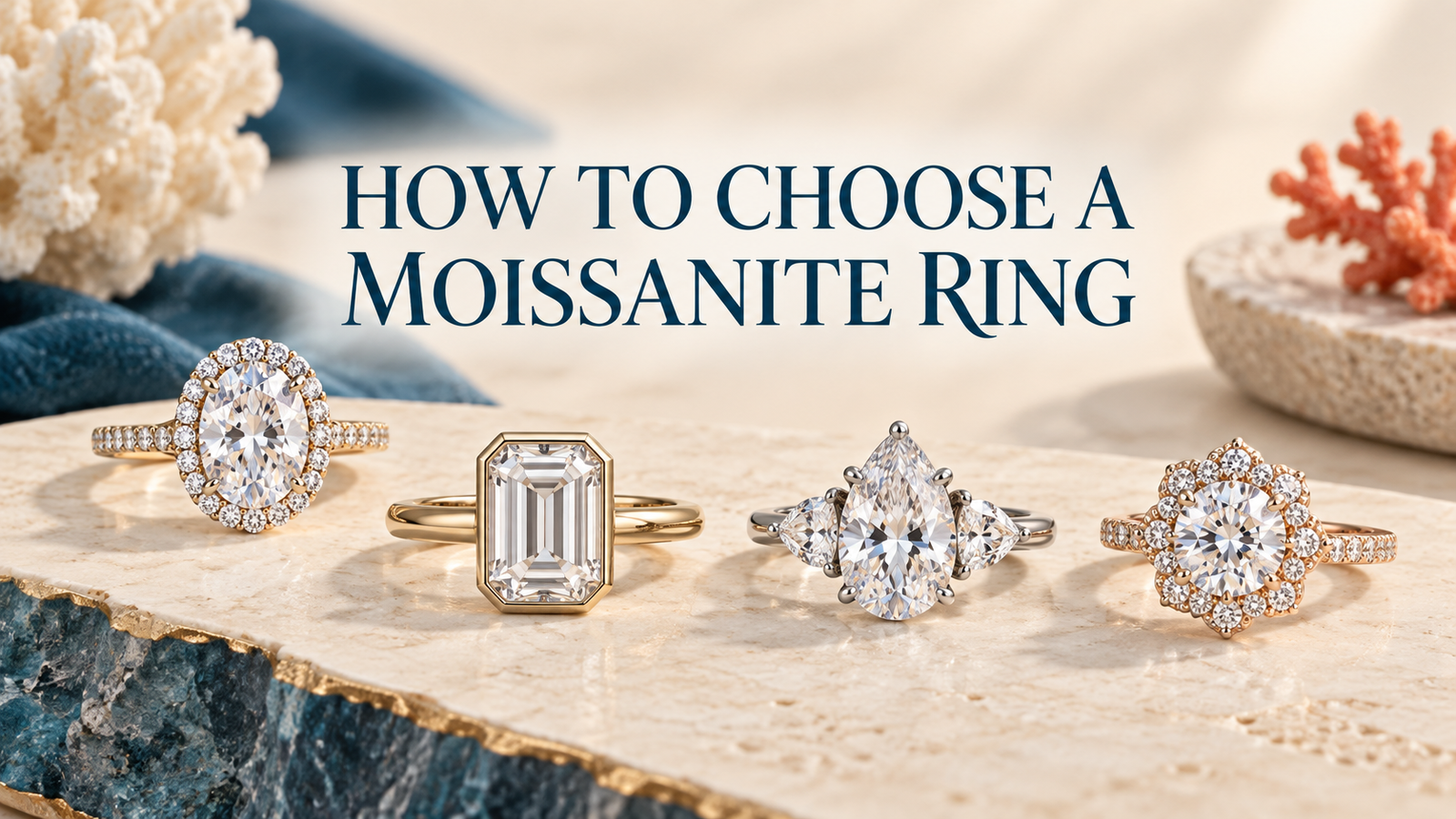
The easiest way to choose a moissanite ring is to decide in this order: shape, setting, center-stone size, lifestyle, and ring size. Shape sets the personality, the setting changes protection and visual impact, size affects presence, and fit determines whether the ring is comfortable enough to wear. Start with those decisions before comparing small design details.
The 60-second decision
- Classic and versatile: choose a solitaire or a clean bezel.
- More visual sparkle: look at halo or floral-halo styles.
- Symbolic and dimensional: consider a three-stone design.
- Active routine or frequent glove wear: prioritize a smoother, lower-profile setting and inspect how much the stone projects above the band.
- Unsure about fit: confirm the size before ordering instead of relying on a guess.
1. Choose the stone shape first
Shape is the outline you notice first. It is different from cut quality: two stones can share the same oval or emerald outline but interact with light differently. For an online purchase, review straight-on and angled images whenever they are available rather than deciding from a single close-up.
| Shape | Visual character | What to inspect | MSEARTHIA example |
|---|---|---|---|
| Oval | Elongated, bright, and softly modern | Outline, symmetry, and the way the halo follows the center | Oval Moissanite Halo Ring |
| Emerald cut | Geometric, clean, and understated | Step-facet appearance, corner protection, and bezel proportions | Emerald Cut Moissanite Bezel Ring |
| Pear | Directional and distinctive | Tip protection, symmetry, and preferred point orientation | Pear Cut Moissanite Three-Stone Ring |
| Floral halo | Romantic and decorative | Overall width, accent-stone layout, and cleaning access | Floral Moissanite Halo Ring |
Pointed shapes such as pear cuts deserve special attention at the tip. GIA notes that pointed outlines benefit from a secure setting that helps protect vulnerable corners or points. That does not make a pear shape impractical; it simply makes the mounting part of the buying decision.
2. Match the setting to your routine
A setting is not only a style choice. It is the structure that holds the center stone and affects the ring’s profile, snag potential, cleaning needs, and visual footprint. GIA distinguishes the stone-holding method—such as prongs or a bezel—from the broader style, such as solitaire, halo, or three-stone.
Bezel
A rim of metal surrounds the stone’s edge. The smooth outline can be practical for people who dislike exposed prongs or frequently catch rings on clothing. A bezel also gives an emerald-cut stone a particularly clean, architectural look.
Halo
A frame of smaller stones surrounds the center and increases the ring’s overall sparkle and visual spread. More small stones also mean more places where lotion or debris can collect, so plan for careful cleaning and periodic inspection.
Three-stone
A center stone is flanked by two side stones. The design creates width across the finger and a layered look without relying on a complete halo. Check how the side stones sit beside the center and whether the profile suits your daily routine.
3. Think in visual presence, not carat alone
Carat is a weight measurement, not a guaranteed face-up dimension. Shape, proportions, halo width, side stones, and band design all change how large a ring looks from above. This is why a 2 ct center stone in a bezel can present differently from a 2 ct center in a halo.
Use the option selector on the product page to see which center-stone sizes and ring sizes are actually offered. For example, the Oval Moissanite Halo Ring currently offers 1 ct, 2 ct, and 3 ct center-stone choices, while the Floral Moissanite Halo Ring offers 1 ct and 2 ct choices. Availability and price can change, so rely on the live product selector rather than a saved screenshot.
4. Verify material wording and product details
Moissanite is its own gemstone material; it is not diamond. GIA describes synthetic moissanite as very hard and durable, with strong fire and brilliance, while also noting that its optical behavior differs from diamond. The U.S. Federal Trade Commission’s Jewelry Guides emphasize truthful disclosure of gemstone type, metallic content, size, treatment, and other material facts. For a property-by-property comparison of the two materials, see Moissanite vs Diamond: Brilliance, Durability, Price and Care.
Read the individual product description for the exact stated material. Do not infer solid gold from a color name. On MSEARTHIA, a finish described as “white gold tone” or “champagne gold tone” describes appearance, not solid-gold content. The Emerald Cut Moissanite Bezel Ring, for example, states S925 sterling silver in its product details.
5. Confirm ring size before ordering
A beautiful ring that spins, pinches, or cannot pass the knuckle is not the right choice. Finger size can vary with temperature and time of day, and a wider band can feel different from a narrow one. If you have a ring that already fits the intended finger, compare its inside diameter with a reliable size chart. For an important purchase or an uncertain measurement, ask a jeweler to confirm the size.
Use the available size options on each product page and contact MSEARTHIA before ordering if you need help with half sizes or a fit question. Do not choose a size based only on a printable guide unless the print scale has been checked.
A practical shortlist
- Choose the Emerald Cut Moissanite Bezel Ring if you prefer a sleek frame and a geometric center.
- Choose the Oval Moissanite Halo Ring if you want an elongated center with a bright halo outline.
- Choose the Pear Cut Moissanite Three-Stone Ring if you want a directional shape and added side-stone dimension.
- Choose the Floral Moissanite Halo Ring if your style leans romantic and decorative.
- Choose the Green Moissanite Halo Ring if color is part of the statement you want to make.
Frequently asked questions
Is moissanite a diamond?
No. Moissanite and diamond are different gemstone materials with different optical and physical properties. Product descriptions should identify moissanite clearly rather than present it as diamond.
Which ring setting is best for an active lifestyle?
A smooth bezel or another lower-profile, well-protected setting can reduce snagging, but no ring is immune to impact. Compare the full profile, not only the top view, and remove fine jewelry for activities that could strike or crush the setting.
Does a halo make a center stone look larger?
A halo increases the ring’s overall visual footprint and frames the center, which can make the complete design look larger. It does not change the actual weight or dimensions of the center stone.
Should I choose a ring by carat weight?
Use carat as one comparison point, not the only one. Shape, proportions, setting, halo, side stones, band width, and finger coverage all affect how the finished ring looks.
Related reading: if you are still weighing moissanite against diamond, see Moissanite vs Diamond: Brilliance, Durability, Price and Care for a full comparison of fire, hardness, price and care.
Sources and methodology
This guide combines MSEARTHIA’s live product descriptions and option sets, checked on September 28, 2026, with general gemological and consumer-advertising guidance. Product availability may change; verify the live product page before ordering.
Leave a Reply