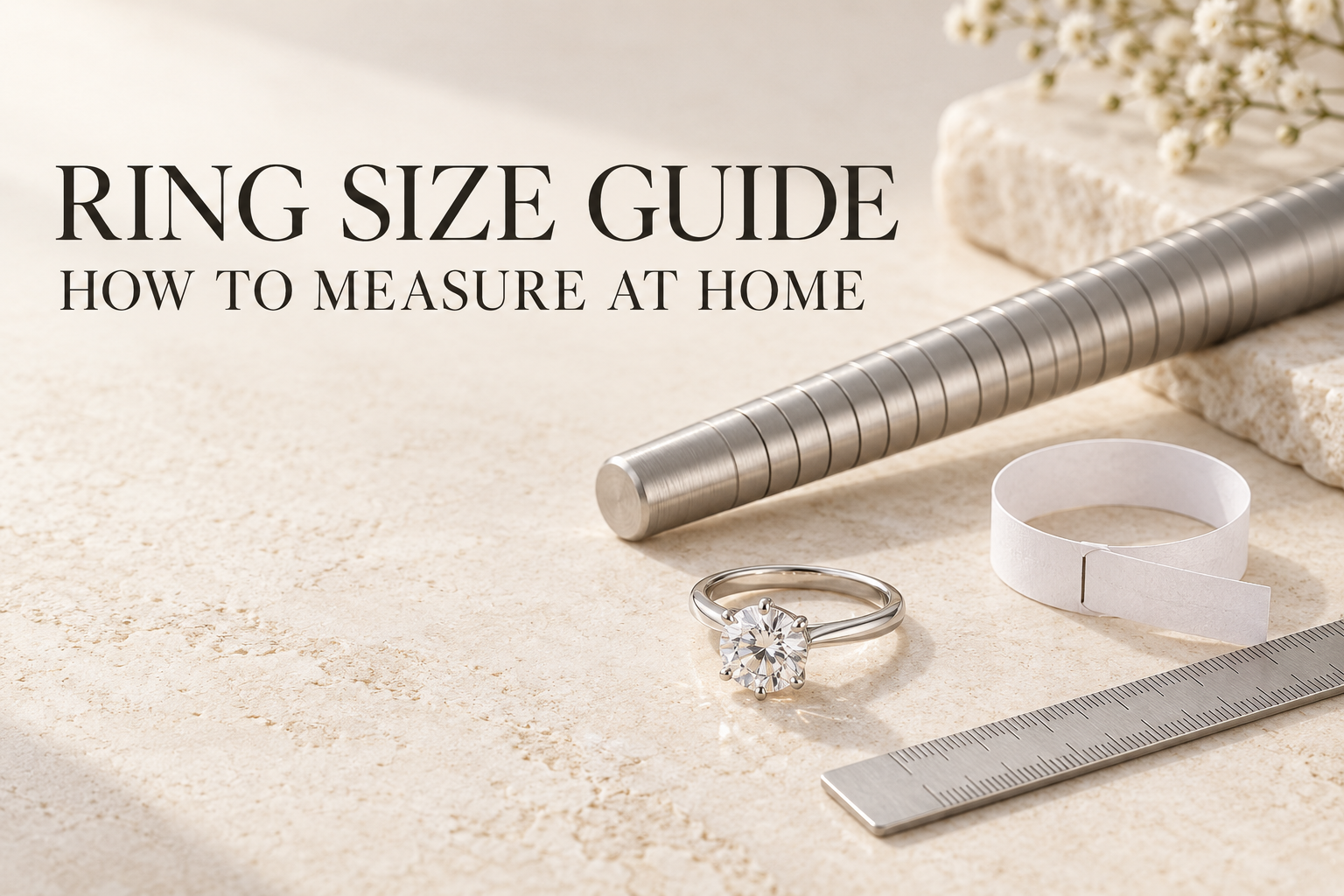
The most reliable at-home starting point is to measure the inside diameter of a ring that already fits the intended finger. If you do not have one, measure the finger’s circumference with a flexible tape or a flat paper strip. Record the result in millimeters, repeat it at different times, and confirm professionally when the purchase is difficult to resize or especially important.
The short answer
- Best home method: measure the inner diameter of a well-fitting ring in millimeters.
- Second method: measure the finger’s circumference with a non-stretch paper strip or flexible tape.
- Measure the correct finger: the same finger on the opposite hand can be a different size.
- Repeat: check two or three times when your hands are at a comfortable, normal temperature.
- Between sizes: the larger option is often more comfortable, but band width and knuckle shape can change the decision.
Method 1: measure a ring that already fits
This method avoids pulling a strip too tightly around the finger. Choose a round ring that fits the exact finger where the new ring will be worn. Place it flat on a ruler marked in millimeters, then measure straight across the widest part of the inside opening—from inner edge to inner edge. Do not include the metal.
- Use a ring with a similar band width if possible.
- Measure the inside diameter at the center, not along an angled line.
- Read to the nearest tenth of a millimeter if your ruler or caliper permits.
- Repeat from a second direction to check that the ring is round.
- Compare the result with the seller’s own size chart; conversion charts can vary slightly.
If you are measuring from a printed chart, print at 100% or “actual size” and verify its scale marker with a physical ruler. “Fit to page” can change every circle on the sheet.
Method 2: measure your finger
Cut a narrow, straight paper strip or use a soft measuring tape. Wrap it around the base of the intended finger so it sits close to the skin without squeezing. Mark where the ends meet, lay the strip flat, and measure the length in millimeters. That length is the finger circumference.
Paper is usually easier to control than elastic string. Stretchy material can produce an artificially small reading. If the knuckle is noticeably wider than the finger base, measure both places. The ring needs to pass over the knuckle while remaining comfortable at the base.
| Situation | What to do | Why it matters |
|---|---|---|
| Hands feel cold | Wait until they return to a normal temperature | Cold fingers can measure smaller |
| Hands are hot or swollen | Measure again later | Heat, exercise and fluid retention can increase size |
| Large knuckle | Measure the knuckle and finger base | The ring must pass one and fit the other |
| Wide band | Ask whether to size up | More metal contacts the finger and can feel tighter |
| Between sizes | Check half-size availability or choose with the band style in mind | A small change can affect comfort and security |
Why one measurement may not be enough
Finger size is not perfectly fixed. Temperature, time of day, recent activity and temporary swelling can alter the result. Measure on at least two occasions rather than trusting one tight wrap. A comfortable ring should slide over the knuckle with gentle resistance and sit securely without leaving a deep indentation.
Band shape matters too. A broad statement ring often feels tighter than a narrow band at the same labeled size. A ring stack occupies more space on the finger, while an adjustable opening changes how a design behaves. Treat the number as a fit starting point, not a universal promise across every ring.
Common ring-sizing mistakes
- Measuring the wrong hand: dominant and non-dominant hands are not always identical.
- Including the ring’s metal: diameter is measured across the empty inner opening.
- Pulling the strip tight: the result may fit on paper but feel restrictive in use.
- Mixing diameter and circumference: label the number before using a chart.
- Rounding too early: keep the millimeter measurement until you compare with the size chart.
- Assuming every country uses the same system: US numbers, UK letters and regional charts are different labels for physical measurements.
How to use a MSEARTHIA product selector
Available sizes depend on the design and current variant. For example, the Colored Round Moissanite Halo Ring currently lists US 5–10 and offers a half-size contact option. The 2 Carat Radiant-Cut Moissanite Ring for Men currently lists US 8–12 with a half-size contact option. The Men’s 1 Carat Square-Set Moissanite Ring also lists US 8–12 and identifies an adjustable option.
Those ranges are examples, not a site-wide rule. Always use the live selector on the product page before ordering, because sizes, finishes and availability can change by variant.
When to ask a jeweler
Professional sizing is worth the extra step for a surprise engagement ring, a wide or unusually shaped band, a ring that cannot easily be resized, or a finger with a pronounced knuckle. A jeweler can compare several sample bands and account for how the specific design feels, which a paper strip cannot reproduce.
Frequently asked questions
Is inside diameter or finger circumference better?
Inside diameter from a ring that already fits is usually the cleaner home measurement. Finger circumference is useful when no suitable ring is available, but the strip must not stretch or compress the finger.
What should I do if I am between two sizes?
Check whether a half size is available. If not, the larger size is often the safer starting point, especially for a wider band, but knuckle shape and the ring’s construction should guide the final choice.
Can I measure secretly for a gift?
Measure the inside diameter of a ring the recipient wears on the same finger. If that is not possible, ask someone close to them or choose a design with a clear exchange or adjustment path rather than guessing from height or clothing size.
Does a wide ring need a different size?
A wide band can feel tighter because more metal contacts the finger. Ask for design-specific guidance and, when possible, try a sample with a similar width.
Choose the design next: compare visual impact and everyday wear in Halo vs Bezel vs Three-Stone Moissanite Rings, then review How to Choose a Moissanite Ring.
Sources and methodology
The measurement steps follow Tiffany & Co.’s public ring-size guidance for measuring an existing ring or a finger. MSEARTHIA product links and live size options were checked on October 2, 2026. Because manufacturing tolerances and fit preferences differ, the seller’s chart and design-specific advice take priority over a generic conversion.