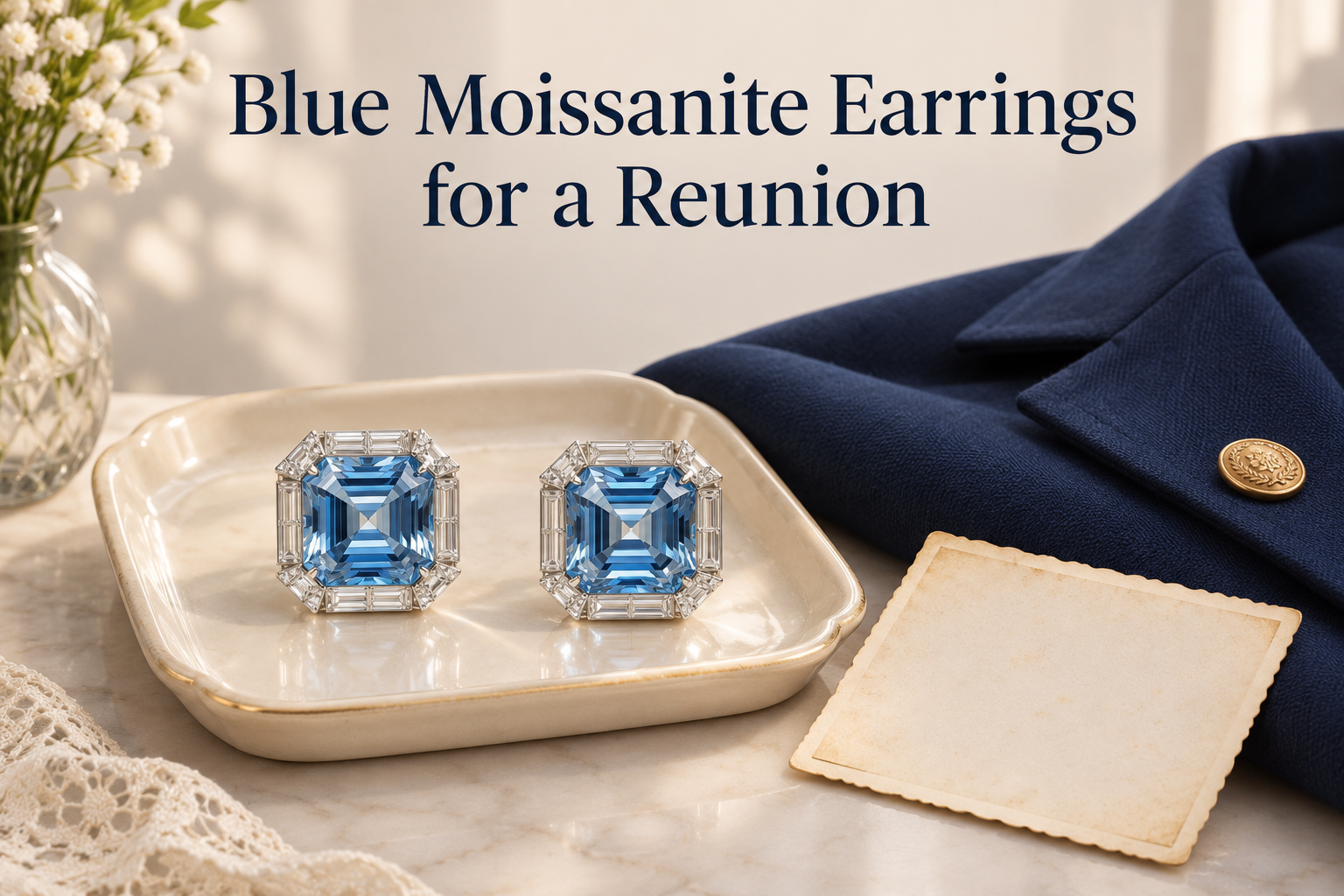
For a reunion, try blue moissanite studs with a familiar navy jacket and a light top. Keep the jacket open so you can see the neckline and earrings together. Let the blue centers supply one detail you chose for the evening.
Imagine meeting old classmates for the first time in several years. There is a table of photographs near the door and someone you recognize across the room. In this illustrative scene, you wear the jacket you usually reach for at dinner. You add blue studs because you like their color beside it.
Start with the clothes you know
Try the jacket with your usual light top and look at the whole outfit in the mirror. Turn slightly so you can see the stud at one ear. If the blue is the detail you enjoy, leave a little plain fabric around it. With a patterned top, try the same earrings and see whether the pattern and color feel balanced to you.
The current listing identifies blue Asscher-cut centers with geometric frames. The squared outline gives you a shape to compare against your jacket collar. Ask for the full front dimensions if you want to picture the exact option before buying. View the Blue Asscher-Cut Moissanite Stud Earrings.
Keep a record of the evening
If you take an outfit photo before leaving, keep it with the group photo afterward. The two pictures can make the earrings part of a memory you enjoy returning to. Try the idea with a pair you already own, or compare the earring collection if you’re looking for another outline. For a different occasion using the same blue design, see the brown outfit styling scene.
Sources and image note
The live listing supplies the design details. Store the earrings in their own padded compartment when you take them off. GIA jewelry care guidance. The cover is an AI-generated editorial illustration.
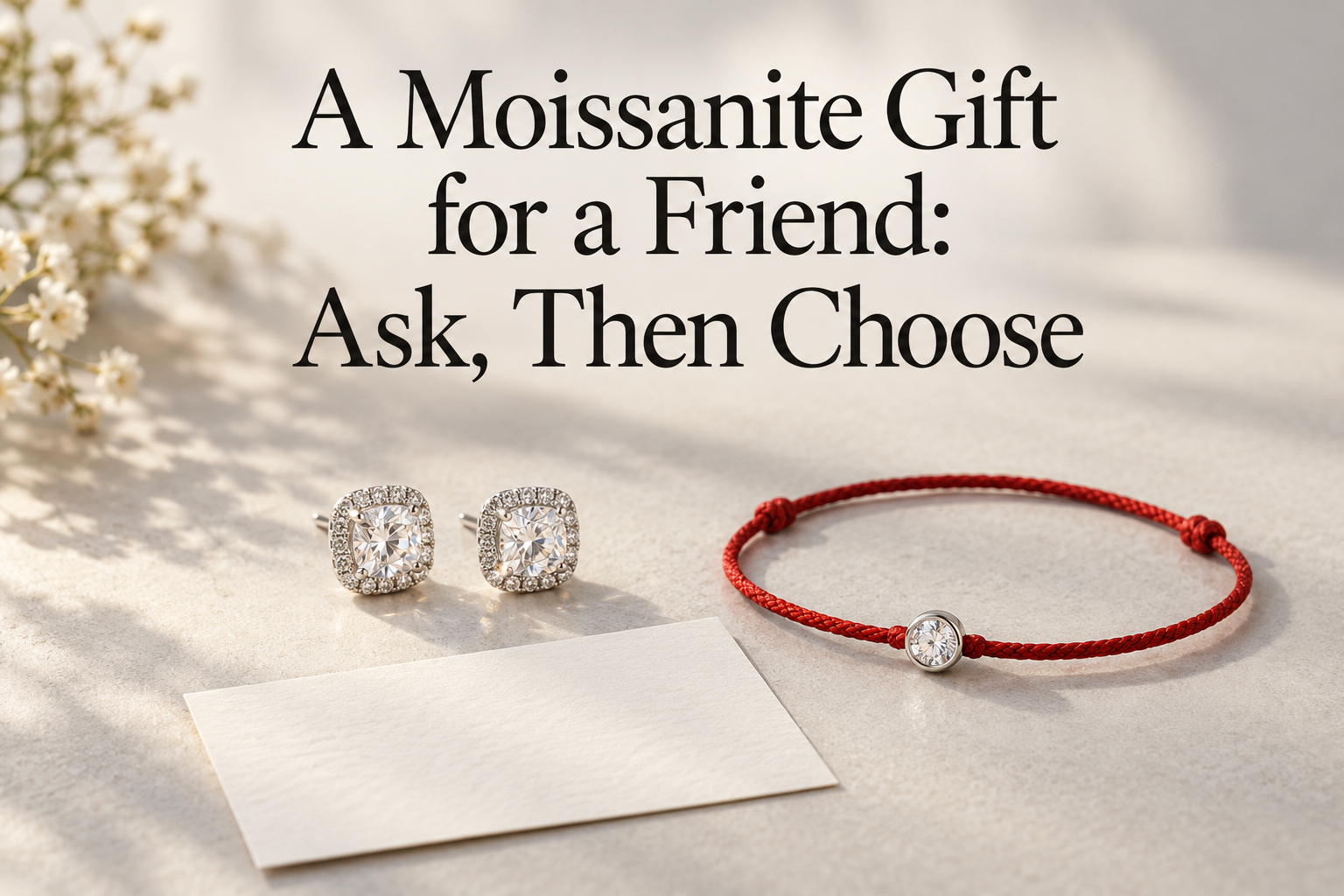
For a moissanite gift for a friend, ask whether they want jewelry at all, which category they wear, and which fit or material details matter to them. Then shortlist an option together. Studs require more than a guess about pierced ears, and an adjustable bracelet is not automatically one-size-fits-all. The personal note can remain a surprise even when the product choice is shared.
This is an editorial gift-dilemma guide, not a real friend’s submission or a promise of a particular reaction. The question is how to make a thoughtful choice without turning familiarity into assumptions. There is no ranking of how much friendship a gemstone, price tag or surprise demonstrates.
Start with one invitation, not a hidden investigation
Try a direct question: “Would you enjoy choosing a piece of jewelry together, or would you prefer something else?” If the answer is jewelry, ask whether they would actually wear earrings, a bracelet, a necklace or a ring. It is fine to say what you had in mind while leaving them space to choose another category or decline.
Do not borrow a ring, inspect belongings or ask others to uncover private details as a substitute for the conversation. A familiar color in their clothes can suggest a question, not prove what they want to wear. Our green-ring outfit scene is an example of a personal preference; it is not a prescription for the friend receiving your gift.
The first fork: do they want the category?
They already enjoy studs: ask whether a clear geometric design appeals, then confirm dimensions, fastening and component materials.
They prefer a wrist detail: ask about cord versus metal-link construction, then confirm the selected bracelet’s real fit range and closure.
You do not know: share a small shortlist without ordering yet. A vague preference is a reason to ask, not a reason to choose the “safest” item.
The forks are practical editorial prompts, not a personality quiz. A friend can like more than one category, or enjoy seeing jewelry without wanting to wear it. Keep the option of another kind of gift open throughout the conversation.
Stud route: a design they actually want near their face
The Geometric Halo Moissanite Stud Earrings offer one example if your friend has already chosen the earring route. The current description identifies a square cushion-cut look framed by a halo. That explains the design, not its fit in a particular piercing or with a particular headset or collar.
Ask the wearer which fastening, dimensions and materials they use, then request the selected product’s full details. The checked listing does not establish exact dimensions, weight, fastening or post-and-back composition. Pierced ears alone do not answer those questions, and “stud” does not prove that a pair will be suitable. The earring buying guide supplies a broader specification checklist.
Bracelet route: adjustable still needs a range
The Red Cord Moissanite Tennis Bracelet provides a different design direction: its description identifies a round moissanite center and adjustable red cord. Offer it only if the cord and red color are things your friend likes. Do not assign a universal friendship, luck or commitment meaning to the color.
The checked listing does not state the usable adjustment range or mechanism. Confirm both and the complete materials before ordering. Its “Gold Moissanite Bracelet” and “White Gold Moissanite Bracelet” option names do not independently verify solid gold or sterling silver. Neither this bracelet nor the checked stud description establishes S925. Use our bracelet-size guide to distinguish wrist measurements from finished fit; adjustable is not a substitute for that information.
The second fork: what can stay a surprise?
Once the wearer has chosen the category, design and fit, you can still write a note they have not seen. Mention a shared memory, a thing you appreciate or a plan you would like to make together. Those words can be personal without claiming that the jewelry has an official meaning or that your friend must wear it immediately.
If they want to choose the exact item themselves, agree on the plan before spending rather than promising a gift-card service that has not been confirmed. If they prefer a ring, use the separate ring-gift guide rather than guessing finger size. A smaller shortlist can be more useful than silently ordering a larger stone.
Before checkout, finish the ordinary checks
Review the selected option’s current availability and the site’s shipping and returns information. Ask about any unanswered question, especially timing, package contents or conditions that matter to the gift. This article does not promise delivery by a particular occasion, special gift packaging or return eligibility for a specific order.
Include the actual product’s care information, not a cleaning recipe copied from a different metal or finish. GIA’s jewelry-care guidance supports protective storage and avoiding damaging chemical exposure. Browse earrings or bracelets once the wearer has expressed a preference; the category link is an invitation to compare, not an obligation to buy.
Editorial notes and sources
Prepared October 26, 2026 (Asia/Taipei). Products 639 and 714 were published and in stock when checked; current descriptions and resolved attributes support the reported designs, not independent measurements or every-variant availability. No physical fit, comfort, metal or adjustment tests were performed. Questions and notes are illustrative editorial suggestions, not submitted letters, customer stories or relationship guarantees. GIA supports limited care context, not product certification. The cover is an AI-generated editorial illustration of alternative gifts, not exact product photography, supplied packaging or a matched set.
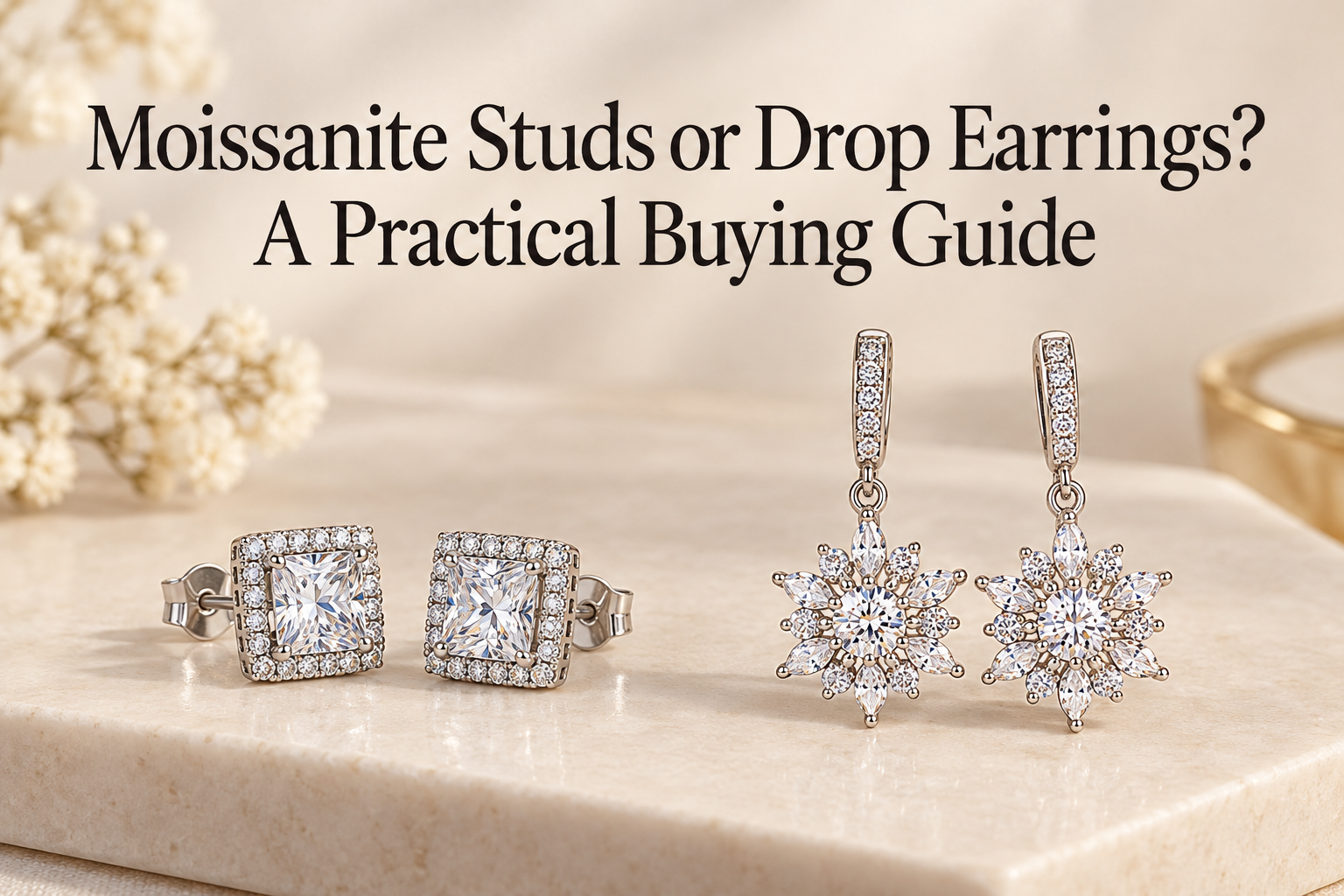
Choose moissanite studs when you want a design centered close to the earlobe; consider drops when you prefer a silhouette extending below it. Then check dimensions, weight per earring, the fastening and component metals. Neither category guarantees comfort, a particular level of sparkle or verified sterling silver.
A close-up can make a pair of earrings look perfectly scaled even when it tells you little about actual size. Instead of choosing only from the brightest photograph, compare how the earrings are built and what the listing really establishes. This guide uses current MSEARTHIA studs and drops as design examples, with missing specifications clearly separated from verified facts.
Studs and drops: what actually changes?
Design
Starting silhouette
Questions before buying
Stud
A design centered near the lobe
Face-up width, projection, post and back type, weight per piece
Drop
A design extending below the lobe
Total length, widest point, connection or hinge, fastening and weight per piece
A drop may have moving elements, but not every drop swings freely. A stud can have a broad halo and be visually prominent. “Stud” does not mean tiny, and “drop” does not mean heavy. Ask for the actual construction and measurements rather than letting the category label answer those questions.
Example one: a geometric halo stud
The Geometric Halo Moissanite Stud Earrings are described as a square cushion-cut look with a geometric halo. Their squared outline is the verified design feature to compare. The surrounding halo contributes to the full visible shape; its footprint is not established by the center-stone label alone.
The current description does not supply millimeter dimensions, weight per earring, post length or a detailed back specification. Some option labels also contain compressed numbers that do not clearly explain the size. Ask what the selected label means and request measurements. Do not infer a per-stone carat amount or total pair weight from an ambiguous string.
Example two: a snowflake-inspired drop
The Moissanite Snowflake Drop Earrings use a snowflake-inspired cluster arrangement and are described as drops with visible movement. That makes them a useful contrast to the stud outline. It does not establish the precise length, weight or metal of the fastening.
Look for a side view and a photograph showing the connection above the decorative section. Ask whether it is articulated and what closure is used. When a scarf, high collar or hairstyle occupies the same area, consider how the drop might meet it. This is a fit question to investigate, not proof that one design will catch or that another cannot.
Five specifications worth asking for
Dimensions in millimeters. Request width and height, plus full drop length where applicable. A ruler photograph can help, but an explicit measurement is easier to compare.
Weight per earring. Clarify whether a listed weight refers to one piece or the pair. Without that figure, there is no factual basis for ranking these examples as lighter or heavier.
The fastening. Ask about post length, back or closure type and how it secures. Do not assume a butterfly back, screw back or leverback from the word “earring.”
Component metals and finish. Verify the decorative body, posts and backs separately, including any plating.
The selected configuration. Confirm whether size and carat labels refer to a center, a complete earring or a pair, and review current price and stock.
Silver-colored is not a complete metal specification
These two examples’ current descriptions identify moissanite and their designs, but do not clearly verify S925 throughout the earrings. A URL containing “925 silver” is not enough to establish every component’s composition. The gemstone, decorative setting, post, back and finish are separate material questions.
If sterling silver is a priority, request explicit confirmation for the exact option and components. A silver mark also does not, by itself, establish a nickel-free alloy or a promise about skin sensitivity. Our sterling-silver and moissanite guide explains how to read material wording without treating surface color as proof.
Choose for your day, then your outfit
For a familiar everyday look, start with a pair whose size and fastening you already know you enjoy. Compare a prospective pair against those measurements. If your day includes a headset, scarf or high neckline, ask how far the design projects or extends. For an occasion, you might prefer a visible drop; do not let the occasion erase the fit checks.
A stud may fit the outline you want while a drop may frame the face differently. Those are visual preferences, not rules about age, gender or face shape. For three ways to build an outfit around studs, read One Pair of Moissanite Earrings, Three Outfit Ideas. For jewelry chosen to remember an achievement, see our personal-milestone pendant story.
Care follows the whole piece
Avoid direct exposure to household cleaners and cosmetics, and store earrings separately so they do not rub against other jewelry. Follow instructions for the complete construction, especially its finish and small connections. An ultrasonic cleaner should not be assumed suitable just because the center stone is moissanite; GIA cautions that vibration can loosen stones. Ask a jeweler if construction or cleaning suitability is unclear.
Explore MSEARTHIA earrings, using the same questions for each design. If a listing leaves a necessary detail unanswered, asking before ordering is more useful than treating a product photo as a measurement.
Frequently asked questions
Are moissanite studs always smaller than drops?
No. Stud and drop describe the general design, not a fixed size. Compare the complete width, height and projection of each pair.
Does a carat label tell me the earring’s weight?
It does not establish the weight of the complete earring. Ask how the stone label is defined and request the finished weight per piece separately.
Can I assume the posts are silver if the setting looks silver?
No. Appearance cannot identify the alloy, and posts or backs may have different specifications. Obtain explicit material information for the selected configuration.
Sources and methodology
Products 639 and 594 were published and in stock when checked on October 10, 2026 (Asia/Taipei). Design examples come from their linked live descriptions; missing dimensions, weight, fastening and component metals have not been invented. Care guidance follows GIA’s Tips on Caring for Jewelry. The cover is an AI-generated editorial comparison, not an exact product photograph, measured scale drawing or documented wear test.
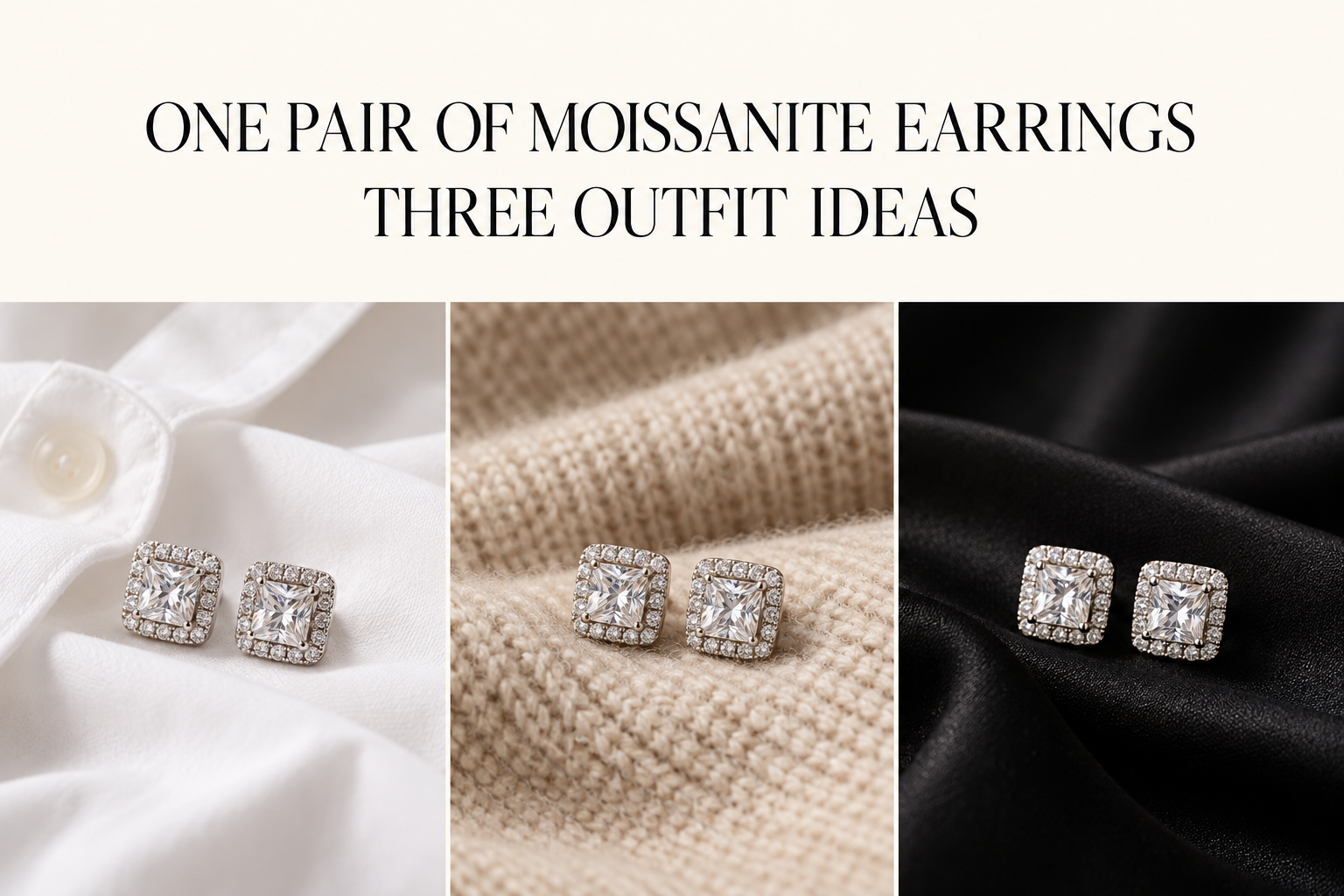
Start with one pair of geometric moissanite studs, then change what surrounds them: a crisp white shirt for a clean look, soft knitwear for a relaxed contrast, or a black evening outfit that lets the earrings become the focal point. The jewelry stays the same; the balance of fabric, neckline and other accessories does the work.
Imagine three invitations in one week: a lunch meeting, a quiet weekend coffee and an evening celebration. Buying a separate jewelry look for each is one option. Another is to choose a familiar pair of earrings and give them three different settings in your wardrobe. The combinations below are editorial outfit suggestions, rather than a documented wear test.
The anchor piece: a geometric halo stud
For a concrete starting point, the Geometric Halo Moissanite Stud Earrings are described as a square cushion-cut look framed by a halo. The squared outline gives these outfit ideas a repeated visual detail, while the halo provides decoration without requiring a dangling silhouette.
The listing identifies the stud design and moissanite, but its current description does not establish exact millimeter dimensions, earring weight or post-and-back metal. Confirm those details before buying if comfort or material is important to you. The cover uses representative earrings as a styling illustration, not a photograph of this exact product.
Look one: the white shirt and a clean line
Begin with a white shirt, straight trousers or dark denim, and a belt or bag with simple hardware. The collar already creates a frame around your face. Let the earrings occupy that space without adding a competing necklace as the first step.
Tuck one side of your hair behind your ear if you want the studs to be visible. If you prefer a more understated finish, leave your hair loose and let the earrings appear in glimpses. This is a styling choice, not a rule about face shape or hair length.
One small adjustment: if the shirt has a busy print, decorative buttons or a contrasting collar, simplify another accessory first. A quieter bag or plain belt can give the earrings room without changing the entire outfit.
Look two: soft knitwear and a little contrast
Try an oatmeal, gray or muted-color sweater with a plain skirt or your favorite jeans. Knitwear has a soft visual texture; the geometric earring outline introduces a sharper detail. That contrast is the idea, rather than matching everything exactly.
A crew neck gives the earrings a relatively uncluttered role around the face. With a V-neck, you might add a simple pendant, but start with the earrings alone and decide whether the neckline needs anything else. If you wear a scarf, check whether it brushes the earrings or catches on the setting.
One small adjustment: repeat the earrings’ visible metal color in a watch or a bag detail if you enjoy a coordinated look. Mixing tones is also an option; consistency is a preference rather than a requirement.
Look three: a black evening outfit and one focal point
A plain black dress, black blouse or tailored jumpsuit can give the same earrings a more deliberate role. Start with an open or simple neckline, then choose whether your focal point is the earrings or a necklace. If the earrings are your choice, keep the next accessory relatively quiet.
You do not need to make every element more ornate because it is evening. Try the familiar studs with a structured clutch, a different hairstyle or a richer fabric texture. Those changes can make the outfit feel intentional while the jewelry remains recognizable.
One small adjustment: check the whole look in ordinary room light before leaving. Strong photographic lighting can exaggerate reflections, so a product photo cannot predict exactly how much sparkle you will see at dinner.
A three-look recipe you can reuse
Outfit
Starting choice
Optional change
White shirt
Earrings with a simple collar and minimal neck jewelry
Tuck hair behind one ear
Soft knitwear
Use the stud outline as a contrast to the fabric
Repeat a metal tone in one accessory
Black evening outfit
Make the earrings one clear focal point
Change hairstyle, bag or fabric texture
If this pair is not your preference
The outfit recipe can work with another pair you already own. For a color-led variation, compare the Blue Asscher-Cut Moissanite Stud Earrings. For a decorative drop silhouette, explore the Moissanite Snowflake Drop Earrings. A drop changes the visual movement of the look, so treat it as an alternative styling direction rather than an identical substitute.
A pair you want to wear often needs more than a pleasing photograph. Check its dimensions, weight, closure, post material and whether the selected option suits you. Avoid assuming that every silver-colored component is sterling silver. Our silver and moissanite buying guide explains what to verify.
Apply fragrance and hair products before putting jewelry on, avoid direct chemical exposure, and store pieces separately when you take them off. For confirmed silver pieces, read the sterling-silver moissanite care guide and follow any finish-specific instructions supplied with the product.
Editorial notes and sources
These outfits are styling proposals from MSEARTHIA, not customer accounts or personal wear-test results. Linked products were published and in stock when checked on October 7, 2026; availability can change. Exact earring measurements and component materials should be confirmed on the selected product. The cover is an AI-generated styling illustration. General chemical-exposure and storage advice follows GIA’s Tips on Caring for Jewelry.