Author: MSEARTHIA Admin

  • Quiet Sparkle or a Statement Piece? Find Your Everyday Jewelry Style

    Quiet Sparkle or a Statement Piece? Find Your Everyday Jewelry Style

    Your everyday jewelry style can start with four choices: what you wear most, how much attention you want the jewelry to draw, whether you enjoy coordinating accessories, and which details catch your eye. Use the questions below to find a starting direction—clean lines, balanced sparkle or a color-led statement—then confirm practical details before buying.

    Some days you want a familiar detail you barely think about. Other days you want a ring that becomes the conversation. Both can belong in the same jewelry box. This short editorial quiz helps you choose for the version of your day you actually have, rather than for a permanent personality type.

    How to use this guide

    Choose A, B or C for each question and note which letter appears most often. If you have a tie, read both directions. The choices describe styling preferences; they are not a psychological assessment, and they cannot predict comfort or how a piece will look on your hand.

    1. What does an ordinary outfit look like?

    • A: Simple shapes and a small palette—a shirt, plain knit or tailored basics.
    • B: Familiar basics with one decorative detail, such as texture, a patterned scarf or a favorite bag.
    • C: Color, contrast or a strong silhouette; I like an outfit to have a visible point of view.

    2. When someone notices your jewelry, what feels right?

    • A: A close-up detail rather than the first thing they see.
    • B: A little sparkle that completes the outfit.
    • C: A piece they might ask me about.

    3. How much do you enjoy building a jewelry combination?

    • A: I prefer choosing one piece and getting on with my day.
    • B: I enjoy a repeatable pair of accessories that works with several outfits.
    • C: I like changing the focal point depending on my mood or occasion.

    4. Which detail makes you pause in a product photo?

    • A: A crisp geometric outline or a smooth metal frame.
    • B: A decorative halo or a repeated shape that feels balanced.
    • C: A colored center, an unusual silhouette or a design with several points of interest.

    Mostly A: start with a clean outline

    Your answers suggest that the arrangement of lines matters more than adding decoration everywhere. Begin with one piece, then see whether you want anything else. A geometric ring can provide a clear focal point without asking you to coordinate several accessories.

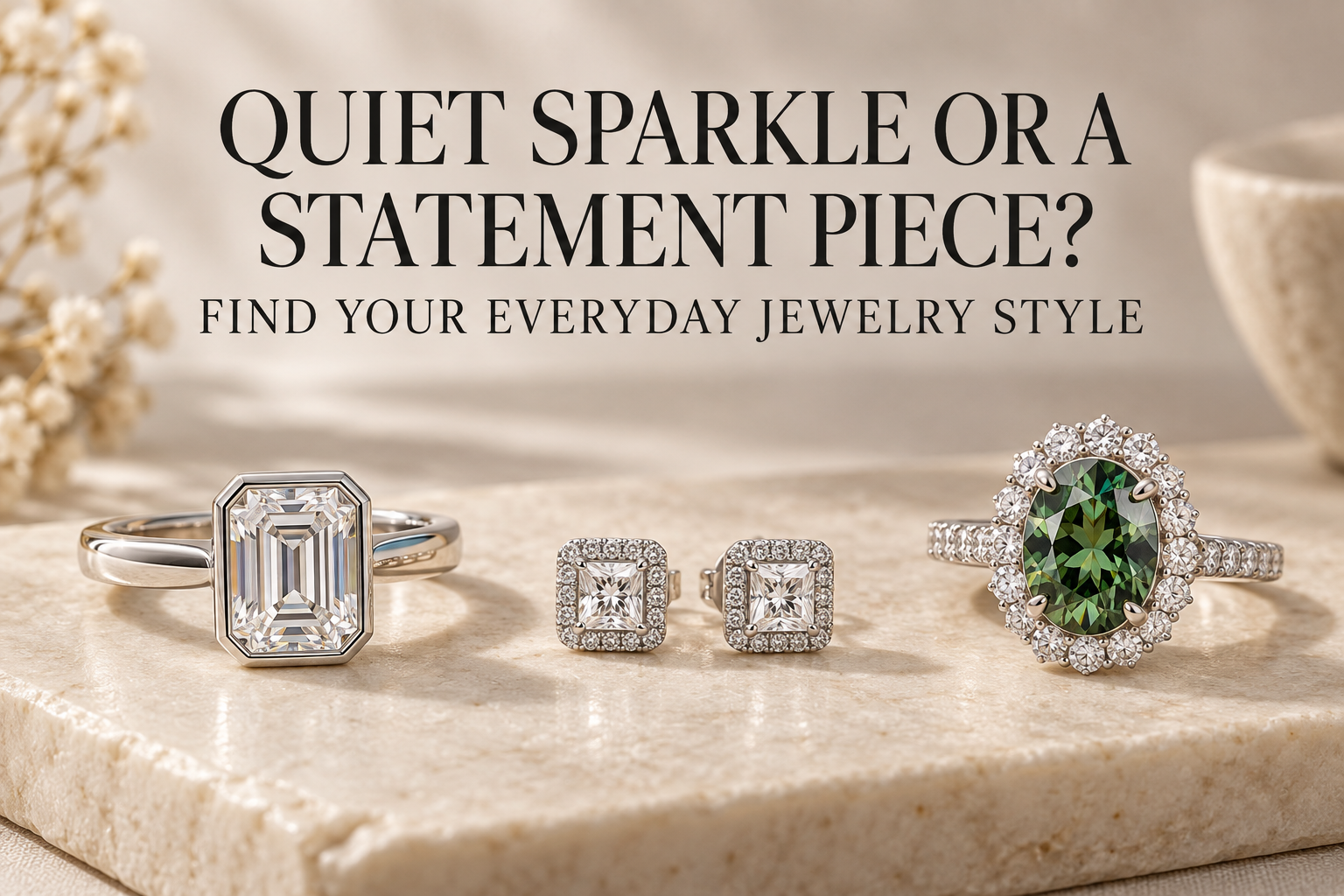
    The Emerald Cut Moissanite Bezel Ring is one example to explore: its current description identifies a 2 ct emerald-cut moissanite, a bezel setting and S925 sterling silver. The white gold tone and champagne gold tone choices describe the finish, rather than solid-gold construction.

    The clean-outline direction does not promise low sparkle or a small ring. Check the actual dimensions and side profile. If you love the lines but want less visual presence, ask about measured size rather than assuming the label “bezel” makes a piece subtle.

    Mostly B: start with a repeatable sparkle detail

    Your answers point toward a familiar piece that can move between outfits. Try choosing earrings as the repeating detail, then change the neckline, fabric or hairstyle around them. You can build a recognizable look without using the same clothes every day.

    The Geometric Halo Moissanite Stud Earrings offer a square cushion-cut look framed by a halo. Their geometric outline is the reason for including them here; exact dimensions, weight and component metals should be confirmed separately.

    Try the three combinations in One Pair of Moissanite Earrings, Three Outfit Ideas. Treat “balanced” as your preference for the whole outfit, not a guaranteed measurement or performance claim about the earrings.

    Mostly C: start with color or a distinctive focal point

    Your answers suggest that you enjoy giving one piece a more visible role. Choose a colored center or a distinctive outline, then decide how much else the outfit needs. You might repeat the color in one detail, or let it stand alone against a neutral outfit.

    The Green Moissanite Halo Ring is a color-led example. Its description identifies an oval green moissanite, halo, pavé band and S925 sterling silver, with current 1 ct and 2 ct center options. The green center and surrounding detail support this style direction; they do not establish the ring’s exact millimeter footprint.

    A statement can come from color rather than size. Compare the ring with what you actually wear and review it in a range of photographs or a video when available. Your favorite image may show lighting quite different from a normal room.

    If your answers are mixed

    A tie is useful. You might want a clean ring for a workday and a colored pair of earrings for a dinner. Instead of trying to fit one label, choose one ordinary-day combination and one occasion combination. Start with jewelry you own before adding another piece.

    For a gift, answer from the recipient’s visible preferences rather than your own. Look at their usual jewelry and outfits, and ask about size or materials when necessary. The quiz cannot substitute for a conversation about what they like.

    Before turning a preference into an order

    1. Confirm dimensions: ask for millimeter measurements and side views if the listing does not provide them.
    2. Check fit: use the ring size guide and the exact product selector.
    3. Check materials: stone, base metal, finish and earring posts are separate details. Read the silver and moissanite material guide.
    4. Consider daily activities: choose based on your actual routine and remove fine jewelry for tasks involving impacts or chemicals.
    5. Confirm the live option: availability and price can change by variant.

    Explore the rings collection or earrings collection with your preferred direction in mind. You are choosing a starting point, and you can change it whenever your outfit or day calls for something else.

    Editorial notes and sources

    This is an editorial preference exercise created by MSEARTHIA, not a validated personality test or a customer survey. The three product examples were checked on October 7, 2026 and were published and in stock at that time. Material claims are limited to explicit product wording. The cover is an AI-generated editorial illustration. General chemical-exposure advice follows GIA’s Tips on Caring for Jewelry; factual product details come from the linked live listings.
  • One Pair of Moissanite Earrings, Three Outfit Ideas

    One Pair of Moissanite Earrings, Three Outfit Ideas

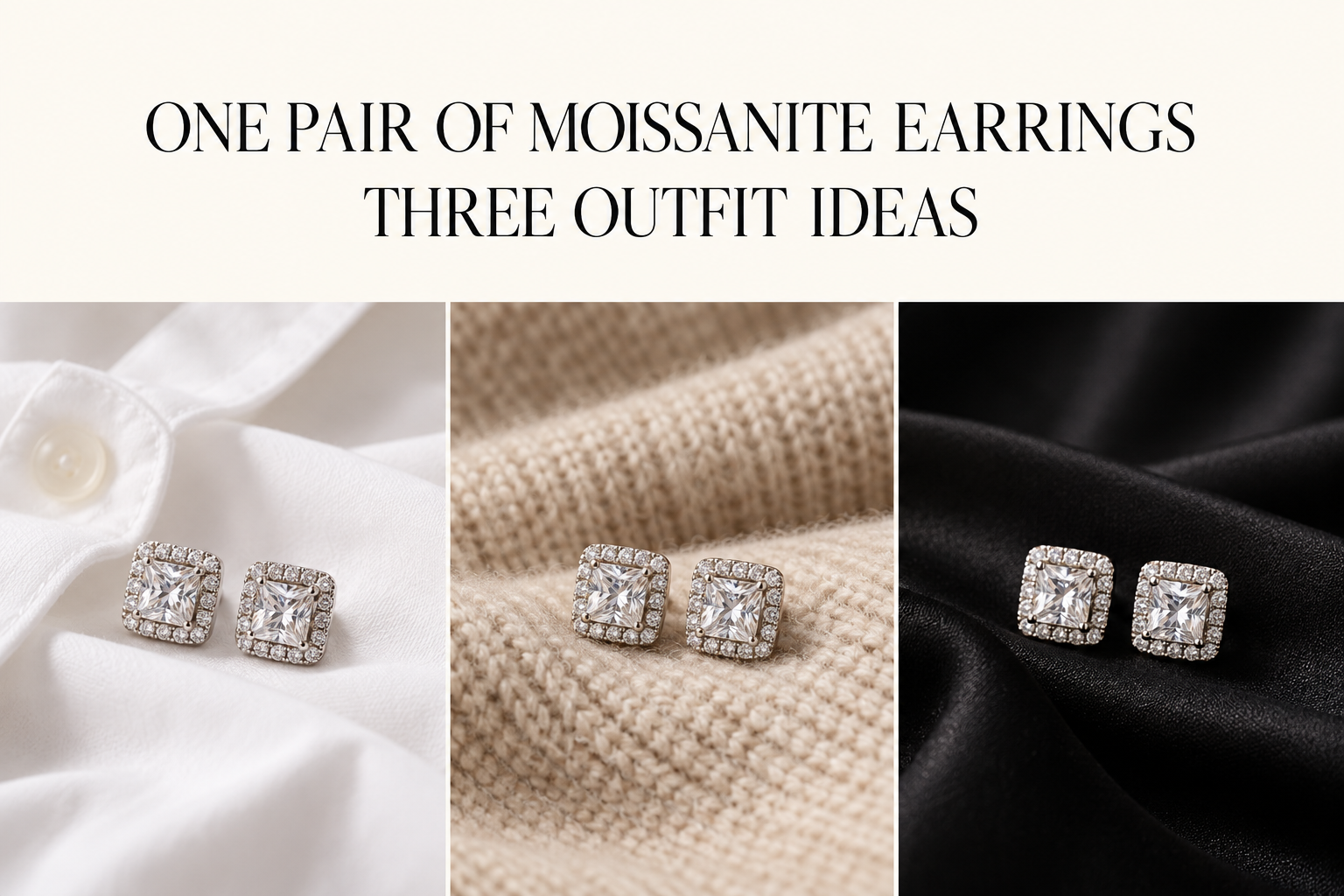
    Start with one pair of geometric moissanite studs, then change what surrounds them: a crisp white shirt for a clean look, soft knitwear for a relaxed contrast, or a black evening outfit that lets the earrings become the focal point. The jewelry stays the same; the balance of fabric, neckline and other accessories does the work.

    Imagine three invitations in one week: a lunch meeting, a quiet weekend coffee and an evening celebration. Buying a separate jewelry look for each is one option. Another is to choose a familiar pair of earrings and give them three different settings in your wardrobe. The combinations below are editorial outfit suggestions, rather than a documented wear test.

    The anchor piece: a geometric halo stud

    For a concrete starting point, the Geometric Halo Moissanite Stud Earrings are described as a square cushion-cut look framed by a halo. The squared outline gives these outfit ideas a repeated visual detail, while the halo provides decoration without requiring a dangling silhouette.

    The listing identifies the stud design and moissanite, but its current description does not establish exact millimeter dimensions, earring weight or post-and-back metal. Confirm those details before buying if comfort or material is important to you. The cover uses representative earrings as a styling illustration, not a photograph of this exact product.

    Look one: the white shirt and a clean line

    Begin with a white shirt, straight trousers or dark denim, and a belt or bag with simple hardware. The collar already creates a frame around your face. Let the earrings occupy that space without adding a competing necklace as the first step.

    Tuck one side of your hair behind your ear if you want the studs to be visible. If you prefer a more understated finish, leave your hair loose and let the earrings appear in glimpses. This is a styling choice, not a rule about face shape or hair length.

    One small adjustment: if the shirt has a busy print, decorative buttons or a contrasting collar, simplify another accessory first. A quieter bag or plain belt can give the earrings room without changing the entire outfit.

    Look two: soft knitwear and a little contrast

    Try an oatmeal, gray or muted-color sweater with a plain skirt or your favorite jeans. Knitwear has a soft visual texture; the geometric earring outline introduces a sharper detail. That contrast is the idea, rather than matching everything exactly.

    A crew neck gives the earrings a relatively uncluttered role around the face. With a V-neck, you might add a simple pendant, but start with the earrings alone and decide whether the neckline needs anything else. If you wear a scarf, check whether it brushes the earrings or catches on the setting.

    One small adjustment: repeat the earrings’ visible metal color in a watch or a bag detail if you enjoy a coordinated look. Mixing tones is also an option; consistency is a preference rather than a requirement.

    Look three: a black evening outfit and one focal point

    A plain black dress, black blouse or tailored jumpsuit can give the same earrings a more deliberate role. Start with an open or simple neckline, then choose whether your focal point is the earrings or a necklace. If the earrings are your choice, keep the next accessory relatively quiet.

    You do not need to make every element more ornate because it is evening. Try the familiar studs with a structured clutch, a different hairstyle or a richer fabric texture. Those changes can make the outfit feel intentional while the jewelry remains recognizable.

    One small adjustment: check the whole look in ordinary room light before leaving. Strong photographic lighting can exaggerate reflections, so a product photo cannot predict exactly how much sparkle you will see at dinner.

    A three-look recipe you can reuse

    OutfitStarting choiceOptional change
    White shirtEarrings with a simple collar and minimal neck jewelryTuck hair behind one ear
    Soft knitwearUse the stud outline as a contrast to the fabricRepeat a metal tone in one accessory
    Black evening outfitMake the earrings one clear focal pointChange hairstyle, bag or fabric texture

    If this pair is not your preference

    The outfit recipe can work with another pair you already own. For a color-led variation, compare the Blue Asscher-Cut Moissanite Stud Earrings. For a decorative drop silhouette, explore the Moissanite Snowflake Drop Earrings. A drop changes the visual movement of the look, so treat it as an alternative styling direction rather than an identical substitute.

    Browse the earrings collection, or use our everyday jewelry style guide to decide whether you want a familiar detail, color accent or more noticeable silhouette.

    The practical details behind a repeat outfit

    A pair you want to wear often needs more than a pleasing photograph. Check its dimensions, weight, closure, post material and whether the selected option suits you. Avoid assuming that every silver-colored component is sterling silver. Our silver and moissanite buying guide explains what to verify.

    Apply fragrance and hair products before putting jewelry on, avoid direct chemical exposure, and store pieces separately when you take them off. For confirmed silver pieces, read the sterling-silver moissanite care guide and follow any finish-specific instructions supplied with the product.

    Editorial notes and sources

    These outfits are styling proposals from MSEARTHIA, not customer accounts or personal wear-test results. Linked products were published and in stock when checked on October 7, 2026; availability can change. Exact earring measurements and component materials should be confirmed on the selected product. The cover is an AI-generated styling illustration. General chemical-exposure and storage advice follows GIA’s Tips on Caring for Jewelry.

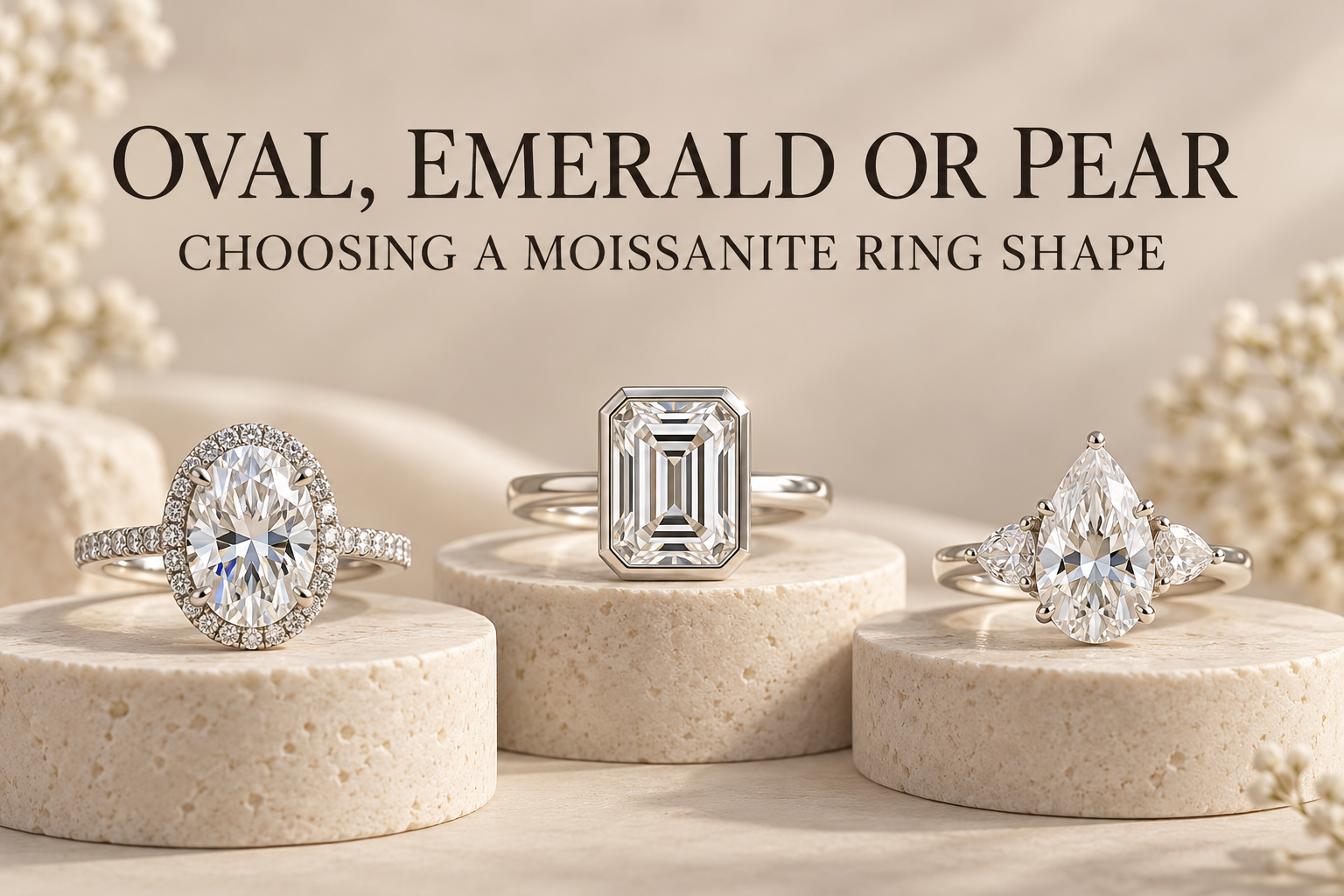
  • Oval, Emerald or Pear: Choosing a Moissanite Ring Shape

    Oval, Emerald or Pear: Choosing a Moissanite Ring Shape

    Choose oval moissanite for a rounded, elongated outline; emerald cut for straight lines and a step-faceted appearance; or pear shape for a distinctive teardrop silhouette. Then compare the whole ring: its setting, profile, dimensions, metal and size options. Shape alone does not determine comfort, quality or how large a ring will look.

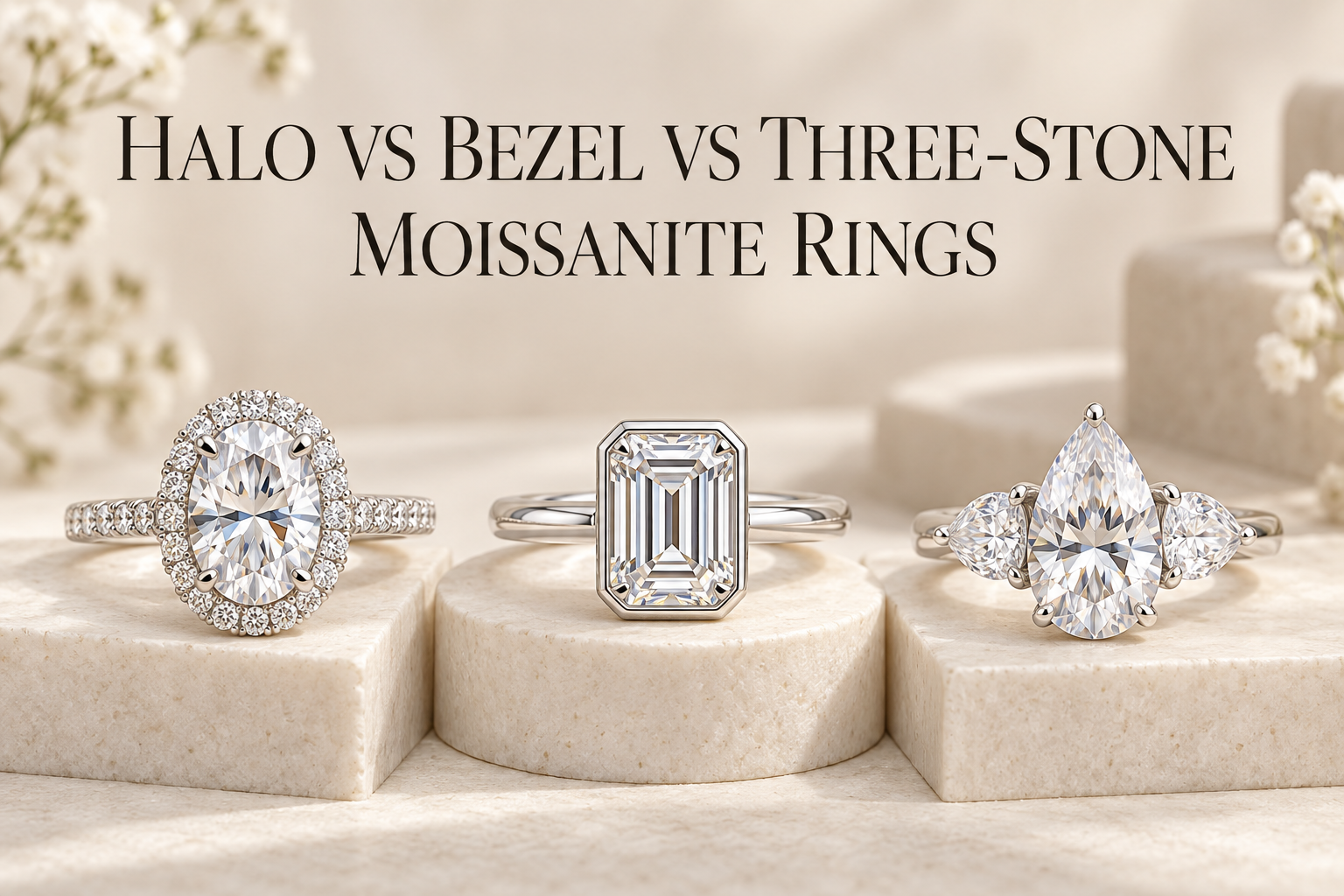
    MSEARTHIA’s current collection offers a useful starting point: an oval halo, an emerald-cut bezel and a pear-cut three-stone ring. These are different complete designs, so this guide separates the center stone’s shape from the surrounding metal and accent stones. That makes it easier to identify what you actually like in a product photograph.

    Three moissanite ring shapes at a glance

    ShapeWhat you see firstWhat to check
    OvalA continuous curved outline with an elongated profileLength-to-width balance, moving reflections and the halo’s total footprint
    Emerald cutA rectangular outline with clipped corners and ordered facetsFacet reflections, corner coverage and the bezel’s width
    PearA rounded end tapering to one pointOutline symmetry, tip protection and the side stones’ arrangement

    Oval: a curved outline with a framed sparkle

    An oval has no pointed end and gives the ring a continuous, rounded silhouette. A shorter oval looks fuller; a longer oval looks slimmer. Neither proportion is automatically better. Start by asking whether you prefer a compact top view or a longer shape running along the finger.

    The Oval Moissanite Halo Ring pairs its center with a halo and a slender accent-stone band. Its live selector currently offers center-stone labels of 1 ct, 2 ct and 3 ct. The halo contributes to the visible outline, so the complete ring can look substantially different from a plain oval solitaire even when the center label is the same.

    If you prefer color, the Green Moissanite Halo Ring offers an oval green center with 1 ct and 2 ct options. Its description explicitly identifies S925 sterling silver. This gives you a verified silver-material example while showing how color changes the overall impression of the same outline.

    Emerald cut: geometry and a clean metal frame

    “Emerald cut” names a cutting style, not the stone’s mineral. An emerald-cut moissanite remains moissanite. The familiar rectangular outline, clipped corners and step-style facets create a different visual rhythm from the smaller, scattered reflections often associated with brilliant-style cutting. Look for a pleasing pattern as the ring moves rather than judging it from one bright photograph.

    The Emerald Cut Moissanite Bezel Ring currently identifies a 2 ct center, a bezel setting and S925 sterling silver. White gold tone and champagne gold tone are finish choices in the selector; the description makes clear that these names do not mean solid gold.

    A bezel emphasizes the stone’s outline with a metal rim. If you like the rectangular geometry but want more accent sparkle, compare a halo version separately: that is a change in the overall design, not a change in the definition of emerald cut. Read our halo, bezel and three-stone comparison to separate those decisions.

    Pear: a teardrop with a clear direction

    A pear combines a rounded end with a single point. That asymmetry gives the ring a direction on the hand. You can prefer the point toward the fingertip or toward the wrist; the best orientation is the one you enjoy and find comfortable.

    The Pear Cut Moissanite Three-Stone Ring places its center between side stones and currently lists 1 ct, 2 ct and 3 ct center options. The side stones add to the overall composition. Compare that full arrangement with the oval halo rather than assuming the pear center alone accounts for every difference in width or sparkle.

    Inspect how the pointed end is held. A protective prong or surrounding metal should support a vulnerable tip, but a product name cannot establish the quality of its workmanship. Ask for a close-up or side view if the setting is unclear. Remove fine jewelry for tasks that expose it to impacts or heavy pressure.

    Compare measurements, not only carat labels

    A carat label does not tell you the ring’s exact visible length, width or height. Moissanite sellers may also use diamond-equivalent size descriptions. Check how the listing defines its label, and ask for dimensions in millimeters when size on the hand matters. Without those measurements, there is no reliable basis for declaring one of these products larger than another at the same nominal carat option.

    Compare the center dimensions and the complete ring head separately. A halo adds a frame; side stones extend the composition; a bezel adds a visible rim. A side photograph also reveals whether the ring sits high enough to catch on clothing or to affect how a neighboring band fits.

    Keep the silver-material check separate

    Moissanite identifies the gemstone. S925 or sterling silver identifies the metal. “White gold tone” identifies appearance unless the listing provides a separate solid-gold statement. Among the examples above, the green oval halo and emerald-cut bezel explicitly state S925 sterling silver in their descriptions. Other examples should be checked through their material attributes and seller confirmation for the selected variant.

    For more detail, read Sterling Silver and Moissanite Jewelry: A Practical Buying Guide. Once you choose a piece, follow a care routine suited to both the silver and any surface finish in our silver moissanite cleaning guide.

    A practical order for making your choice

    1. Choose the outline: curved oval, geometric emerald cut or directional pear.
    2. Choose the surrounding design: halo, bezel or three-stone, based on the complete top and side views.
    3. Review movement: request a video if reflections or dark areas are difficult to judge from photographs.
    4. Verify dimensions and materials: confirm millimeter measurements, base metal and finish for your option.
    5. Confirm fit and availability: use the live selector and our ring size guide before ordering.

    Frequently asked questions

    Is an emerald-cut moissanite a green emerald?

    No. Emerald cut describes the cutting style. The stone material is moissanite, and its color is a separate product detail.

    Which moissanite ring shape looks largest?

    You need actual dimensions and the complete setting footprint to make a useful comparison. A nominal carat label alone cannot establish which of these rings will look largest.

    Which way should a pear ring point?

    Either orientation can be worn. Try the point toward the fingertip and toward the wrist, then choose the look and feel you prefer.

    Does a silver-colored ring always use sterling silver?

    No. Check an explicit S925 or sterling-silver statement and confirm the selected variant. The visible color alone does not identify the base metal.

    Sources and methodology

    GIA’s cutting-style definitions inform the distinction between an outline and a facet arrangement; its setting guidance informs the inspection of metal support. These general design principles are applied here to named moissanite products, without transferring diamond grading claims to moissanite. MSEARTHIA product descriptions, options, stock status and links were checked on October 6, 2026. Prices and variant availability should always be confirmed on the live page.

  • Halo vs Bezel vs Three-Stone Moissanite Rings

    Halo vs Bezel vs Three-Stone Moissanite Rings

    Choose a halo for the strongest visual spread and extra sparkle, a bezel for a smooth modern outline with fewer exposed stone edges, or a three-stone design for added width and a center-with-side-stones composition. These terms are not perfectly parallel: bezel describes how a stone is held, while halo and three-stone usually describe the arrangement of stones. One ring can combine them.

    DesignVisual effectEveryday consideration
    HaloFrames the center with smaller stones for more sparkle and apparent spreadMore small settings and spaces to inspect and clean
    BezelDefines the stone with a clean metal rimSmoother edge and fewer snag points, but more of the stone’s perimeter is covered
    Three-stoneAdds two side stones for width, balance and symbolismMore stones and setting points than a simple solitaire

    First, separate setting type from setting style

    A setting is the metal structure that secures a gemstone. A bezel is a thin rim of metal around the stone’s edge; prongs are separate metal claws. A setting style describes the overall arrangement, such as a solitaire, halo or three-stone ring. This distinction explains why a three-stone ring can use bezels, prongs or a mixture, and why a three-stone design can also include a halo.

    Product names often use “setting” more loosely in everyday shopping. The practical question is not which label wins, but what the ring physically contains: how many stones, how each one is held, how high the design sits and how much detailed cleaning it needs.

    Halo moissanite rings: maximum visual sparkle

    A halo surrounds the center stone with a frame of smaller accent stones. The extra outline can make the center area appear larger and brighter from above. It is a natural match for moissanite when the goal is conspicuous sparkle, a defined silhouette or a more decorative engagement-ring look.

    The trade-off is detail. Small stones create more tiny settings and spaces where lotion, soap residue and lint can collect. They should be cleaned gently and checked if the ring takes an impact. The Oval Moissanite Halo Ring is a clear MSEARTHIA example, with an oval center framed by a halo and S925 sterling silver listed as the metal.

    Bezel moissanite rings: a smooth, defined outline

    A bezel wraps a metal rim around all or part of the stone’s perimeter. Compared with exposed prongs, that rim can shield more of the edge and reduce snagging on clothing or gloves. The result often looks streamlined and contemporary, which suits shoppers who prefer crisp geometry over a heavily decorated frame.

    A bezel also covers more of the stone’s edge and can admit less light from the side than an open prong setting. That does not automatically make the ring dull: cut quality, cleaning, the opening beneath the stone and the complete design all influence its appearance. The Emerald Cut Moissanite Bezel Ring pairs a geometric emerald-cut center with a clean S925 sterling-silver bezel.

    Three-stone moissanite rings: width, balance and meaning

    A three-stone design places a center gemstone between two side stones. The side stones can extend the composition across the finger, repeat the center shape or introduce contrast. Many people associate the three stones with past, present and future, but the design works just as well as a visual choice without a symbolic meaning.

    Three stones mean more edges and setting points than a simple solitaire, so look closely at symmetry and how the stones meet. The Pear Cut Moissanite Three-Stone Ring uses a pear-shaped center with two side stones and lists S925 sterling silver. For a hybrid example, the Oval Three-Stone Moissanite Halo Ring combines a three-stone arrangement with halo detailing.

    Which design fits your priorities?

    • Choose halo when top-view sparkle and a larger-looking center composition matter most.
    • Choose bezel when you prefer a smooth perimeter, a modern line and less exposed stone edge.
    • Choose three-stone when you want visual width, side-stone contrast or the traditional three-part symbolism.
    • Choose a hybrid when you enjoy both a multi-stone layout and a decorative halo, while accepting the added cleaning detail.

    Lifestyle should narrow the choice, not dictate it. A well-made bezel can be practical for frequent wear, but no fine ring is impact-proof. A halo can suit everyday use when cared for properly. A three-stone ring can be low or high profile depending on its gallery and prongs. Inspect the actual product from the top and side rather than relying on the category name alone.

    Five checks before you choose

    1. View the profile. Top photos show the design, but side photos reveal height and how the center is supported.
    2. Count the maintenance points. More accent stones usually mean more small spaces and settings to monitor.
    3. Check the metal. Moissanite describes the stone; S925 or sterling silver describes the base metal.
    4. Confirm the selected variant. Carat labels, color, size, price and availability can change with the option.
    5. Get the fit right. A wider or heavier top can feel different on the finger; use our ring size guide as a starting point.

    Frequently asked questions

    Does a halo make a moissanite look bigger?

    A halo increases the visible outline around the center and can make the center composition appear larger from above. It does not change the center stone’s actual dimensions or carat label.

    Is a bezel always better for everyday wear?

    A bezel has fewer exposed edges and snag points than many prong designs, but workmanship, ring profile, metal condition and the wearer’s activities still matter. Remove fine jewelry for hard impacts, chemicals and abrasive work.

    Can a three-stone ring also have a halo?

    Yes. Three-stone describes the main stone arrangement, while a halo describes an accent-stone frame. A design can combine both, as shown by MSEARTHIA’s Oval Three-Stone Moissanite Halo Ring.

    Which style is easiest to clean?

    A simpler design with fewer stones and open access is generally easier to clean than a detailed halo. A bezel may have fewer snag points, but residue can still collect beneath or around the setting, so construction matters more than the label alone.

    Continue your research: read How to Choose a Moissanite Ring for stone, metal and seller checks, or use the Ring Size Guide before selecting a variant.

    Sources and methodology

    The technical distinction between a stone-holding setting and an overall setting style follows GIA’s ring-setting guide. MSEARTHIA product descriptions, material statements and live variants were checked on October 2, 2026. Product examples explain visible construction; they are not laboratory grading claims.

  • Ring Size Guide: How to Measure at Home

    Ring Size Guide: How to Measure at Home

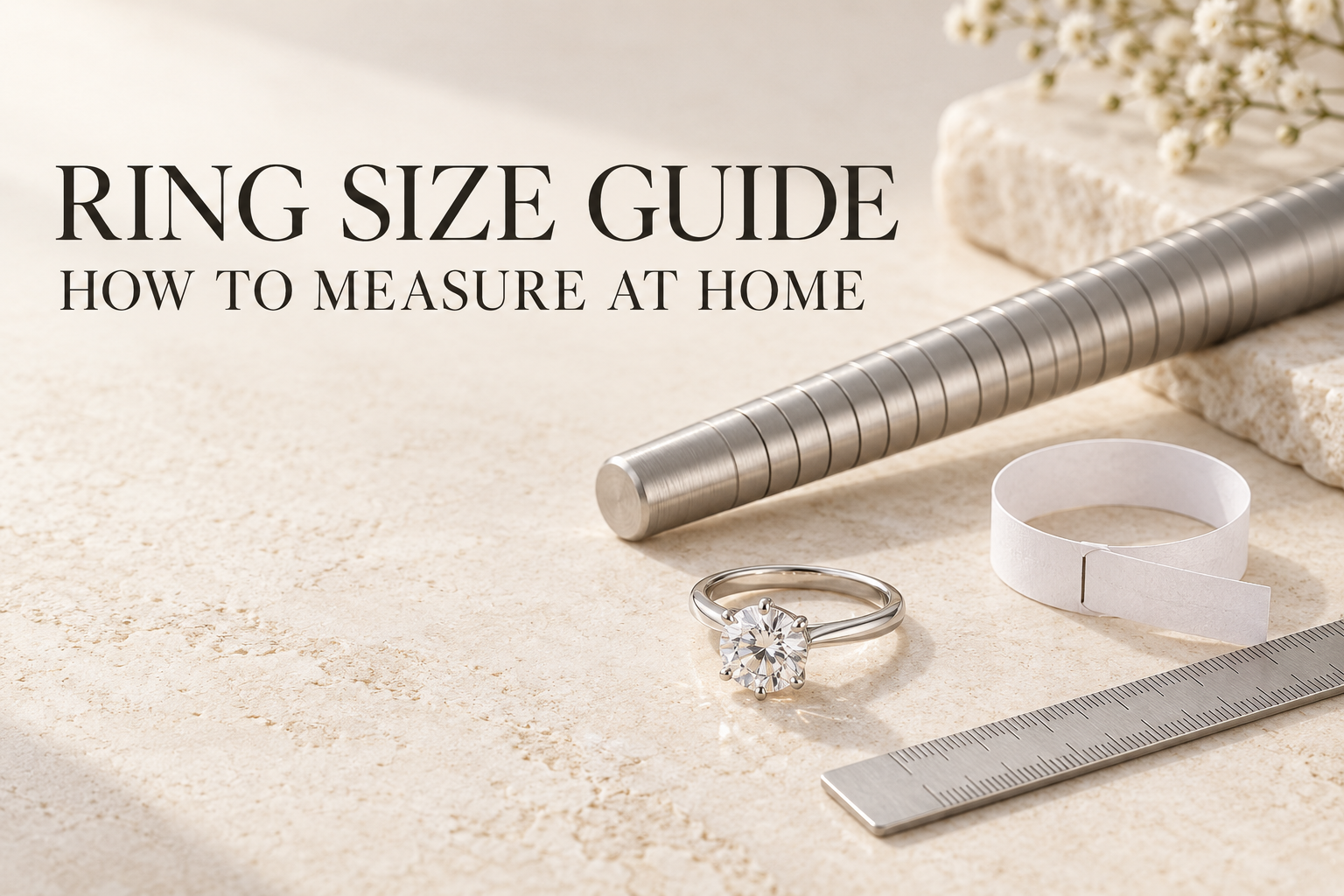
    The most reliable at-home starting point is to measure the inside diameter of a ring that already fits the intended finger. If you do not have one, measure the finger’s circumference with a flexible tape or a flat paper strip. Record the result in millimeters, repeat it at different times, and confirm professionally when the purchase is difficult to resize or especially important.

    The short answer

    • Best home method: measure the inner diameter of a well-fitting ring in millimeters.
    • Second method: measure the finger’s circumference with a non-stretch paper strip or flexible tape.
    • Measure the correct finger: the same finger on the opposite hand can be a different size.
    • Repeat: check two or three times when your hands are at a comfortable, normal temperature.
    • Between sizes: the larger option is often more comfortable, but band width and knuckle shape can change the decision.

    Method 1: measure a ring that already fits

    This method avoids pulling a strip too tightly around the finger. Choose a round ring that fits the exact finger where the new ring will be worn. Place it flat on a ruler marked in millimeters, then measure straight across the widest part of the inside opening—from inner edge to inner edge. Do not include the metal.

    1. Use a ring with a similar band width if possible.
    2. Measure the inside diameter at the center, not along an angled line.
    3. Read to the nearest tenth of a millimeter if your ruler or caliper permits.
    4. Repeat from a second direction to check that the ring is round.
    5. Compare the result with the seller’s own size chart; conversion charts can vary slightly.

    If you are measuring from a printed chart, print at 100% or “actual size” and verify its scale marker with a physical ruler. “Fit to page” can change every circle on the sheet.

    Method 2: measure your finger

    Cut a narrow, straight paper strip or use a soft measuring tape. Wrap it around the base of the intended finger so it sits close to the skin without squeezing. Mark where the ends meet, lay the strip flat, and measure the length in millimeters. That length is the finger circumference.

    Paper is usually easier to control than elastic string. Stretchy material can produce an artificially small reading. If the knuckle is noticeably wider than the finger base, measure both places. The ring needs to pass over the knuckle while remaining comfortable at the base.

    SituationWhat to doWhy it matters
    Hands feel coldWait until they return to a normal temperatureCold fingers can measure smaller
    Hands are hot or swollenMeasure again laterHeat, exercise and fluid retention can increase size
    Large knuckleMeasure the knuckle and finger baseThe ring must pass one and fit the other
    Wide bandAsk whether to size upMore metal contacts the finger and can feel tighter
    Between sizesCheck half-size availability or choose with the band style in mindA small change can affect comfort and security

    Why one measurement may not be enough

    Finger size is not perfectly fixed. Temperature, time of day, recent activity and temporary swelling can alter the result. Measure on at least two occasions rather than trusting one tight wrap. A comfortable ring should slide over the knuckle with gentle resistance and sit securely without leaving a deep indentation.

    Band shape matters too. A broad statement ring often feels tighter than a narrow band at the same labeled size. A ring stack occupies more space on the finger, while an adjustable opening changes how a design behaves. Treat the number as a fit starting point, not a universal promise across every ring.

    Common ring-sizing mistakes

    • Measuring the wrong hand: dominant and non-dominant hands are not always identical.
    • Including the ring’s metal: diameter is measured across the empty inner opening.
    • Pulling the strip tight: the result may fit on paper but feel restrictive in use.
    • Mixing diameter and circumference: label the number before using a chart.
    • Rounding too early: keep the millimeter measurement until you compare with the size chart.
    • Assuming every country uses the same system: US numbers, UK letters and regional charts are different labels for physical measurements.

    How to use a MSEARTHIA product selector

    Available sizes depend on the design and current variant. For example, the Colored Round Moissanite Halo Ring currently lists US 5–10 and offers a half-size contact option. The 2 Carat Radiant-Cut Moissanite Ring for Men currently lists US 8–12 with a half-size contact option. The Men’s 1 Carat Square-Set Moissanite Ring also lists US 8–12 and identifies an adjustable option.

    Those ranges are examples, not a site-wide rule. Always use the live selector on the product page before ordering, because sizes, finishes and availability can change by variant.

    When to ask a jeweler

    Professional sizing is worth the extra step for a surprise engagement ring, a wide or unusually shaped band, a ring that cannot easily be resized, or a finger with a pronounced knuckle. A jeweler can compare several sample bands and account for how the specific design feels, which a paper strip cannot reproduce.

    Frequently asked questions

    Is inside diameter or finger circumference better?

    Inside diameter from a ring that already fits is usually the cleaner home measurement. Finger circumference is useful when no suitable ring is available, but the strip must not stretch or compress the finger.

    What should I do if I am between two sizes?

    Check whether a half size is available. If not, the larger size is often the safer starting point, especially for a wider band, but knuckle shape and the ring’s construction should guide the final choice.

    Can I measure secretly for a gift?

    Measure the inside diameter of a ring the recipient wears on the same finger. If that is not possible, ask someone close to them or choose a design with a clear exchange or adjustment path rather than guessing from height or clothing size.

    Does a wide ring need a different size?

    A wide band can feel tighter because more metal contacts the finger. Ask for design-specific guidance and, when possible, try a sample with a similar width.

    Choose the design next: compare visual impact and everyday wear in Halo vs Bezel vs Three-Stone Moissanite Rings, then review How to Choose a Moissanite Ring.

    Sources and methodology

    The measurement steps follow Tiffany & Co.’s public ring-size guidance for measuring an existing ring or a finger. MSEARTHIA product links and live size options were checked on October 2, 2026. Because manufacturing tolerances and fit preferences differ, the seller’s chart and design-specific advice take priority over a generic conversion.

  • How to Clean Sterling Silver Moissanite Jewelry Safely

    How to Clean Sterling Silver Moissanite Jewelry Safely

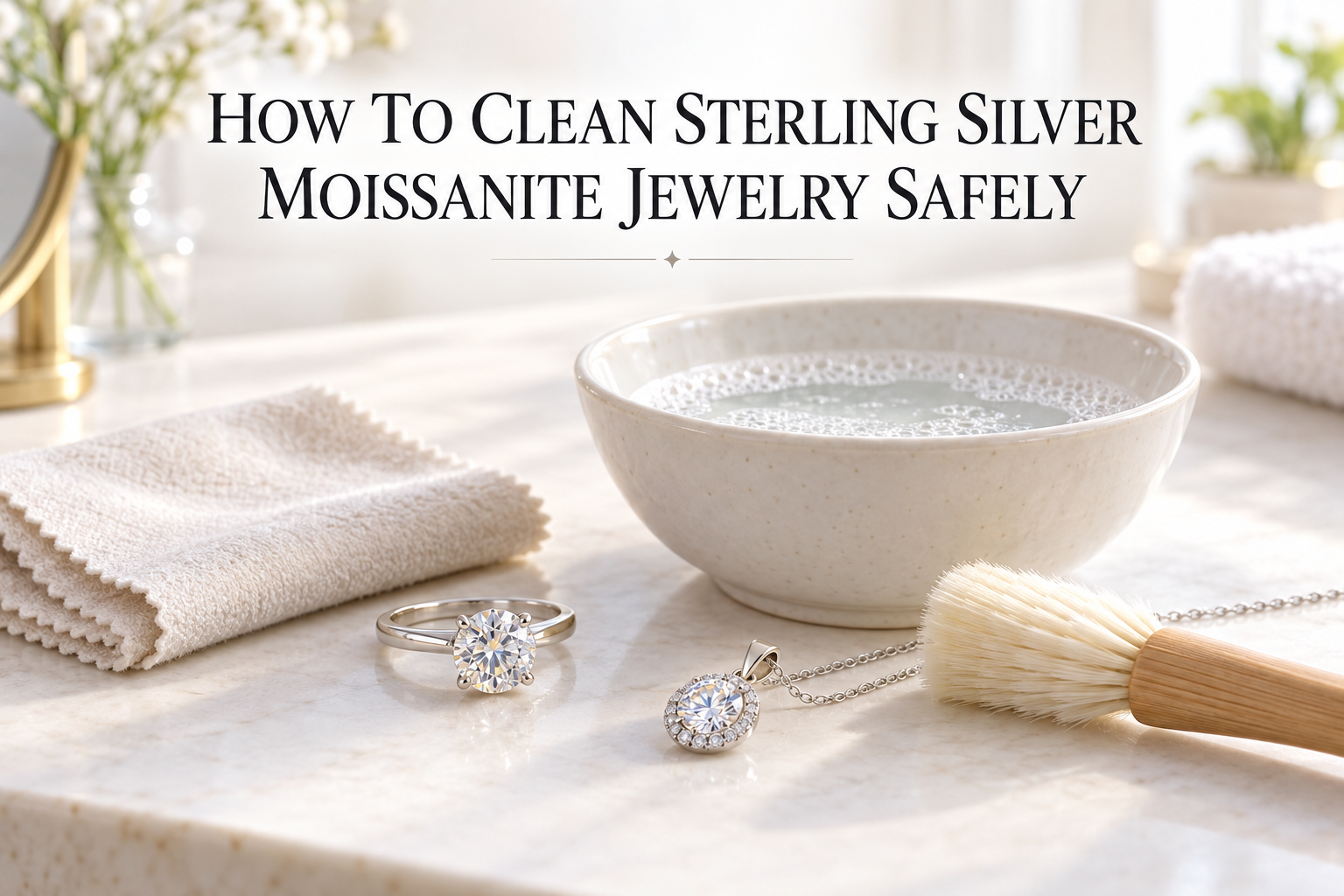
    For routine cleaning, soak sterling silver moissanite jewelry briefly in lukewarm water with a small amount of mild dish soap, brush gently with a very soft brush, rinse carefully and dry completely with a lint-free cloth. Check the product’s plating and construction first, because a method that is gentle on moissanite may still wear a plated or delicate silver surface.

    Safe routine at a glance

    1. Confirm the metal, plating and setting.
    2. Prepare lukewarm water with a few drops of mild dish soap.
    3. Soak briefly, then brush gently around and behind the setting.
    4. Rinse in a bowl or with the drain securely closed.
    5. Pat dry and let the piece dry completely before storage.
    6. Stop if a stone moves, a prong catches or plating appears damaged.

    First identify what you are cleaning

    Moissanite and sterling silver need to be considered separately. Moissanite is a hard gemstone material. Sterling silver is the softer metal that holds it, and that silver may have a rhodium, yellow-gold or rose-gold surface layer. The safest routine protects the most delicate part of the complete piece, not only the stone.

    If a listing only says “silver tone,” do not assume the base is sterling silver. If the piece is S925, do not assume it is unplated. Read Sterling Silver and Moissanite Jewelry: A Practical Buying Guide if you need help separating the stone, base metal and finish.

    What you need

    • A small bowl of lukewarm water
    • A few drops of mild, lotion-free dish soap
    • A very soft toothbrush or jewelry brush
    • A clean lint-free or microfiber cloth
    • A second bowl of clean water for controlled rinsing

    Use separate bowls for small earrings, pendants and rings. That reduces the chance of losing a piece down the drain. Clean one item at a time so chains do not tangle and stones do not rub against one another.

    Step-by-step cleaning method

    1. Inspect before soaking

    Look at the prongs, bezel edge, clasp and any small accent stones. Gently touch the setting with a fingertip; do not pull or twist it. If a stone moves, a prong looks lifted or a clasp is failing, stop and have the piece inspected instead of cleaning it at home.

    2. Mix a mild solution

    Add a few drops of mild dish soap to lukewarm water. Hot water is unnecessary, and extreme temperature changes are not worth the risk. Avoid soaps with grit, bleach, strong fragrance, lotion or unknown polishing additives.

    3. Soak briefly

    A short soak helps loosen skin oil, soap film and lotion around the stone. Do not leave plated jewelry sitting in solution for long periods. If the piece uses glue, enamel, porous gems or another treatment, follow its specific care instructions instead of this general method.

    4. Brush with light pressure

    Use the soft brush behind the moissanite and around the setting, where residue blocks light and reduces visible sparkle. Support the piece in your hand rather than pressing it against a hard counter. Let the bristles and soap do the work.

    5. Rinse and dry completely

    Rinse in a clean bowl or over a closed, covered drain. Soap left behind can create a dull film. Pat the jewelry dry with a lint-free cloth, then allow hidden areas around the setting and clasp to air-dry before storage.

    What not to use

    AvoidWhySafer alternative
    Toothpaste or baking-soda pasteAbrasive particles can scratch silver or wear platingMild soap and a soft brush
    Bleach or chlorine cleanerHarsh chemicals can attack metals and finishesRemove jewelry before cleaning or swimming
    Paper towels or rough clothFibers and abrasive texture can mark polished surfacesLint-free microfiber cloth
    Hard scrubbingCan stress prongs and thin surface finishesLight pressure and repeated gentle rinsing
    Unknown silver dipMay be unsuitable for plating, stones or darkened detailsUse only a product approved for the exact construction

    What about polishing cloths?

    A cloth made for unplated sterling silver can remove surface tarnish, but some polishing cloths are treated with compounds that also remove a tiny amount of metal. Use light pressure and follow the cloth maker’s instructions. Do not aggressively polish gold- or rhodium-plated areas because repeated rubbing can wear the finish.

    For a ring with an intentional darkened or oxidized detail, a silver polish may change the design. When construction is uncertain, a jeweler can clean the piece without erasing the finish you meant to keep.

    Are ultrasonic and steam cleaners safe?

    GIA lists ultrasonic and steam cleaning as safe for synthetic moissanite itself. That does not automatically make either method safe for the complete piece. Loose settings, solder joints, plating, accent stones, adhesives and previous repairs can change the answer.

    For routine home care, mild soap and a soft brush are the lower-risk choice. If a deeper clean is needed, ask a jeweler to inspect the setting first and choose a method for the entire piece rather than the center stone alone.

    Tarnish versus a dull stone

    Tarnish changes the metal surface, often making sterling silver look darker or less bright. A dull-looking moissanite is more often covered by oil, soap or cosmetic residue. Cleaning the stone can restore sparkle, while tarnish on the silver may need a metal-appropriate cloth or professional service.

    The Green Moissanite Halo Ring and Emerald Cut Moissanite Bezel Ring both identify S925 sterling silver in their live product details. Their halo and bezel constructions create different cleaning access: a halo has more small spaces, while a bezel has a continuous metal edge that should be brushed gently.

    How to keep it cleaner between washes

    • Put jewelry on after lotion, fragrance, makeup and hair products.
    • Remove it before swimming, showering, cleaning, exercise or work that could strike the setting.
    • Wipe the piece gently after wear.
    • Store it dry in a separate soft pouch or lined compartment.
    • Keep sterling silver away from harder jewelry that can scratch it.
    • Inspect prongs, clasps and stones periodically, especially after an impact.

    Frequently asked questions

    Can I use dish soap on sterling silver moissanite jewelry?

    For most securely set pieces, a small amount of mild dish soap in lukewarm water is a practical routine. Check for plating, adhesives and other stones first.

    Why does my moissanite look cloudy?

    Skin oil, soap, lotion and hard-water film can reduce sparkle. Gentle cleaning usually removes that surface buildup. If the appearance does not improve, have the stone and setting inspected.

    Can I use toothpaste to clean sterling silver?

    It is better not to. Toothpaste can contain abrasive particles that scratch silver or wear a plated finish. Use mild soap, a soft brush and a suitable lint-free cloth.

    How often should I clean it?

    Clean when visible film or reduced sparkle appears rather than following a rigid schedule. Frequent wear, lotion and cosmetics can make cleaning necessary sooner. A gentle wipe after wear reduces buildup.

    Should I remove sterling silver jewelry before showering?

    Removing it is the lower-risk habit. Soap, shampoo, repeated moisture and friction can dull the surface or affect plating, and drying hidden areas around a setting is harder after a shower.

    Related reading: see Sterling Silver and Moissanite Jewelry: A Practical Buying Guide for S925 and plating terms, and Moissanite vs Diamond for a broader comparison of material properties and care.

    Sources and methodology

    This guide uses GIA care guidance for jewelry, synthetic moissanite and storage, plus FTC guidance on sterling-silver descriptions. Product construction and availability were checked against live MSEARTHIA pages on September 29, 2026. The routine is deliberately conservative because the complete setting can be more sensitive than the moissanite itself.

  • Sterling Silver and Moissanite Jewelry: A Practical Buying Guide

    Sterling Silver and Moissanite Jewelry: A Practical Buying Guide

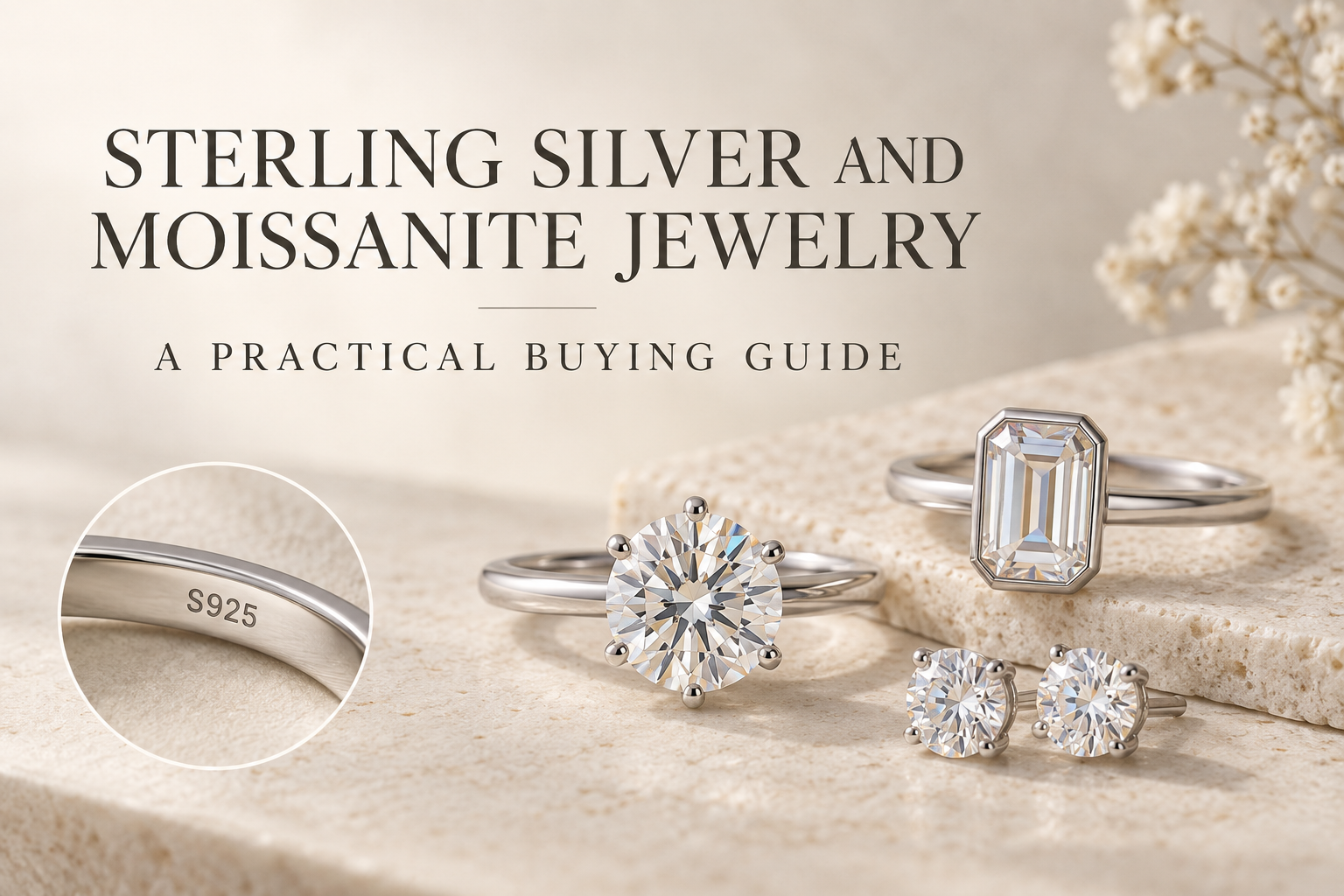
    Sterling silver can be a practical metal for moissanite jewelry because it gives the stone a bright white setting at a more accessible price than solid gold or platinum. The important distinction is that moissanite describes the stone, while S925 or sterling silver describes the metal. Check both separately, along with any plating, before buying.

    The 60-second material check

    • Stone: the listing should identify the center and accent stones as moissanite where applicable.
    • Base metal: S925 or sterling silver represents 92.5% silver by fineness.
    • Surface finish: white, yellow or rose color may come from plating; it does not automatically mean solid gold.
    • Components: check whether the chain, clasp, earring posts or backs use the same metal as the decorative setting.
    • Exact option: material, color, carat and size can change by variant, so verify the selected combination.

    What does S925 mean?

    S925 is a retail marking used for sterling silver. The number 925 represents 925 parts silver per 1,000, or 92.5% silver. The mark does not identify the remaining alloy metals, prove the identity of a gemstone or describe a surface coating.

    This is why a complete description matters more than a stamp by itself. “S925 moissanite ring” should answer two different questions: what the band is made from and what the stone is. It may also need to explain whether the silver is unplated, rhodium plated or gold plated.

    Why pair sterling silver with moissanite?

    Moissanite has strong brilliance and fire. A bright white metal can keep the visual focus on that sparkle without adding the higher metal cost associated with solid gold or platinum. Sterling silver also works across many styles, from a clean bezel to a decorative halo.

    The trade-off is that sterling silver needs realistic care. It is softer than platinum and can scratch, bend or tarnish with wear. Moissanite is much harder than the surrounding silver, so the metal, prongs and setting often deserve more attention than the center stone during daily use.

    Part of the pieceWhat the term tells youWhat still needs checking
    MoissaniteThe named stone materialWhich stones are moissanite, size options and setting
    S925 / sterling silver92.5% silver fineness claimWhich components use it and the remaining alloy details
    Gold tone / rose toneThe visible colorWhether it is plating and what metal sits underneath
    Rhodium platedA bright surface layerBase metal, wear expectations and care instructions

    Sterling silver is not the same as “silver tone”

    “Silver tone” normally describes appearance, not silver content. Stainless steel, plated copper, sterling silver and other materials can all look white or silver in product photography. If the base metal matters to you, look for an explicit material statement rather than relying on color.

    The same caution applies to gold-colored silver jewelry. Sterling silver can be gold plated, but that does not make it solid gold. The silver is the base and the gold color is a surface finish. Plating can change with friction, chemicals and time, so care instructions should match the complete construction.

    Two verified MSEARTHIA examples

    The Green Moissanite Halo Ring identifies an oval green moissanite, halo setting and S925 sterling silver. Its stone-size and ring-size options are separate choices, so the live selector is the correct place to confirm current price and availability.

    The Emerald Cut Moissanite Bezel Ring identifies a 2 ct emerald-cut moissanite, bezel setting and S925 sterling silver. Its color names describe the finish rather than solid-gold content. That component-by-component wording is what a careful buyer should look for.

    What to check before buying

    1. Read the base-metal line. Look for S925, sterling silver or another specific metal rather than a color description.
    2. Identify the finish. Confirm whether the surface is unplated, rhodium plated, gold plated or simply described by color.
    3. Check every component. A pendant and chain, or an earring setting and its back, may not share one material.
    4. Confirm the stones. Do not assume every accent stone is moissanite unless the description says so.
    5. Review the selected variant. Size, stone color, carat label, price and availability may change with the option.
    6. Plan for care. Sterling silver and plated finishes benefit from dry storage, gentle cleaning and reduced chemical exposure.

    When sterling silver may not be your first choice

    Sterling silver may not be ideal if you want a piece that will rarely show surface wear, if you expose jewelry to chlorine or hard impacts, or if you want the long-term metal value associated with solid precious-metal jewelry. It is also not a promise about skin sensitivity: a 925 mark does not disclose the exact remaining 7.5% alloy.

    For many shoppers, however, the balance is appealing: a genuine silver alloy, strong moissanite sparkle and a lower entry price. The right choice depends on honest material wording and whether you are comfortable with routine cleaning and eventual surface wear.

    Frequently asked questions

    Is S925 real silver?

    S925 represents sterling silver at 92.5% silver by fineness. A stamp alone does not independently verify the complete piece, so also read the seller’s material and component details.

    Is moissanite set in sterling silver durable?

    Moissanite is very hard and suitable for regular wear. Sterling silver is softer and can scratch, tarnish or deform under force, so the setting and prongs should be handled carefully and inspected if the piece is struck.

    Does S925 mean the jewelry is solid gold?

    No. S925 identifies a sterling-silver base. A yellow or rose surface may be gold plated, but plating is not the same as solid gold.

    Can sterling silver moissanite jewelry tarnish?

    The silver surface can tarnish even though the moissanite remains stable. Tarnish is a metal-surface change, not evidence that the stone has become cloudy or fake.

    Next step: read How to Clean Sterling Silver Moissanite Jewelry Safely for a routine that accounts for the stone, the silver setting and possible plating.

    Related reading: compare stone properties in Moissanite vs Diamond: Brilliance, Durability, Price and Care, or start with How to Choose a Moissanite Ring.

    Sources and methodology

    This guide combines FTC consumer guidance on silver fineness and jewelry descriptions with GIA material and care guidance. MSEARTHIA product wording and live availability were checked on September 29, 2026. The article distinguishes verified S925 descriptions from appearance-only terms such as “silver tone.”

  • Moissanite vs Diamond: Brilliance, Durability, Price and Care

    Moissanite vs Diamond: Brilliance, Durability, Price and Care

    Moissanite and diamond are different materials, and almost every difference follows from that. Diamond is crystallized carbon with a Mohs hardness of 10; jewelry moissanite is laboratory-created silicon carbide at about 9.25, with more fire, less density and a much lower purchase price. If you want the hardest known gem material and the traditional diamond market, choose diamond. If you want intense fire, excellent everyday durability and far more visual size for the money, moissanite is the stronger value—provided it is sold and described honestly as moissanite.

    The 60-second decision

    • Choose diamond if owning the actual diamond material, maximum scratch resistance and a conventional resale market matter most.
    • Choose moissanite if you want stronger rainbow fire, a larger-looking stone for the budget, and durability that comfortably handles daily wear.
    • Compare by millimeters, not carat when switching between the two: moissanite is less dense, so equal carat weights do not look the same size.
    • Buying for disclosure and honesty: moissanite should be identified as moissanite or as a diamond simulant. It is not a laboratory-grown diamond.
    • Still deciding on shape and setting? Read How to Choose a Moissanite Ring first, then come back to the material question.

    The material difference behind everything else

    GIA describes diamond as a gem material composed almost entirely of carbon, and it classifies synthetic moissanite—silicon carbide—as a diamond imitation or simulant, because it can resemble diamond while remaining chemically and structurally different. A laboratory-grown diamond is still diamond: it has essentially the same optical, physical and chemical properties as a mined diamond. Moissanite does not, and should not be described as a natural, laboratory-grown or synthetic diamond.

    That distinction is not marketing hairsplitting. It explains the fire, the weight, the price and the long-term care, and it is why the U.S. Federal Trade Commission’s Jewelry Guides require truthful disclosure of gemstone identity rather than vague wording.

    Side-by-side properties

    PropertyDiamondMoissanite
    MaterialCrystallized carbonSilicon carbide (SiC)
    CategoryDiamondDiamond simulant
    Mohs hardness10About 9.25
    Refractive indexAbout 2.422.648 and 2.691
    Dispersion (fire)0.0440.104
    Optical behaviorSingly refractiveDoubly refractive
    Specific gravityAbout 3.52About 3.22

    The numerical values for synthetic moissanite come from the Gems & Gemology study by Nassau, McClure, Elen and Shigley, which recorded refractive indices of 2.648 and 2.691, dispersion of 0.104, a hardness of 9¼ on the Mohs scale and a specific gravity of 3.22. Diamond values are GIA’s published reference figures.

    1. Brilliance and fire

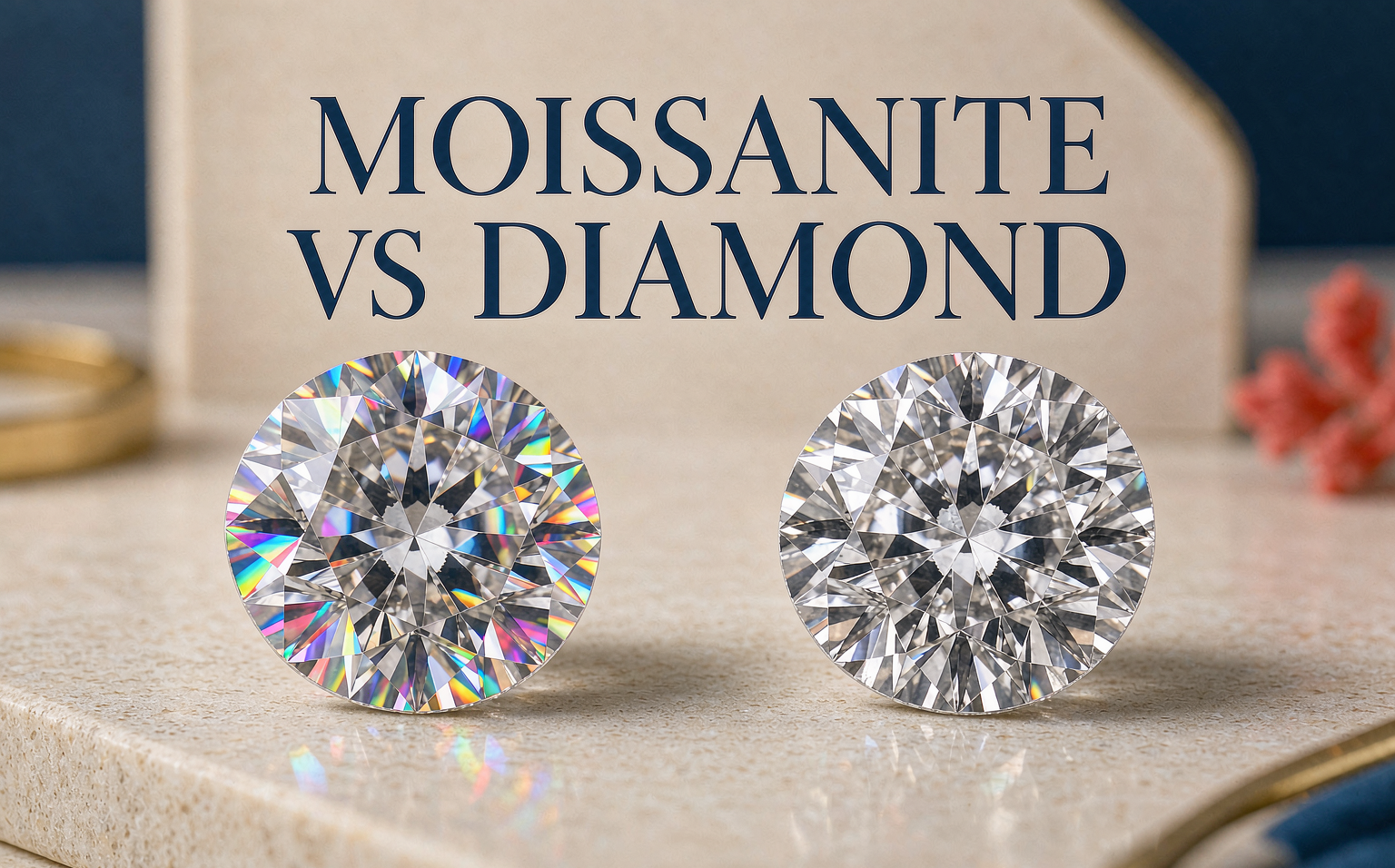
    Fire is the colored light you see when a stone splits white light into spectral flashes. Moissanite’s dispersion of 0.104 is more than twice diamond’s 0.044, and GIA notes that moissanite also has slightly more brilliance. In practice that means larger, more obvious rainbow flashes, especially under spotlights or direct sun.

    Whether that is a feature depends on taste. GIA also records the trade-off: in sizes of roughly one carat and above, moissanite’s intense fire may give it away as a non-diamond gem, and because moissanite is doubly refractive, viewing through the crown can show a doubling of the back facets that makes the interior look slightly fuzzy. Diamond shows no such doubling. Neither effect is a defect—they are simply what the material does.

    2. Durability for everyday wear

    On the Mohs scale, diamond is 10 and moissanite is about 9.25, which still makes moissanite harder than every other diamond simulant and harder than sapphire or ruby. Both are hard enough for a ring worn daily. Hardness resists scratching; it is not the same as toughness, and a hard stone with a thin girdle can still chip from a sharp blow. That is true of diamond too.

    GIA notes that because diamond is harder, it can take a better polish and therefore shows a brighter luster than most simulants, and that many simulants may develop scratches and abrasions along facet junctions sooner. For a piece you intend to wear for years, that polish retention is a real advantage for diamond. For a piece you intend to wear and enjoy rather than keep pristine, the practical gap is smaller than the numbers suggest.

    3. Price, and what you are actually comparing

    Moissanite is manufactured, so its supply is not constrained by mining, and comparable-looking stones generally cost far less than natural diamonds. The honest way to shop is to compare complete rings—same metal, similar stone size, setting included—rather than comparing a loose diamond price to a finished moissanite ring.

    On MSEARTHIA, the five published moissanite rings were listed between roughly $43 and $69 at the time of writing, with prices varying by center-stone size and ring size. Use the live option selector on each product page rather than a saved screenshot, because availability and price change. If you want the classic look with the fewest moving parts, the Moissanite Solitaire Ring is a clean starting point; the Oval Moissanite Halo Ring shows what a halo adds to visual spread.

    4. Care and cleaning

    Both materials are low-maintenance, and GIA lists warm soapy water as safe for diamond simulants generally. For synthetic moissanite specifically, GIA lists ultrasonic cleaning and steam cleaning as safe, and notes that moissanite is less likely to attract grease than diamond, so it tends to hold its sparkle between cleanings.

    • Routine cleaning: warm water, a drop of mild dish soap and a soft brush, then dry with a lint-free cloth.
    • Ultrasonic and steam: safe for the stone according to GIA, but home ultrasonic units can stress solder joints and prongs. If you use one, check the setting afterwards.
    • Avoid: chlorine bleach, harsh chemicals and abrasive pastes such as toothpaste, which can dull metal even when the stone is unaffected.
    • Storage: keep pieces in separate soft pouches. Diamond can scratch moissanite, and either can scratch softer metals and gems.
    • Metal matters: read each product’s stated metal. Several MSEARTHIA rings are described as S925 sterling silver; silver is softer than platinum and can tarnish, so treat it accordingly and remove rings for gym work, cleaning and swimming.

    5. Telling them apart, and buying honestly

    Do not rely on a thermal conductivity pen. The Gems & Gemology study found that synthetic moissanite’s thermal properties are close enough to diamond that such probes react to it as if it were diamond. Jewelers separate the two by optical behavior instead: moissanite’s double refraction produces a visible doubling of facet junctions, while diamond does not.

    When you buy, the disclosure should match the material. Moissanite, laboratory-created moissanite and diamond simulant are all acceptable descriptions. “Lab-created” used alone as a product name is not, because it does not say what was created. If the identity of a stone you own is uncertain, GIA accepts stones for laboratory identification.

    A practical shortlist

    Frequently asked questions

    Is moissanite a fake diamond?

    No. Moissanite is a genuine gemstone material, but it is silicon carbide rather than carbon, so GIA classifies it as a diamond simulant. A simulant resembles diamond without sharing its chemistry or structure. That is different from a laboratory-grown diamond, which is diamond.

    Which one sparkles more?

    Moissanite. GIA states that moissanite has more than twice the fire of diamond and slightly more brilliance. Some people love that; others find the rainbow flashes read as obviously non-diamond, particularly above about one carat.

    Will moissanite scratch or cloud over time?

    Moissanite at about 9.25 on the Mohs scale resists scratching very well and does not cloud the way softer simulants can. GIA does note that diamond, being harder, takes a better polish and holds a brighter luster longer. Surface film from soap, lotion and hard water is the usual reason a stone looks dull, and cleaning fixes it.

    Why does the same carat weight look bigger in moissanite?

    Moissanite has a specific gravity of about 3.22 versus diamond’s roughly 3.52, so a moissanite of the same weight occupies slightly more volume. When comparing the two, compare millimeter dimensions rather than carat weight.

    Can a jeweler tell the difference?

    Yes, and it is quick. Thermal testers alone are unreliable because moissanite conducts heat similarly to diamond. Doubling of the back facets caused by double refraction is the standard visual separation, and a jeweler or laboratory can confirm it.

    Sources and methodology

    Property values, simulant classification and care guidance come from GIA publications. Availability and pricing refer to MSEARTHIA’s live product pages checked on September 28, 2026, and may change; verify the product page before ordering.

  • How to Choose a Moissanite Ring

    How to Choose a Moissanite Ring

    The easiest way to choose a moissanite ring is to decide in this order: shape, setting, center-stone size, lifestyle, and ring size. Shape sets the personality, the setting changes protection and visual impact, size affects presence, and fit determines whether the ring is comfortable enough to wear. Start with those decisions before comparing small design details.

    The 60-second decision

    • Classic and versatile: choose a solitaire or a clean bezel.
    • More visual sparkle: look at halo or floral-halo styles.
    • Symbolic and dimensional: consider a three-stone design.
    • Active routine or frequent glove wear: prioritize a smoother, lower-profile setting and inspect how much the stone projects above the band.
    • Unsure about fit: confirm the size before ordering instead of relying on a guess.

    1. Choose the stone shape first

    Shape is the outline you notice first. It is different from cut quality: two stones can share the same oval or emerald outline but interact with light differently. For an online purchase, review straight-on and angled images whenever they are available rather than deciding from a single close-up.

    ShapeVisual characterWhat to inspectMSEARTHIA example
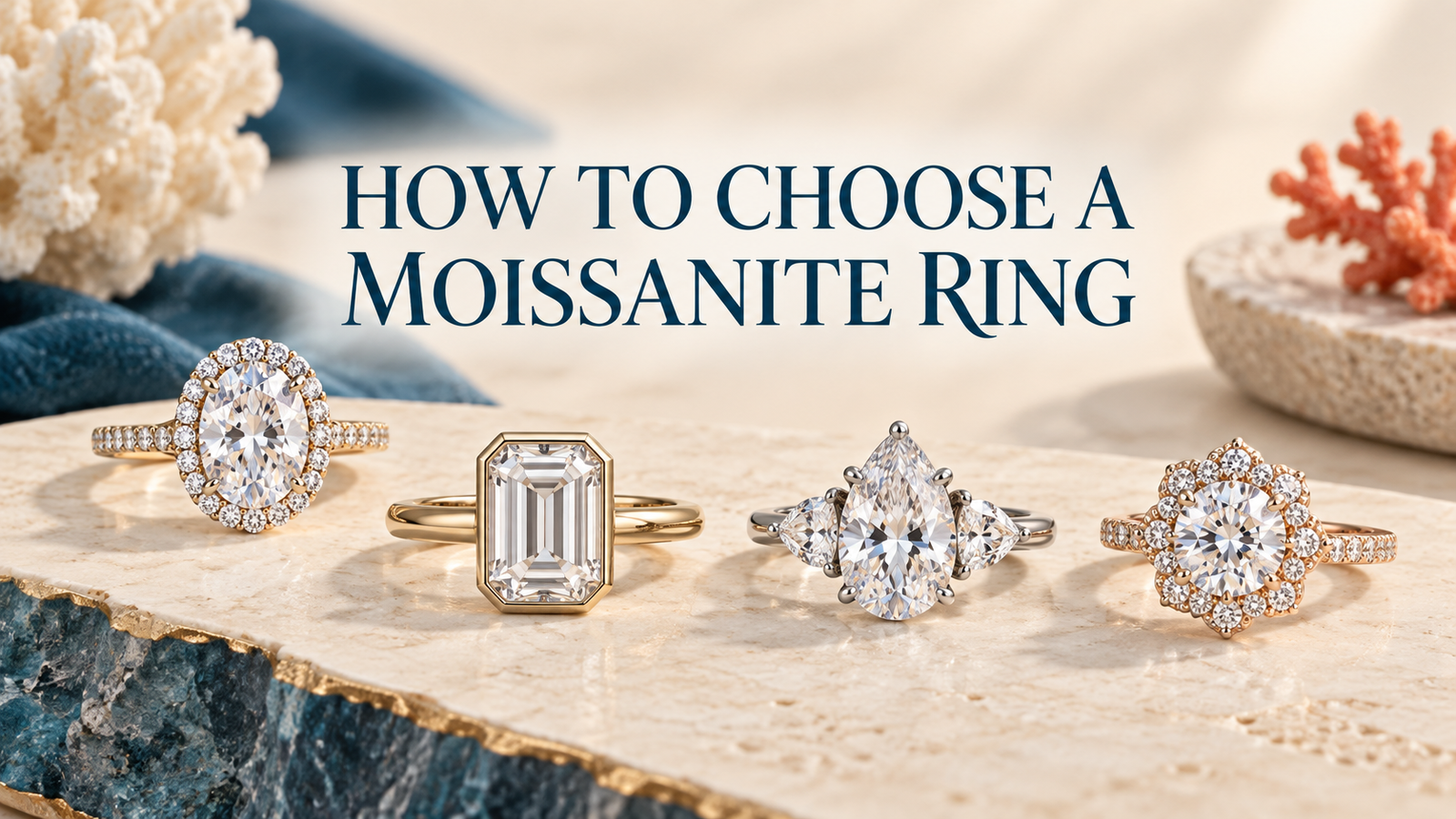
    OvalElongated, bright, and softly modernOutline, symmetry, and the way the halo follows the centerOval Moissanite Halo Ring
    Emerald cutGeometric, clean, and understatedStep-facet appearance, corner protection, and bezel proportionsEmerald Cut Moissanite Bezel Ring
    PearDirectional and distinctiveTip protection, symmetry, and preferred point orientationPear Cut Moissanite Three-Stone Ring
    Floral haloRomantic and decorativeOverall width, accent-stone layout, and cleaning accessFloral Moissanite Halo Ring

    Pointed shapes such as pear cuts deserve special attention at the tip. GIA notes that pointed outlines benefit from a secure setting that helps protect vulnerable corners or points. That does not make a pear shape impractical; it simply makes the mounting part of the buying decision.

    2. Match the setting to your routine

    A setting is not only a style choice. It is the structure that holds the center stone and affects the ring’s profile, snag potential, cleaning needs, and visual footprint. GIA distinguishes the stone-holding method—such as prongs or a bezel—from the broader style, such as solitaire, halo, or three-stone.

    Bezel

    A rim of metal surrounds the stone’s edge. The smooth outline can be practical for people who dislike exposed prongs or frequently catch rings on clothing. A bezel also gives an emerald-cut stone a particularly clean, architectural look.

    Halo

    A frame of smaller stones surrounds the center and increases the ring’s overall sparkle and visual spread. More small stones also mean more places where lotion or debris can collect, so plan for careful cleaning and periodic inspection.

    Three-stone

    A center stone is flanked by two side stones. The design creates width across the finger and a layered look without relying on a complete halo. Check how the side stones sit beside the center and whether the profile suits your daily routine.

    3. Think in visual presence, not carat alone

    Carat is a weight measurement, not a guaranteed face-up dimension. Shape, proportions, halo width, side stones, and band design all change how large a ring looks from above. This is why a 2 ct center stone in a bezel can present differently from a 2 ct center in a halo.

    Use the option selector on the product page to see which center-stone sizes and ring sizes are actually offered. For example, the Oval Moissanite Halo Ring currently offers 1 ct, 2 ct, and 3 ct center-stone choices, while the Floral Moissanite Halo Ring offers 1 ct and 2 ct choices. Availability and price can change, so rely on the live product selector rather than a saved screenshot.

    4. Verify material wording and product details

    Moissanite is its own gemstone material; it is not diamond. GIA describes synthetic moissanite as very hard and durable, with strong fire and brilliance, while also noting that its optical behavior differs from diamond. The U.S. Federal Trade Commission’s Jewelry Guides emphasize truthful disclosure of gemstone type, metallic content, size, treatment, and other material facts. For a property-by-property comparison of the two materials, see Moissanite vs Diamond: Brilliance, Durability, Price and Care.

    Read the individual product description for the exact stated material. Do not infer solid gold from a color name. On MSEARTHIA, a finish described as “white gold tone” or “champagne gold tone” describes appearance, not solid-gold content. The Emerald Cut Moissanite Bezel Ring, for example, states S925 sterling silver in its product details.

    5. Confirm ring size before ordering

    A beautiful ring that spins, pinches, or cannot pass the knuckle is not the right choice. Finger size can vary with temperature and time of day, and a wider band can feel different from a narrow one. If you have a ring that already fits the intended finger, compare its inside diameter with a reliable size chart. For an important purchase or an uncertain measurement, ask a jeweler to confirm the size.

    Use the available size options on each product page and contact MSEARTHIA before ordering if you need help with half sizes or a fit question. Do not choose a size based only on a printable guide unless the print scale has been checked.

    A practical shortlist

    Frequently asked questions

    Is moissanite a diamond?

    No. Moissanite and diamond are different gemstone materials with different optical and physical properties. Product descriptions should identify moissanite clearly rather than present it as diamond.

    Which ring setting is best for an active lifestyle?

    A smooth bezel or another lower-profile, well-protected setting can reduce snagging, but no ring is immune to impact. Compare the full profile, not only the top view, and remove fine jewelry for activities that could strike or crush the setting.

    Does a halo make a center stone look larger?

    A halo increases the ring’s overall visual footprint and frames the center, which can make the complete design look larger. It does not change the actual weight or dimensions of the center stone.

    Should I choose a ring by carat weight?

    Use carat as one comparison point, not the only one. Shape, proportions, setting, halo, side stones, band width, and finger coverage all affect how the finished ring looks.

    Related reading: if you are still weighing moissanite against diamond, see Moissanite vs Diamond: Brilliance, Durability, Price and Care for a full comparison of fire, hardness, price and care.

    Sources and methodology

    This guide combines MSEARTHIA’s live product descriptions and option sets, checked on September 28, 2026, with general gemological and consumer-advertising guidance. Product availability may change; verify the live product page before ordering.