Author: MSEARTHIA Admin

  • Gold Tone Is a Color, Not a Metal Specification

    Gold Tone Is a Color, Not a Metal Specification

    Gold tone and white gold tone describe appearance; by themselves, they do not establish a gold alloy, gold plating or a sterling silver body. Read moissanite finish labels alongside an explicit metal description. If the listing says S925 sterling silver, that identifies the stated silver composition, while the surface treatment remains a separate question.

    You can enjoy a warm or cool finish without confusing it with a material specification. The practical task is to keep three pieces of information separate: the stone, the metal that forms the piece and any surface treatment. A photograph or an option name may help you select a look; neither supplies every missing construction detail.

    Start with the words actually used

    • Moissanite: the stated stone, not the surrounding metal.
    • S925 sterling silver: a stated silver composition. GIA’s white-metal guide explains sterling as 925 parts silver per thousand; a listing statement is not an independent assay of this particular item.
    • Gold tone or champagne gold tone: a color description. It does not identify a karat value or the material used to create the surface.
    • Gold plated: a specific surface-construction statement, when expressly provided. It does not mean the whole piece is a gold alloy.
    • White gold: when used as a metal claim, it needs supporting gold-alloy information, such as a karat specification. “White gold tone” does not supply that evidence.

    Do not fill a gap with whichever explanation sounds most premium. A silver-colored finish is not automatically rhodium plating, and a warm finish is not automatically a layer of gold. If a piece is described as solid gold, that still does not mean pure 24K gold: the FTC distinguishes the construction wording from its karat purity. Keep the seller’s actual metal and finish statements together.

    Example one: S925 plus two finish names

    The current Emerald Cut Moissanite Bezel Ring description explicitly identifies S925 sterling silver and offers white gold tone and champagne gold tone choices. You can therefore distinguish the stated silver body from the visual choice. Calling the white gold tone version a solid white-gold ring would change the claim rather than summarize the listing.

    Those facts still do not establish the exact coating material, thickness or expected wear interval. Ask about the selected finish if those details matter to you. The listing’s S925 wording also does not prove a nickel-free formula, suitability for a particular sensitivity or resistance to every cleaning product. Our broader sterling silver and moissanite guide provides material context; this checklist focuses on the finish wording.

    Example two: a gold option with missing metal details

    The Red Cord Moissanite Tennis Bracelet has option names including Gold Moissanite Bracelet and White Gold Moissanite Bracelet. Its current description identifies a moissanite center and an adjustable red cord. The checked description and attributes do not establish the metal components’ composition or a karat value.

    That missing information is a reason to ask what the selected version contains. It is not evidence that the bracelet is S925, solid gold, gold plated or made of the same metal as the ring above. Even two pieces with similar color labels can have different construction. Browse bracelets and rings for designs, then confirm each item’s specification separately.

    Four questions before you choose the finish

    1. What metal forms the selected item’s band, setting and other relevant components?
    2. Is the color a coating, and what material is used for that surface?
    3. Does the written specification apply to this exact option rather than a different item in the menu?
    4. What care instructions apply to the complete piece, including stones, coatings and any cord?

    Save the answer with the product details so a shade preference does not become an unsupported material assumption later. If the answer remains incomplete, you can delay the purchase or choose an item whose construction is clearer. There is no need to settle the missing facts by inspecting a screen image more closely.

    Care follows construction, not just color

    Do not treat every gold-colored surface as solid gold or every silver-colored surface as bare sterling silver. The FTC notes that plated layers can wear with use, depending in part on their thickness. GIA’s care guidance also emphasizes the effect of chemicals and the limits of ultrasonic cleaning. Neither source establishes a lifetime or cleaning method for an unspecified coating on these products.

    Read the seller’s instructions for the actual finish before using a polishing treatment or machine. Our silver moissanite care guide discusses coating-aware care; it is not a substitute for identifying an unknown surface. Once the ordinary specifications are clear, you can return to the personal decision, such as choosing a ring to mark a new job.

    Two quick questions

    Does white gold tone mean white gold?

    No. The tone wording describes a look. Confirm an explicit metal composition and, for a gold-alloy claim, the karat specification rather than inferring one from the color.

    Does S925 identify the finish too?

    No. It states sterling silver composition, not the coating material or thickness. Ask about the selected finish separately; do not infer waterproof, allergy or wear guarantees from S925.

    Sources and editorial method

    Live linked product descriptions and attributes were checked before publication; missing specifications remain identified as missing. GIA’s white-metal guide supports the sterling and white-gold composition distinction. The FTC’s consumer guide to gold and silver jewelry supports the limited gold terminology and plated-layer context. GIA’s jewelry-care guidance supports the limited chemical and cleaning context. These are general references, not assays, product certifications or a legal compliance assessment.

    The cover is an AI-generated editorial illustration of alternative finishes, not a product photograph, exact shade comparison, material test or evidence that two rings are sold as a set.
  • A New Job, a Moissanite Ring and a Note to Yourself

    A New Job, a Moissanite Ring and a Note to Yourself

    A moissanite ring can mark a new job if you like the design, have confirmed its fit and can comfortably afford it. Choose it for the beginning you want to remember, rather than as a way to look more successful. A short note to yourself can carry the meaning, whether you wear the ring at work, after work or only occasionally.

    This is an illustrative self-gifting scene, not a customer’s career story or our own wear test. Imagine accepting a new role, then giving yourself time to decide how to acknowledge it. Buying jewelry is optional; an existing ring, a handwritten page or a quiet dinner can mark the same moment.

    Begin with a sentence, not a shopping list

    In this example, the first decision happens at home with an open notebook. Write the date and one sentence you want to keep: perhaps what you hope to learn, what you are glad you attempted or what you want to protect outside work. Leave space for the experience to be different from your expectations.

    A useful prompt is: “When I remember this beginning, I want to remember…” You do not need to promise yourself a promotion or turn the ring into a reward for being productive every day. The marker can simply say that you began. Keep the note somewhere you choose, separately from any workplace document.

    One design to consider: an emerald-shaped bezel

    The Emerald Cut Moissanite Bezel Ring is the design example here. Its current description identifies an emerald-cut moissanite framed by a polished bezel and an S925 sterling silver setting. The rectangular outline offers a clear visual direction if you prefer one central shape to a cluster of decorative details.

    The listing describes a 2 ct center and offers US sizes 5–9, with white gold tone and champagne gold tone choices. Those are listing labels, not measurements taken for this article. The color names describe the finish; they do not make the ring solid gold. Our guide to moissanite finish labels separates those decisions before you choose a shade.

    No setting-height or complete millimeter measurements are established here. A bezel outline alone does not prove that the ring will clear a cuff, avoid catching fabric or feel comfortable through a workday. Ask for the missing dimensions if those details affect your choice. Browse moissanite rings for alternatives without treating one design as the correct symbol for every career.

    Let the first week stay practical

    Picture the ring beside the notebook on an evening after the first week. You have learned a few names and have questions you could not have anticipated. Read the original sentence without grading your progress against it. If the ring is ready and you want to wear it, this can be its first occasion; there is no requirement to debut it on day one.

    If your role restricts rings or involves tasks where jewelry must be removed, follow those requirements. Choose an after-work moment instead. Even in a desk-based role, leave comfort and fit as questions for the actual wearer. This article has not tested typing, glove compatibility, equipment clearance or all-day wear.

    Confirm the ordinary details before the meaningful ones

    Check the intended finger with the ring-size guide and confirm the selected option with the seller. Do not choose a size by how a model’s hand looks, assume every variant is available or rely on an unconfirmed resizing service. Ask for millimeter dimensions if visual presence matters; our carat-label guide explains why the number alone does not show the ring’s footprint.

    When you take the ring off, give it a separate protected place rather than dropping it loose among keys. GIA’s general jewelry-care guidance supports protective storage and attention to chemicals; it does not establish this ring’s finish durability or workplace suitability. Keep the purchase details with your note so the meaning and the material information remain easy to find.

    The note can outlast the occasion

    Return to the sentence whenever you want, not on a compulsory anniversary. You might add a line about something unexpected, or leave the original page alone. The ring does not need to represent your whole professional identity. It can belong to your life outside the role as well. If a pendant feels more natural, our personal-milestone pendant scene explores a different way to keep a private marker.

    Sources and editorial method

    Product details were checked against the linked live MSEARTHIA listing before publication. The scene and notebook prompts are editorial suggestions, not reader submissions or promises about confidence or career outcomes. GIA’s jewelry-care guidance supports the limited storage and chemical-care context, not a product test or certification.

    The cover is an AI-generated editorial illustration. It is not an exact product photograph, an authentic try-on, a scale reference or evidence of supplied stationery or packaging.

  • A Moissanite Gift for a Friend: Ask, Then Choose

    A Moissanite Gift for a Friend: Ask, Then Choose

    For a moissanite gift for a friend, ask whether they want jewelry at all, which category they wear, and which fit or material details matter to them. Then shortlist an option together. Studs require more than a guess about pierced ears, and an adjustable bracelet is not automatically one-size-fits-all. The personal note can remain a surprise even when the product choice is shared.

    This is an editorial gift-dilemma guide, not a real friend’s submission or a promise of a particular reaction. The question is how to make a thoughtful choice without turning familiarity into assumptions. There is no ranking of how much friendship a gemstone, price tag or surprise demonstrates.

    Start with one invitation, not a hidden investigation

    Try a direct question: “Would you enjoy choosing a piece of jewelry together, or would you prefer something else?” If the answer is jewelry, ask whether they would actually wear earrings, a bracelet, a necklace or a ring. It is fine to say what you had in mind while leaving them space to choose another category or decline.

    Do not borrow a ring, inspect belongings or ask others to uncover private details as a substitute for the conversation. A familiar color in their clothes can suggest a question, not prove what they want to wear. Our green-ring outfit scene is an example of a personal preference; it is not a prescription for the friend receiving your gift.

    The first fork: do they want the category?

    • They already enjoy studs: ask whether a clear geometric design appeals, then confirm dimensions, fastening and component materials.
    • They prefer a wrist detail: ask about cord versus metal-link construction, then confirm the selected bracelet’s real fit range and closure.
    • You do not know: share a small shortlist without ordering yet. A vague preference is a reason to ask, not a reason to choose the “safest” item.

    The forks are practical editorial prompts, not a personality quiz. A friend can like more than one category, or enjoy seeing jewelry without wanting to wear it. Keep the option of another kind of gift open throughout the conversation.

    Stud route: a design they actually want near their face

    The Geometric Halo Moissanite Stud Earrings offer one example if your friend has already chosen the earring route. The current description identifies a square cushion-cut look framed by a halo. That explains the design, not its fit in a particular piercing or with a particular headset or collar.

    Ask the wearer which fastening, dimensions and materials they use, then request the selected product’s full details. The checked listing does not establish exact dimensions, weight, fastening or post-and-back composition. Pierced ears alone do not answer those questions, and “stud” does not prove that a pair will be suitable. The earring buying guide supplies a broader specification checklist.

    Bracelet route: adjustable still needs a range

    The Red Cord Moissanite Tennis Bracelet provides a different design direction: its description identifies a round moissanite center and adjustable red cord. Offer it only if the cord and red color are things your friend likes. Do not assign a universal friendship, luck or commitment meaning to the color.

    The checked listing does not state the usable adjustment range or mechanism. Confirm both and the complete materials before ordering. Its “Gold Moissanite Bracelet” and “White Gold Moissanite Bracelet” option names do not independently verify solid gold or sterling silver. Neither this bracelet nor the checked stud description establishes S925. Use our bracelet-size guide to distinguish wrist measurements from finished fit; adjustable is not a substitute for that information.

    The second fork: what can stay a surprise?

    Once the wearer has chosen the category, design and fit, you can still write a note they have not seen. Mention a shared memory, a thing you appreciate or a plan you would like to make together. Those words can be personal without claiming that the jewelry has an official meaning or that your friend must wear it immediately.

    If they want to choose the exact item themselves, agree on the plan before spending rather than promising a gift-card service that has not been confirmed. If they prefer a ring, use the separate ring-gift guide rather than guessing finger size. A smaller shortlist can be more useful than silently ordering a larger stone.

    Before checkout, finish the ordinary checks

    Review the selected option’s current availability and the site’s shipping and returns information. Ask about any unanswered question, especially timing, package contents or conditions that matter to the gift. This article does not promise delivery by a particular occasion, special gift packaging or return eligibility for a specific order.

    Include the actual product’s care information, not a cleaning recipe copied from a different metal or finish. GIA’s jewelry-care guidance supports protective storage and avoiding damaging chemical exposure. Browse earrings or bracelets once the wearer has expressed a preference; the category link is an invitation to compare, not an obligation to buy.

    Editorial notes and sources

    Prepared October 26, 2026 (Asia/Taipei). Products 639 and 714 were published and in stock when checked; current descriptions and resolved attributes support the reported designs, not independent measurements or every-variant availability. No physical fit, comfort, metal or adjustment tests were performed. Questions and notes are illustrative editorial suggestions, not submitted letters, customer stories or relationship guarantees. GIA supports limited care context, not product certification. The cover is an AI-generated editorial illustration of alternative gifts, not exact product photography, supplied packaging or a matched set.

  • A Black Outfit, One Green Moissanite Ring

    A Black Outfit, One Green Moissanite Ring

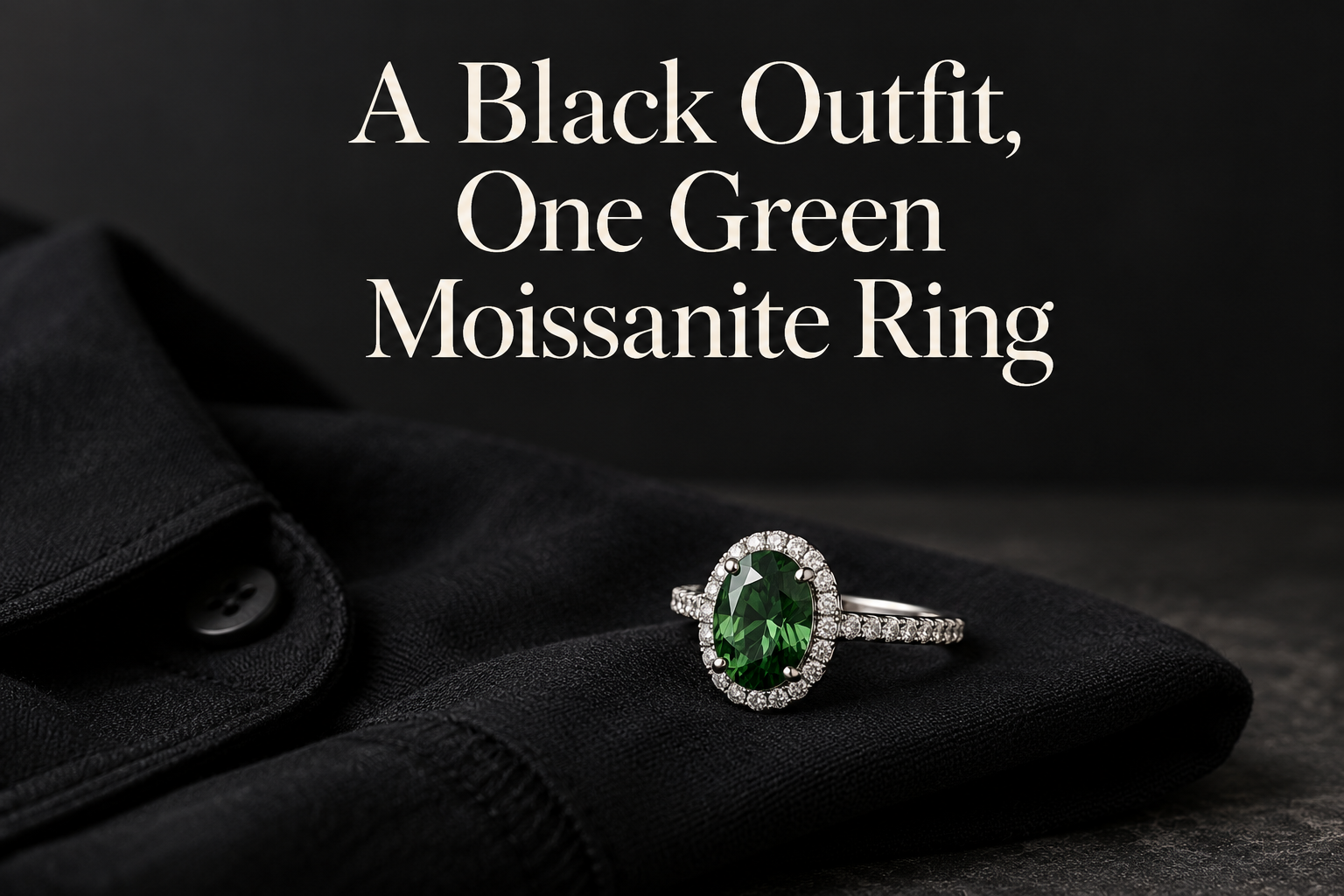
    Style a green moissanite ring with a black outfit by keeping the clothes you already enjoy and trying the ring as one chosen color accent. Start without a matching necklace, bag or manicure. Check the actual finger fit and sleeve contact; the green can be a detail you enjoy yourself, not something that must dominate the outfit.

    The three scenes below are illustrative outfit proposals, not our own try-ons or a customer’s wardrobe diary. Imagine a familiar black shirt, knit or jacket rather than a new shopping list. You might use an existing colored ring to explore the idea first. Black clothes do not need jewelry to be complete, and green is a preference rather than a universal styling rule.

    The design example: an oval with a halo

    The Green Moissanite Halo Ring supplies the specific design direction here. Its current description identifies an oval green moissanite, surrounding halo, pavé band and S925 sterling silver. The listing offers 1 ct and 2 ct center options, but does not provide the center or complete setting’s millimeter dimensions.

    Choose the outline and color because you enjoy them, then confirm the selected size and option separately. A larger carat label is not automatically a better accent and does not establish coverage on your hand. Our carats-versus-millimeters guide explains the missing measurements to ask for; it is not a reason to estimate them from the cover.

    Scene one: a plain black sleeve

    Begin with a plain black shirt or long-sleeved top and the trousers you already wear with it. Imagine the green ring as the one detail at your hand, leaving the wrist unstacked for the first comparison. Look at the whole outfit with your arms relaxed rather than holding your hand near your face to make the ring conspicuous.

    If a watch is part of the outfit you like, keep it in the comparison. The point is not to erase your usual accessories. It is to find out whether the ring adds something you want without creating a requirement for matching stones elsewhere. You can decide that the plain outfit is better on its own.

    Scene two: texture instead of more color

    In a second version, the black top is a textured knit. Let that texture remain part of the look rather than treating it as a blank background. You might prefer the green detail with the knit, or find that the knit and an existing accessory already give you enough to look at. Neither result calls for a different stone size.

    Check the real sleeve as you normally wear it. If the setting meets the fabric or repeatedly catches, change or remove an item; do not pull a knit across the ring as a durability test. A halo name does not establish setting height or snag resistance. If you would rather leave your hands free of jewelry, our scarf-day earring scene offers a different kind of detail, not another piece you need to add.

    Scene three: the same ring with a jacket

    For the third scene, put a familiar black jacket over a top you already enjoy. Compare the ring with the jacket open and with it fastened as intended. You are not looking for an approved ratio of green to black. You are deciding whether you like the accent with the actual cuff, buttons and bag you use.

    There is no need to buy green accessories to explain the choice. A small repetition of color is available if you enjoy it, but exact matching is optional. The broader wardrobe-first color article explores that preference without a complexion system, fixed palette or promise that one shade will appear the same under every light.

    Keep the fitting decision separate

    Use the ring on a finger it actually fits; moving it to another finger for a photograph is not a substitute for confirming size. Consult the ring-size guide as a starting point and ask about unresolved fit details before ordering. No outfit idea promises resizing, delivery timing or all-day comfort.

    Put a removed ring in a protective place rather than loose against other jewelry. GIA’s care guidance supports protective storage and avoiding damaging chemical exposure. Follow the instructions for the complete setting and finish rather than treating a gemstone label as permission for every cleaning method.

    Explore moissanite rings if the idea fits a real preference, not because an otherwise black outfit needs “fixing.” If you are choosing for someone else, use our friend-gift decision guide instead of assuming your color choice belongs in their wardrobe too.

    Editorial notes and sources

    Prepared October 26, 2026 (Asia/Taipei). Product 54 was published and in stock when checked; its current description explicitly supports S925 and the stated design/options, not independent measurements or every-variant availability. Styling scenes are editorial illustrations, not customer testimony, a wear trial, color test or trend ranking. GIA supports limited care guidance, not certification of this ring. The cover is an AI-generated editorial illustration, not exact product photography, a scale reference or an authentic try-on.

  • Moissanite Pendant or Bracelet? Choose Your Focal Point

    Moissanite Pendant or Bracelet? Choose Your Focal Point

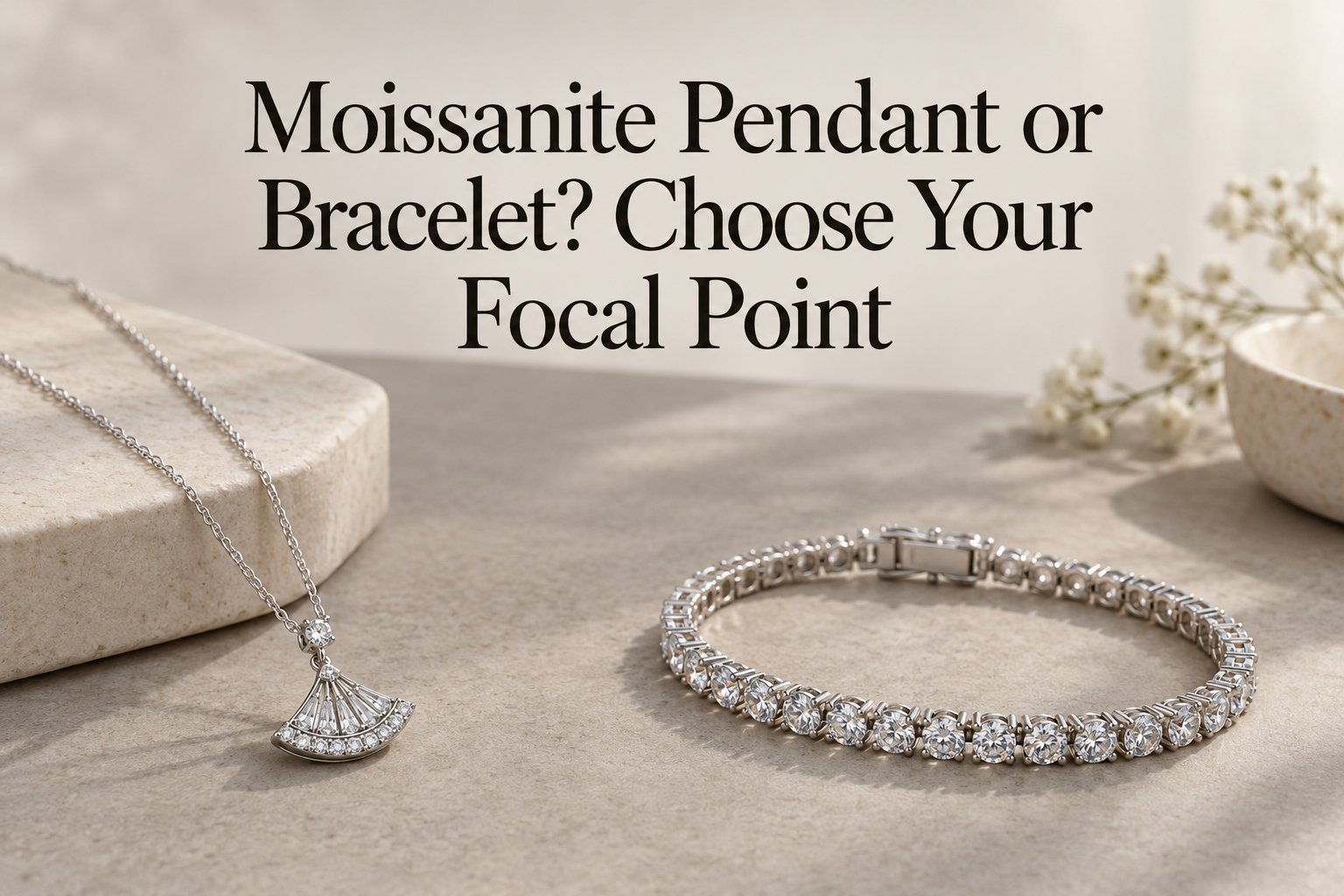
    Choose a moissanite pendant if the detail you want belongs with your neckline; choose a bracelet if you would rather put that detail at your wrist. Then check the actual garment, length, closure and selected product. Neither category is automatically easier, more versatile or a better gift. You can also choose neither.

    This two-route editorial guide is for the moment when you like both ideas but do not want to buy a matching set. It is a preference exercise, not a personality test or a ranking based on physical trials. Begin with pieces you already own, if possible. You are deciding where you want a focal point, not proving that your jewelry collection needs another category.

    Question one: which detail would you miss?

    Think of an outfit you enjoy wearing, not an image you would need to recreate from scratch. Imagine it once with a neckline accent and once with a wrist accent. Which version interests you more? If your answer is “I would not miss either,” keep the outfit. There is no need to turn a comparison into a purchase.

    If you want a detail in the frame of a top or open cardigan, explore the pendant route. If you prefer something you notice at your hand or beside a sleeve, explore the bracelet route. These are starting directions only. A watch, scarf, printed neckline or an activity may change which idea you prefer on another day.

    Route A: a pendant that belongs with the top

    The Moissanite Fan Pendant Necklace provides one design example: its current description identifies a fan-shaped moissanite focal point. Consider that geometric outline if it is the part you like. You do not need the same motif in earrings or a bracelet to make it a deliberate choice.

    Try a familiar necklace with the actual top before shopping for a different one. Notice where it sits without holding it and whether a collar or scarf occupies the same area. Our pendant-and-knitwear scenes offer three outfit contexts, while the chain and fit checklist handles the separate specification questions.

    Before ordering the fan design, confirm whether the selected order includes a chain, its usable length, the pendant dimensions and the connection. The checked description does not establish those facts. Its “Small Diamond Pendant” option wording is not independent proof of diamond content; ask for clarification rather than treating a selector label as a gemstone report.

    Route B: a bracelet that belongs with the sleeve

    The Four-Prong Moissanite Tennis Bracelet provides a different role. Its description identifies round moissanite stones held in four-prong settings along a continuous line. That repeating outline is a design reason to consider it, not evidence of a particular weight, finished length or clasp performance.

    Try the wrist-detail idea with a bracelet you already know fits. Keep the actual cuff and watch in view and notice contact during ordinary movement. Do not assume that changing to the other wrist settles fit; the selected bracelet still needs to suit that wrist. If the combination repeatedly catches or presses, remove or change an item rather than making your day accommodate it.

    For the linked tennis design, ask for finished length, how it is measured, closure details and complete materials before choosing a configuration. Our bracelet-size guide explains the difference between wrist circumference and the measurements of a finished piece. A classic line is not a universal fit formula.

    Question two: which uncertainty needs resolving?

    • Pendant route: if you like the neckline detail but do not know where it will sit, resolve chain configuration and length before choosing.
    • Bracelet route: if you like the wrist detail but do not know whether it will fit, resolve usable length, closure and adjustment before choosing.
    • Both routes: if the materials or selected option remain unclear, ask first. A silver-colored surface does not answer the metal question.

    Neither checked product description verifies S925. Do not read sterling silver into the cover’s silver-tone appearance. Follow the care instructions for the actual construction: GIA’s care guidance supports protective storage and avoiding damaging chemical exposure, not a durability ranking between necklaces and bracelets.

    A tie does not require buying both

    If both routes appeal, keep two notes rather than two cart items: the outfit you would wear each with, and the specification still missing. Revisit them with the clothes in front of you. You may discover that an existing piece already serves one role, or that earrings suit the outfit better. Our scarf-day earring scene is one such alternative, not another item to add automatically.

    Explore necklaces or bracelets after a route becomes useful. If this is a gift, let the intended wearer make the preference and fit decisions; a choice you enjoy for yourself is not evidence of what someone else wants. The outcome can be a shortlist, a question or no purchase.

    Editorial notes and sources

    Prepared October 24, 2026 (Asia/Taipei). Products 203 and 578 were published and in stock when checked. Their current descriptions and resolved attributes support the design details, not independent dimensions, all-variant availability or tested performance. The two routes are editorial preferences, not scientific assessment, universal versatility scores or a matched set. No wear test or material analysis was performed. GIA supports limited care context only. The cover is an AI-generated editorial illustration of alternatives, not exact product photography, a scale comparison or proof that the pictured chain is supplied.

  • A Scarf Day with Moissanite Earrings

    A Scarf Day with Moissanite Earrings

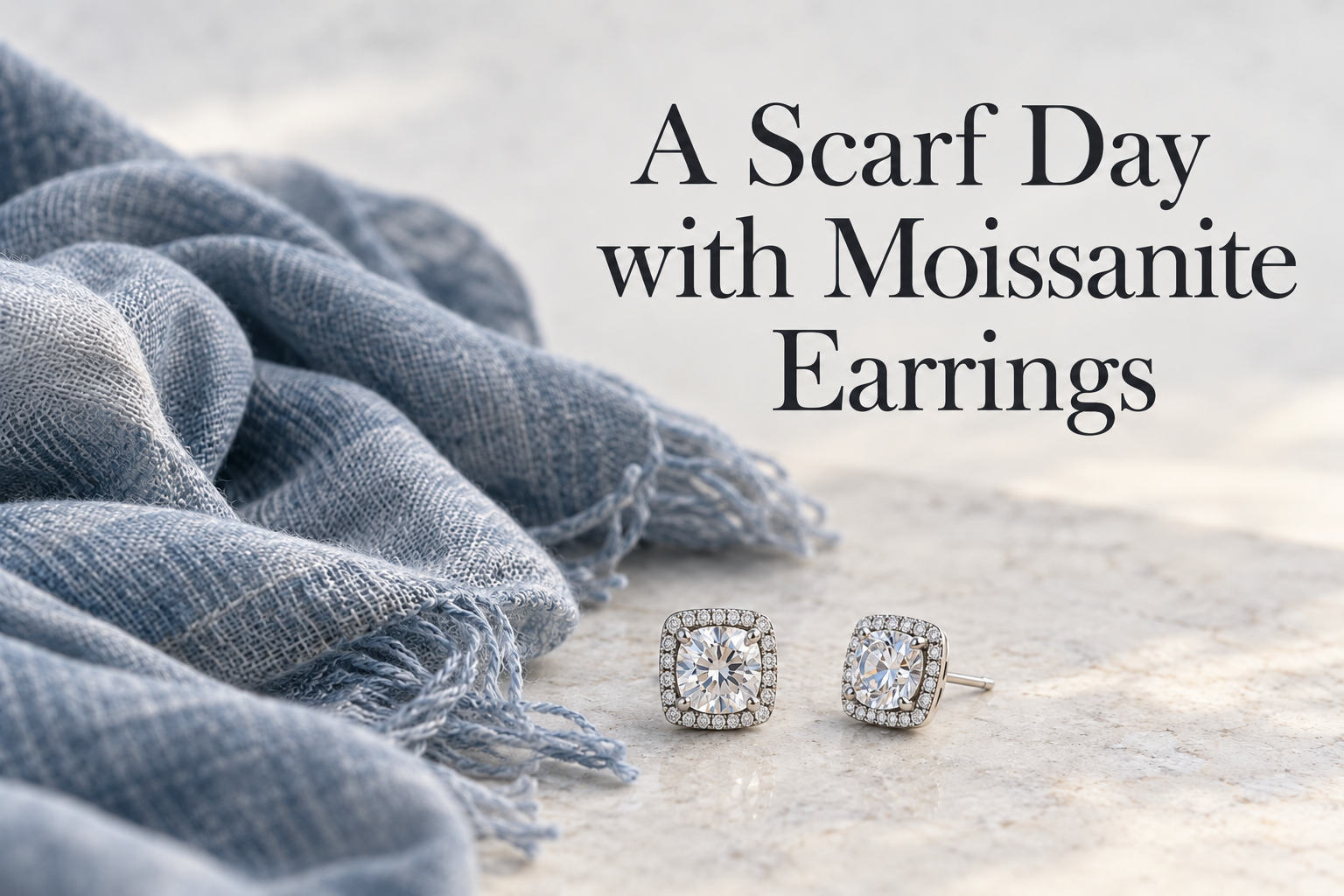
    To wear moissanite earrings with a scarf, arrange the scarf and collar as you normally wear them, then decide whether earrings add a detail you enjoy. Check the space around your ears while turning your head gently. A stud label does not guarantee clearance, and leaving the earrings off is a complete choice if the combination catches or presses.

    Picture an afternoon that begins outside, moves into a café and ends with the scarf folded over a chair. You are wearing familiar layers, not building three separate looks. This is an illustrative editorial scene, not a customer account or our own wear trial. Its starting point is the scarf you actually want to use, not a reason to buy another accessory.

    Outside: let the scarf have its normal shape

    Put on the intended top and outer layer, then wrap the scarf comfortably. A loose fold, a high collar and a bulky wrap can occupy different places near the ears. Look at the whole arrangement before choosing jewelry. There is no need to leave your neck exposed, hold a fold down or alter a comfortable hairstyle to make earrings visible.

    If the scarf already gives you the color and texture you want, stop there. If you would enjoy a second detail, start with a pair you know and check it with the actual layers. Do not use “small-looking” in a product photo as a substitute for dimensions, or assume that a decorative edge cannot meet the fabric simply because the earring is a stud.

    One version: a clear geometric outline

    The Geometric Halo Moissanite Stud Earrings offer a design direction for a plain scarf. Their current description identifies a square cushion-cut look framed by a halo. In this scene, imagine that structured outline beside a soft fold, with no necklace competing for the same area.

    That is an outfit proposal, not proof of low projection or snag resistance. The checked description does not establish the finished dimensions, weight or fastening. Ask for the actual pair’s specifications before ordering, especially if space beside a collar matters. Our studs-and-drops buying guide separates silhouette from those unanswered fit questions.

    Another version: blue without an exact match

    For a different mood, consider the Blue Asscher-Cut Moissanite Stud Earrings, described as blue centers with geometric frames. You might enjoy a blue detail with a gray scarf or beside a different color already in your wardrobe. It does not have to reproduce the scarf’s exact shade.

    Compare the idea with the same clothes rather than adding a blue bag and another purchase to make it “work.” Our wardrobe-first color article explores that preference. Neither this scene nor a display image promises a particular shade in daylight, a complexion effect or comfortable contact with your scarf. The earring’s fastening, dimensions and component materials still need confirmation.

    Inside: the outfit can change without adding anything

    When you take off the scarf, do it without pulling fabric against the earrings. If something catches, stop and separate the items carefully instead of tugging. The plain top underneath may now give the earrings more room visually, but it does not require a necklace to replace the scarf.

    Look once at the outfit you are wearing now. You may like the pair alone. You may prefer to remove it too. If a wrist or neckline detail interests you on another day, our pendant-or-bracelet choice guide starts with where you want the emphasis rather than a rule to fill every jewelry category.

    A brief real-outfit check

    • Use the actual scarf, collar and hairstyle, not only an earring close-up.
    • Turn your head gently and notice unwanted contact. Do not pull the fabric across the jewelry as a strength test.
    • If you also need glasses, a hat or headphones, include them in your decision without forcing the combination.
    • Change or remove an item if it presses or repeatedly catches. Another pair, another outfit or no earrings may be the better choice for that day.

    Store a removed pair protectively rather than loose in a coat pocket. GIA’s care guidance supports protective storage and avoiding damaging chemical exposure, not a claim that either pair tolerates rubbing. Follow the care instructions for the complete construction.

    Browse the earring collection only if the scene clarifies a preference you want to explore. The scarf can remain the main detail, and a familiar pair can be enough. For a less layered context, see one pair across three outfit ideas.

    Editorial notes and sources

    Prepared October 24, 2026 (Asia/Taipei). Products 639 and 621 were published and in stock when checked. Their live descriptions and resolved attributes support the stated designs, not independent dimensions, per-variant stock or wear performance. Neither checked description verifies S925, fastening or post-and-back composition. The scene and movement suggestions are illustrative, not an ergonomic test, customer experience or guarantee of scarf compatibility. GIA supports only the limited care context. The cover is an AI-generated editorial illustration, not exact product photography or a tested fabric pairing.

  • Moissanite Carats vs Millimeters: Read the Size Label

    Moissanite Carats vs Millimeters: Read the Size Label

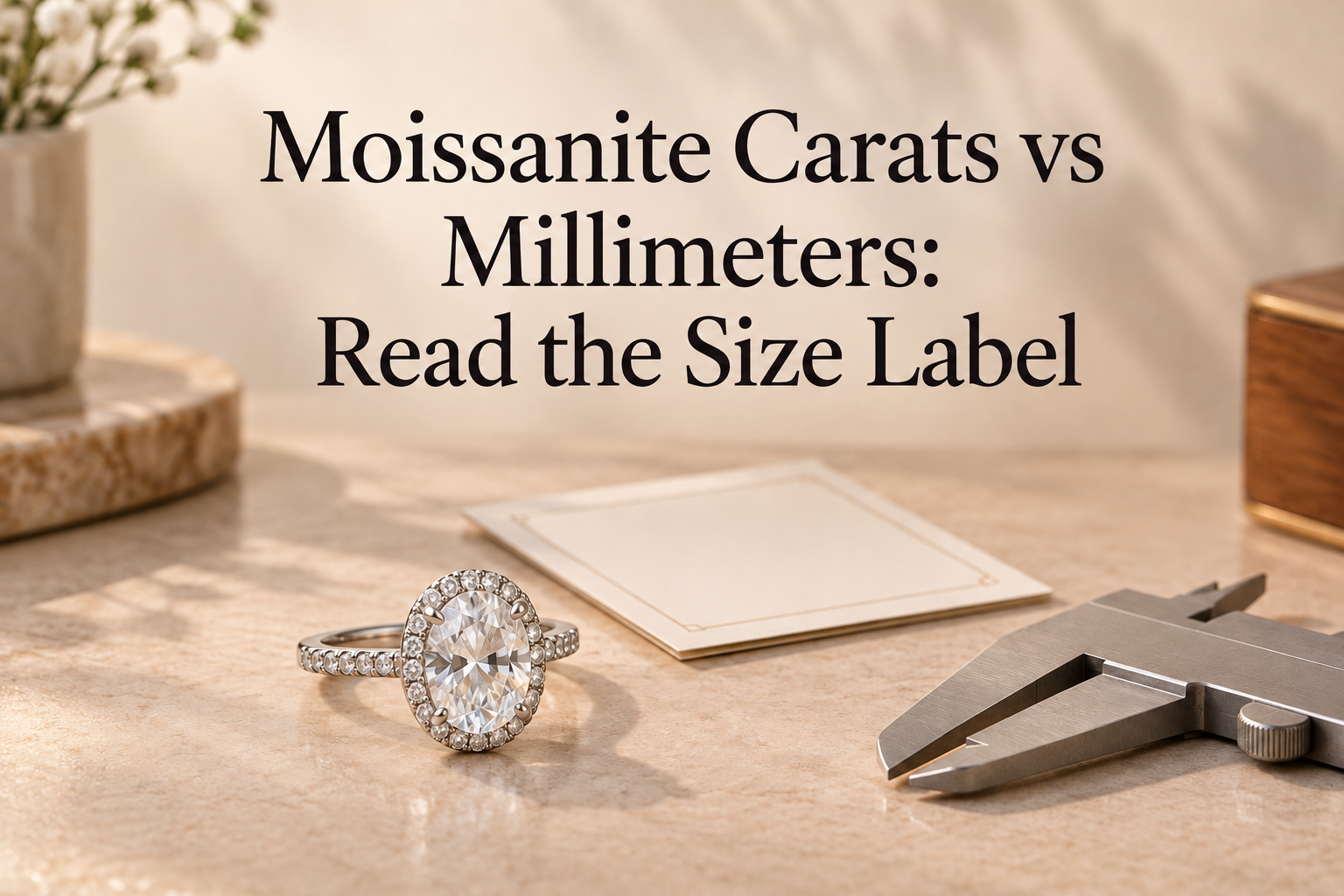
    A moissanite carat label is not a millimeter measurement or a finger size. Confirm what the seller means by “ct,” ask for the selected center stone’s length, width and depth in millimeters, then check the complete setting’s dimensions and the ring-size system separately. Do not use one universal carat-to-millimeter chart to fill missing product specifications.

    A product menu can contain “2 ct” beside “US 7,” while a photograph shows a halo or side stones. Those pieces of information are not interchangeable. This guide explains how to read them and what to ask next. It does not assign unverified dimensions to the rings below or replace our finger-size measurement guide.

    First ask what the carat label describes

    GIA’s diamond-quality explanation defines a metric carat as 0.2 gram and distinguishes carat from karat, the gold-purity term. That establishes a unit, not a conversion from weight to a moissanite’s width. GIA’s diamond grading and price discussion should not be transferred to a moissanite listing.

    For the particular moissanite option, ask whether the stated number is actual gemstone weight or a diamond-equivalent size/weight designation. If an equivalent is used, ask the seller to explain its basis and provide the actual millimeter dimensions. Do not assume either interpretation when the listing does not define it. Also ask whether the number refers to one center stone or a total across several stones.

    Millimeters describe geometry, not the whole ring

    Request the center stone’s length, width and depth for the exact selected shape and option. A single “size” number leaves too much unclear for an oval, pear or rectangular outline. For a round stone, ask for the diameter and depth. These are specification questions, not measurements to estimate from the displayed image.

    Then ask for the complete head or setting’s length and width and how high it sits above the finger. A halo, bezel or side-stone arrangement has its own outline beyond the center. Center-stone dimensions alone cannot establish the full footprint or prove sleeve clearance. Band width and thickness are separate again. No one measurement guarantees comfort.

    Three live examples, three different specification questions

    The Green Moissanite Halo Ring currently lists 1 ct and 2 ct center options and describes an oval center, halo, pavé band and S925 sterling silver. Ask for the selected oval’s dimensions and the halo’s outside dimensions. The checked description does not state either, or clarify whether its ct labels are actual weight or equivalent designations.

    The Emerald Cut Moissanite Bezel Ring describes a 2 ct emerald-cut center, bezel and S925 sterling silver. Ask for the rectangular center’s length and width plus the complete bezel’s footprint and height. Its 2 ct label does not establish that it occupies the same space as the green ring’s 2 ct option. Finish names describe tones, not solid-gold composition.

    The Pear Cut Moissanite Three-Stone Ring lists 1 ct, 2 ct and 3 ct center options. Its description distinguishes the pear center from the three-stone design. Ask about the pear’s dimensions and the full side-to-side setting span; do not treat the center label as the total weight or full width. Its checked description does not verify S925.

    Ring size answers a different question

    A US ring-size option concerns finger fit, not center-stone width. Choosing a larger ct option does not substitute for selecting the right finger size. Equally, selecting a larger ring size is not a method for making a setting more comfortable if its shape or profile does not suit you. Confirm both the size system and the intended finger before ordering.

    For an occasion such as a birthday lunch, you can choose the outline you enjoy without assigning it a mandatory number. For design differences beyond measurements, see the halo, bezel and three-stone guide. Neither the occasion nor the setting name completes a missing specification.

    A short message to send before ordering

    “For this exact shape, center option and ring size, does ct mean actual weight or a diamond-equivalent designation? Does it refer to the center or all stones? Please confirm the center’s length, width and depth, the complete setting’s outside dimensions and height, and the band’s width and thickness.” Add material or finish questions where the listing is incomplete. This is an example request, not a promise that unlisted measurements are already available.

    If the information remains unclear, postpone the decision instead of replacing it with a photograph estimate. Browse the ring collection for shapes you enjoy, then compare the same kinds of facts for each selected option. A ruler held against your screen is not a scale reference for a cropped product image.

    Questions worth separating

    Is every 2 ct moissanite the same number of millimeters?

    No universal dimensions are established by that label alone. Confirm its meaning, the shape and the exact stone’s measurements. Do not borrow the width of another product, another shape or a diamond size illustration.

    Can I read the whole ring’s size from the center stone?

    No. Ask about the outside setting dimensions, height and band separately, especially for halos and side-stone designs. A product image can show the style without establishing its scale on your finger.

    Does a larger carat option mean I need a larger US ring size?

    Do not choose finger size from the stone label. Measure the intended finger and confirm the selected ring’s fit guidance independently. If band construction changes between options, ask about that too rather than guessing an adjustment.

    Sources and verification limits

    Prepared October 22, 2026 (Asia/Taipei). Current WooCommerce descriptions and resolved attributes for products 54, 73 and 130 were checked read-only; all three were published and in stock, not a guarantee for every selected variant. GIA supports the metric-carat definition and carat/karat distinction, not a moissanite conversion chart, product certification or material analysis. Listing labels are reported as labels, not independently weighed or measured stones. The cover is an AI-generated editorial illustration, not an exact product photograph, calibrated tool reading or scale diagram.

  • Moissanite Jewelry for a Birthday Lunch

    Moissanite Jewelry for a Birthday Lunch

    For a birthday lunch, start with the clothes you already want to wear and choose one moissanite detail you will enjoy: a ring at your hand or earrings near your face. Keep fit and the actual plans in mind. A matching set, a larger stone and a new purchase are optional, not what makes the day a celebration.

    Imagine a birthday you help plan yourself: a favorite lunch, a short walk afterward and enough time to linger over a conversation. This is an illustrative editorial scene, not a customer’s birthday story or a wear test. The point is to give a familiar outfit a deliberate detail, not to create an occasion that depends on buying jewelry.

    Choose the afternoon before the accessories

    Decide what is actually on the calendar. Lunch followed by a walk is a different plan from lunch before helping in a kitchen or joining an activity with jewelry restrictions. Dress for that day first. Your favorite shirt, a comfortable knit or a dress you have worn before can be the starting point.

    Then ask where you want a detail. Perhaps you like a ring you can see yourself while sitting at the table. Perhaps you would rather leave your hands free and wear earrings. Neither choice needs to be visible in every photograph. It is also reasonable to keep the outfit exactly as it is and let the meal or a note mark the birthday.

    A bezel ring with a familiar sleeve

    The Emerald Cut Moissanite Bezel Ring is one design direction for a hand-focused accent. The current description identifies a 2 ct emerald-cut moissanite, polished bezel and S925 sterling silver. Its white gold tone and champagne gold tone names describe finishes, not solid-gold composition.

    In this scene, try the idea with a plain cuff and no additional ring stack. The rectangular outline can be the detail you choose without requiring a new bracelet. A bezel is a design fact, however, not a guarantee that the ring will avoid all contact or feel comfortable for every activity. Use the finger it actually fits and remove it if it presses or repeatedly meets something you handle.

    If you are considering a purchase, separate the birthday date from the specification decisions. Confirm your ring size and the selected option before ordering; this article makes no delivery promise. Our carats-and-millimeters guide explains why a listed 2 ct center does not tell you the ring’s complete footprint or its finger fit.

    Or blue studs and no hand jewelry

    For another version of the same lunch, leave off the ring and consider a color accent. The Blue Asscher-Cut Moissanite Stud Earrings are described as blue centers with geometric frames. You could explore that direction with the same shirt, rather than changing the whole outfit to match the blue.

    Choose the option because you enjoy the idea near your face, not because blue carries a required birthday meaning or suits everyone. The checked description does not establish exact dimensions, weight, fastening or post-and-back materials. Confirm those separately before ordering. For the color decision itself, see starting with your wardrobe, not a prescribed palette.

    Give the day a detail that is not a product

    Write down something you want to keep from the past year or something you would like more time for in the next. It can be a private line on a card, a lunch-table question or a plan you share with a friend. The jewelry does not need an official meaning; you can decide what, if anything, it represents.

    If someone else wants to give a ring, let them share the moment without having to guess your finger size or taste. Our ring-gift decision guide keeps those choices separate. An existing piece can also mark a new birthday. You do not have to replace it for the occasion to count.

    Keep the practical ending simple

    When the plans change, the jewelry can change too. Put a removed piece in a protective place rather than loose beside cutlery or in a bag. GIA’s care guidance supports protective storage and avoiding damaging chemical exposure. Follow the instructions for the actual piece, and keep jewelry separate from cleaning tasks.

    If this scene reveals a genuine preference, explore rings or earrings with that preference in mind. If it does not, keep your own outfit and enjoy the lunch. For a different personal occasion, our milestone pendant article offers another way to connect an object with a date without assigning universal symbolism.

    Editorial notes and sources

    Prepared October 22, 2026 (Asia/Taipei). Products 73 and 621 were published and in stock when checked. Their current descriptions support the stated design facts; only ring 73 explicitly verifies S925. No physical wear, clasp, comfort, color or material tests were performed. Outfit and birthday ideas are illustrative, not customer testimony or a promise of emotional benefits. GIA supports limited care guidance, not product certification. The cover is an AI-generated editorial illustration, not an authentic birthday, exact product photograph or scale reference.

  • Colored Moissanite: Start with Your Wardrobe

    Colored Moissanite: Start with Your Wardrobe

    Choose colored moissanite by starting with clothes you already enjoy, then deciding whether you want the color at your hand, near your face or nowhere in that outfit. Green and blue do not need a matching garment. Treat product color, fit and material as separate questions, and do not buy a new wardrobe to justify one piece.

    Our editorial view is simple: a color you like wearing is a better starting point than a rule about what a person “should” wear. This is not a claim about this season’s trends or a color-analysis system. You do not need a prescribed palette, a new style identity or a permanent preference for colorful jewelry before considering one ring or pair of studs.

    A useful question, not a reader submission

    “I like a colored stone, but do I need clothes in exactly the same shade?” This is an illustrative editorial question, not a submitted letter. Our answer is no: exact matching is one possible choice, not the admission price for colored jewelry. You can repeat a color you already wear, place it beside a neutral you like or decide that a particular outfit needs no extra accent.

    Set out two familiar outfits before browsing. Notice whether you are drawn to the stone itself or to the complete styled photograph around it. If you would need to replace the clothes, bag and other accessories to enjoy the piece, pause. You may be responding to that image rather than identifying something you actually want to wear.

    Green at the hand: one detail you choose for yourself

    The Green Moissanite Halo Ring offers a hand-focused option. Its current description identifies an oval green moissanite, halo, pavé band and S925 sterling silver, with listed 1 ct and 2 ct center options. That supports a specific design and material description; it does not establish exact stone dimensions or how a selected green will look in every setting.

    In an illustrative outfit, try that idea with a plain shirt or familiar knit and leave the rest of the jewelry unchanged. You might like seeing a green detail when you reach for a book; it does not have to echo a green sleeve. If you already wear a patterned top, compare the idea with that as well rather than assuming color belongs only with neutrals.

    Decide the finger and confirm sizing before choosing a stone option. A carat label is not a fit measurement, and a larger option is not automatically the better way to express a color preference. Use our ring-size guide as a starting point and resolve uncertainties before ordering. No resizing promise follows from the styling idea.

    Blue near the face: a different place for the accent

    If you would rather leave your hands free of a ring, the Blue Asscher-Cut Moissanite Stud Earrings provide another direction. Their live description states blue Asscher-cut centers and geometric frames. They are an alternative way to place a color accent, not a requirement to build a matching ring-and-earring set.

    Look at that idea beside the collar and hairstyle you actually use. There is no need to promise that blue will flatter every complexion, bring out a particular eye color or appear identical on different screens. Exact dimensions, weight, post-and-back materials and fastening are not established by the checked description. Confirm those details separately; the compressed option labels are not a reliable basis for inventing them.

    Keep one thing, change one thing

    Try a small wardrobe exercise with pieces you already own. Keep the clothes the same and change only the jewelry’s color or position. Then keep the jewelry and change one top. You are comparing your own preferences, not collecting points or finding a scientifically correct combination. An existing accessory in a similar color can help you explore the idea without making a purchase.

    • Repeat: let the accent echo a color you already enjoy in a garment or accessory, without requiring an exact shade.
    • Contrast: try the accent beside a different color you like and decide whether the combination feels right to you.
    • Pause: if neither version appeals, keep the outfit and skip the colored piece. That is a useful result, not a failed styling test.

    For a different kind of detail in familiar clothes, see our pendant-and-knitwear scenes. For combining pieces you already have, read why your jewelry does not have to match. This article’s narrower question is where a color accent fits in your actual wardrobe, not how many pieces to coordinate.

    The color is a preference; the specification is a question

    Check the selected ring or earring option’s current information before ordering. Ask about the complete materials and any color treatment or finish when that affects your choice. The words “green” and “blue” do not identify a treatment, certify color stability or guarantee the shade shown by your display. The ring description verifies S925; the checked earring description does not.

    Follow construction-specific care instructions. GIA’s jewelry-care guidance explains why chemical exposure and protective storage deserve attention, and why known treatments can affect care. That is a reason to ask for information, not evidence that either featured item has a particular treatment. Personal taste and reliable product details can sit comfortably beside each other.

    Editorial notes and sources

    Prepared October 20, 2026 (Asia/Taipei). Products 54 and 621 were published and in stock when checked; only their stated descriptions and resolved attributes support the product facts here. No independent color, wear, fit or material test was performed, and parent availability is not every-variant availability. Styling questions and outfits are illustrative opinion, not customer submissions, personality analysis or measured trend research. GIA supports limited care context, not product certification. The cover is an AI-generated editorial illustration of alternative accents, not exact product photography or a color-accurate matched set.

  • A Moissanite Pendant with Knitwear: Three Styling Scenes

    A Moissanite Pendant with Knitwear: Three Styling Scenes

    To style a moissanite pendant with knitwear, put on the actual knit first and choose where you want the pendant to sit: in the opening, over the fabric or not at all. Try one necklace before adding layers. Its finished length, pendant size and contact with the garment matter more than a universal neckline rule.

    The three scenes below are illustrative outfit ideas, not photographs of a wearer, customer stories or tested garment-and-necklace combinations. Think of them as ways to look again at a familiar cardigan or sweater. You do not need to buy three necklaces, alter a neckline or wear a piece that catches simply to complete the picture.

    Scene one: an open cardigan and an unhurried morning

    Imagine a plain top under an open cardigan, worn with the trousers or jeans you already reach for. Before adding jewelry, notice the space the cardigan makes around the top. Try a pendant within that opening if you enjoy a defined detail there; it can remain a single accent rather than the beginning of a layered arrangement.

    The Moissanite Fan Pendant Necklace is one design direction. Its live description identifies a fan-shaped moissanite focal point. A geometric outline could be the detail you choose beside a plain top, but the product name does not establish where it will fall on you. Confirm the supplied configuration and dimensions before turning this styling idea into an order.

    Leave the cardigan as open or closed as you normally like it. If a comfortable fastening hides part of the pendant, that is not a problem to solve by changing your clothes. The necklace can be a detail you see occasionally, or you can leave it off and let the buttons lead.

    Scene two: a plain crew neck and a visible outline

    In a second scene, the knit is a plain crew neck and you want a pendant over the fabric. Begin with a necklace you already own to see whether you like that arrangement. Look at it with your arms relaxed and while sitting, rather than holding the chain in place for a mirror photograph.

    The 1 Carat Moissanite Circle Pendant Necklace provides a rounded alternative to the fan. Its checked description states a circle pendant with pavé accents and a U-shaped necklace profile. Those are design facts, not proof of a particular chain length, pendant diameter or position on a sweater. The listed carat option is not a millimeter measurement.

    A smooth-looking knit in a photograph may behave differently from your actual garment. If the chain or setting repeatedly catches, remove the necklace rather than pulling it free against the fabric. Do not stretch a chain to reach a preferred position, and do not assume that every pendant can move to a different chain. Our pendant configuration and fit checklist separates those buying questions from the outfit idea.

    Scene three: a V-neck knit with room to leave things out

    For a quiet meal or an afternoon away from your desk, try the V-neck knit exactly as you usually wear it. Compare one pendant in the opening with the same outfit without it. You may enjoy the rounded circle outline, prefer the fan shape or find that the knit’s own edge is enough.

    There is no required pendant-to-neckline ratio here. Keep earrings, a scarf and other visible details in the comparison, rather than choosing a necklace in isolation. If color is the part you want to change, our wardrobe-first approach to colored moissanite offers a different starting point. A new pendant is not the only way to revisit a familiar outfit.

    Make the choice in your real clothes

    1. Put on the knit and any top underneath it in their normal positions.
    2. Try one familiar necklace, fastened as intended, and look at its position without holding it.
    3. Sit and move gently as you ordinarily would. Notice unwanted contact with buttons, fabric or another accessory.
    4. Keep the combination only if you enjoy it and it works for the garment. No necklace is a complete styling choice too.

    Browse the necklace collection if these scenes clarify a genuine gap, not because each neckline needs a separate purchase. For another way to give an existing or new piece a role, read a pendant for your own milestone. Occasion and outfit can inform the choice without dictating it.

    After the outfit

    Remove the necklace before laundering the knit and follow care instructions for the complete piece. GIA’s jewelry-care guidance supports protective storage and avoiding damaging chemical exposure; it does not certify that either pendant resists fabric contact. Neither linked description verifies S925 or the chain’s material. Ask for component details rather than treating a silver-colored illustration as a metal specification.

    Editorial notes and sources

    Prepared October 20, 2026 (Asia/Taipei). Products 203 and 210 were published and in stock when checked; product descriptions support the stated shapes and listed details, not independent measurements or every-variant availability. Outfit scenes are editorial suggestions, not wear tests or universal dressing rules. The fan listing’s “Small Diamond Pendant” option label does not independently establish diamond content. GIA supports only the limited care points above. The cover is an AI-generated editorial illustration, not an exact product photograph, scale reference or authentic try-on.